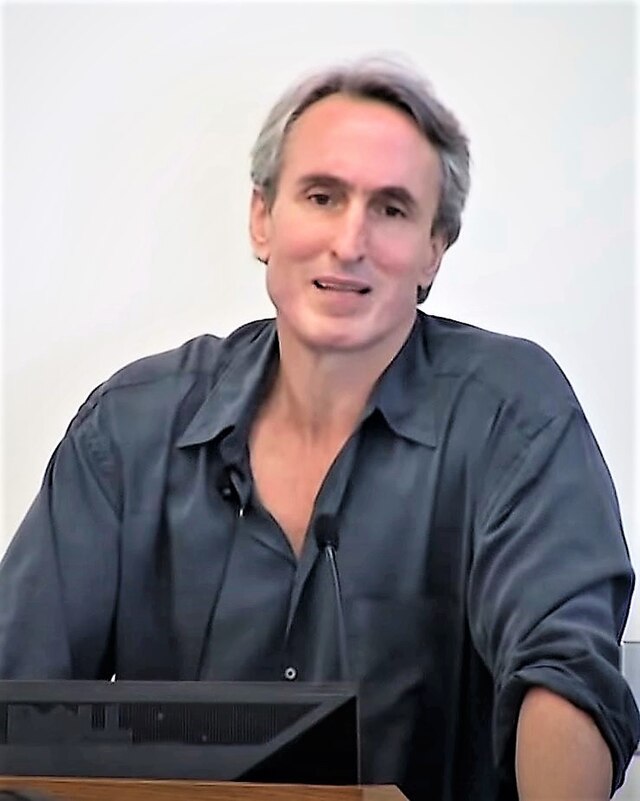
Gary Taubes
American journalist and writer
8
APPEARANCES
6
PODCASTS
Oct 16, 2026


Gary TaubesGUEST
Well, first of all, back twenty-five years ago, nobody read the medical literature, not even the journalists.
Gary TaubesGUEST
I mean, the doctors supposedly did, but journalists didn't and, and influencers didn't exist back then, and socio- social media personalities didn't exist back then.
Gary TaubesGUEST
So, and if you-- as a journalist, if you did a story, you just called people up and talked [chuckles] to their secretary and made an appointment and then interviewed them, and that's all you did.
21 MINS LATER

speaker_6ADVERTISER
Learn more about teen accounts and Instagram's ongoing work to protect teens online at instagram.com/teenaccounts.
Gary TaubesGUEST
Really hard-nosed scientists working in, in, in hard sciences, and hard sciences are sciences where you can actually test your hypotheses rigorously.
Gary TaubesGUEST
Everything that I had learned about what you had to do to make sure you got the right answer was considered kind of a luxury in public health, 'cause for the most part we can't do it.
Gary TaubesGUEST
If you have a hypothesis that some aspect of your diet or environment causes a chronic disease, um, you can't, [clears throat] you can't really test that hypothesis and experiment.
Gary TaubesGUEST
You can't randomize people to, for instance, smoke cigarettes or not smoke cigarettes and see, run it out for 20 years and see if the people who smoke get more lung cancer.
46 MINS LATER


Cynthia ThurlowHOST
And so I, I think in a lot of different ways you do such a beautiful job of painting the picture of how we've gotten to where we are right now, and how we're largely, as a culture, we're very focused on drugs to address lifestyle-related disorders.
Gary TaubesGUEST
Well, it's funny, I had an epigraph at one point, a quote that I used to begin the very first introductory chapter, and, uh, it eventually got Move to the end for a variety of reasons.
Gary TaubesGUEST
One of the problems was kind of gave the book away right up front, but the quote was from a chef turned journalist who was diagnosed with Type 1 diabetes.
Gary TaubesGUEST
I think it was thirty-one years of age, and he describing to me the conversation he had with his physician endocrinologist, and they're explaining to him what the problem is, what his body's failing to do, and then what they would-- how they were gonna treat it.
Gary TaubesGUEST
So what you're telling me is carbohydrates are now a poison to me, and insulin is the antidote, and I should eat the poison and take the antidote rather than just not eating the poison?" [chuckles] And the guy goes, "No, there's nothing about this." It's just his way of thinking.
17 MINS LATER
Cynthia ThurlowHOST
Well, is it evolving beyond the diabetes piece? Is it something similar to what this book is about or something totally different?

speaker_5ADVERTISER
Kroger, fresh for everyone.
Gary TaubesGUEST
And if fat cells are just connective tissue filling up with fat, then it's easy to imagine that when people eat too much, the fat just sort of oozes into the fat cells, into the connective tissue, and you get an excess of fat.
Gary TaubesGUEST
And for the next 50 years, basically people confirmed Fleming's view until the 1920s, 50 years later, when a fellow named Wasserman came along and proved Fleming was wrong and Talt was mostly right.
Gary TaubesGUEST
But by that time, the idea that fat was just connective tissue expanding with fat had sort of settled into the zeitgeist, a German term.
Gary TaubesGUEST
So Cantani, when he was writing about the nature of fat tissue in 1879, said, look, we're more inclined to accept Talt's theory than Fleming's.
33 MINS LATER
speaker_6UNKNOWN
[laughs]

Gary TaubesGUEST
In fact, for this book, I interviewed you and 120 other physicians, and it's the same experience over and over again.
Gary TaubesGUEST
It helps when the physician themselves is suffering is from obesity or overweight or diabetes or pre-diabetes or metabolic syndrome or pick your chronic disease so that they can try it themselves and see what happens.
Gary TaubesGUEST
I mean, there's a few of our colleagues out there were always lean and then became pre-diabetic like Mark Kukazela or athletes who had pre-diabetic numbers and then tried Keto as an experiment.
30 MINS LATER

Ken BerryHOST
And so I love how you talk about the, the difference between the researchers and then the doctors, where the rubber's actually meeting the road on a day-to-day basis.
Gary TaubesGUEST
You know, for the, uh, medical establishment to, to screw up quite so badly takes a sort of, uh, a, a collection of different errors along the way.
Gary TaubesGUEST
I mean, they, they created a, a, a thought construct by which they can rationalize away what you're seeing in your clinic, right? So it doesn't matter how many physicians like you report what you're seeing.
Gary TaubesGUEST
And, and recently we had, uh, David Unwin, who's a kind of British version of you, writing in the British Medical Journal Nutrition about exactly this issue, and saying, what we do is we, we have all these huge epidemiologic cohort studies, they're called.
57 MINS LATER
Ken BerryHOST
Which, which one of the three is it? Fraud, is it foolishness, or is it just their paradigm and they honestly, truthfully, earnestly believe that their paradigm is correct and they just can't see the evidence on the other side?

Gary TaubesGUEST
The reason I started my career as a journalist, my expertise and my interest has always been technology.
Gary TaubesGUEST
You become a scientific historian when you do this kind of work because you have to understand the evidence base of whatever arguments that you're discussing, analyzing, and so you have to go back in time to see, in effect, why we believe what we believe.
Gary TaubesGUEST
In diabetes, you end up going back, I ended up going back to 1797, which was when the first claim was made that this was a disorder that could be kept under control.
Gary TaubesGUEST
And it was a British physician named Rallo who was treating, he was a British army physician.
13 MINS LATER
Gary TaubesGUEST
I talked to, when I was first doing my research, I talked to Pete Aarons, who was one of the leading, probably the leading lipidologist in the world.
6 MINS LATER