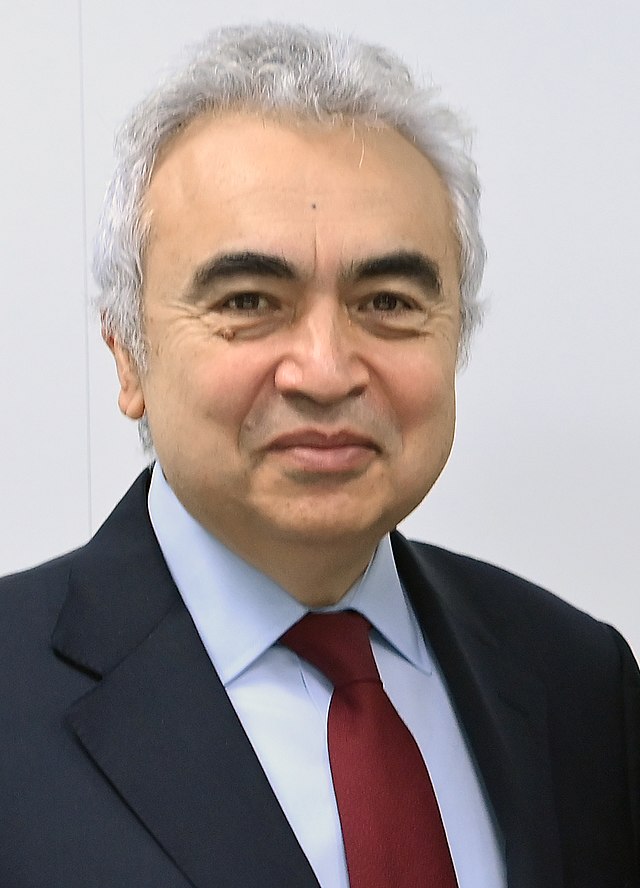
Fatih Birol
Executive director of the International Energy Agency
12
APPEARANCES
10
PODCASTS
Aug 20, 2026


David BachHOST
And when you look big picture, how should we think about demands, drivers of demand, and the sort of big trends on the supply side that people should be aware of?

Fatih BirolGUEST
So on the demand side, we see that almost all the fuels are growing very strongly, oil, gas, in some countries even coal, but renewables make a huge move.
Fatih BirolGUEST
But when I look at the entire picture, what I see is that electricity is growing much faster than anything else.
Fatih BirolGUEST
When you look at the history of energy, The Industrial Revolution, for example, was fueled mainly by coal.
Fatih BirolGUEST
So remember the novels of Emile Zola, for example, the workers bringing from coal mines to the factories.
Fatih BirolGUEST
Then, especially after the Second World War, the oil and then natural gas were the main supplier of the global economy.
7 MINS LATER
David BachHOST
What do you see as the main obstacles? Is it technology? Is it capital? Is it policy? Is it lack of interconnection? Where would you emphasize to accelerate that transformation in Europe and

7:08

And you have a deliverable maybe coming up at the UNGA session at the UN, so we'll watch for
Fatih BirolGUEST
In fact, we were organizing a major event with 2,000 people in Nairobi, but because of Ebola.
Fatih BirolGUEST
And we worked with the Indian government, and there's a program called Ujwala program.
5 MINS LATER
12:52
What's going on there and what can we expect next? How long can this last?


Maria TadeoCORRESPONDENT
Well, the Europeans have also said they will not pay for passage, but, uh, as it stands, do you now begin to factor a scenario in which, uh, and I know it's extreme, but do you think $100, uh, a barrel oil is possible? What, what numbers are you looking at, uh, in terms of your new scenarios?
Fatih BirolGUEST
It is, uh, there are so many uncertainties, and the, but the uncertainties are not related to energy sector.
Fatih BirolGUEST
It is related to the politics and the, and the, what is happening in the conflict, uh, over there.
Fatih BirolGUEST
If, uh, Hormuz is c- closed again, we may see a upward pressure on the prices with, uh, significant implications on the, uh, economies.
Maria TadeoCORRESPONDENT
What is the key now for Europe to be able to have homegrown energy at an affordable place? Because what companies in European, uh, across Europe continue to say is competing on the energy front with the US, which is pretty much self-reliant, and the Chinese, is very difficult.
Fatih BirolGUEST
We have to electrify our energy, our economy as much as possible, which means more electric cars, more heat pumps, uh, industry more electrified.

Fatih BirolGUEST
There will be a lot of immediate changes happening, but there are also going to be is some major strategic choices that the countries are making.
Fatih BirolGUEST
First of all, in terms of the, uh, building alternative pipelines, both Emirates and, uh, Saudi Arabia or, uh, Emirates and the Saudis, Israel, and other countries making stockpiling in other countries, in India, in, in Japan, and elsewhere.
Fatih BirolGUEST
But coming more, uh, we see that the electric car, uh, sales, uh, in Southeast Asia, the, where the bulk of the, uh, the impact, uh, took place, is also, uh, going up.

Manus CrannyHOST
Is it an Islamabad Memorandum of Understanding that extends beyond 60 days, or is it a reopening, a significant and substantive reopening of the northern route through the Strait?

speaker_4HOST
What's the alternative? What can be done?
Fatih BirolGUEST
So, in fact, as a world, we are a bit fortunate because before we entered this crisis, before the 28th of February, we had a lot of oil in the markets, a surplus of oil.
Fatih BirolGUEST
And after this crisis has started, we use the surplus and we release some stocks.
Fatih BirolGUEST
If the stocks continue to come down so much, Plus, the July-August demand is going up because of the traveling season.
Fatih BirolGUEST
So I would call we are entering the red zone in terms of the implications on the markets.
9 MINS LATER
speaker_4HOST
bash Europe?

Maeve McMahonHOST
Our Europe editor, Maria Tadeo, sat down with the agency's executive director, Fatih Birol, in an exclusive interview from Paris, where they discussed the outlook for Europe and, of course, the risks ahead.
Fatih BirolGUEST
We had three energy crisis up to now, and two oil crisis in 19- uh, 70s, 1973 and 1979, and in 2022, after the Russia's invasion of Ukraine, in Europe we had a natural, uh, gas, uh, crisis.
Fatih BirolGUEST
If I add how much oil and gas we lost in this, all three crisis, it is much less than what we lost in the Middle East crisis, Iran crisis now.
Fatih BirolGUEST
It's a huge problem for the global energy system, global economy for Europe and, uh, beyond.


Fatih BirolGUEST
So I call this the biggest energy crisis in the history, uh, because of the following reason.
Fatih BirolGUEST
When we look at the last fifty, sixty years, we had three major energy crisis: nineteen seventy-three oil crisis, nineteen seventy-nine oil crisis, and after the Russia's invasion of Ukraine in Europe, we had a major, uh, natural gas crisis.
Fatih BirolGUEST
The amount of oil and gas we lost in this, all these three crisis, if you put it together, is much less than the oil and gas we lost in this current crisis.
Fatih BirolGUEST
The amount of fertilizers, petrochemicals, sulfur, the li-- uh, the helium flowing from, uh, this very Strait of Hormuz is interrupted, and this will have devastating implications, especially for the developing countries, and we will find out more and more how important they are, uh, for our, uh, daily economic businesses.
8 MINS LATER


Fatih BirolGUEST
So what will happen as soon as it is open, if it is the end of May, there are more than 100 tankers loaded with a lot of oil and about 11 LNG tankers loaded with natural gas.
Fatih BirolGUEST
Having said that, to come back to the levels of production before the war will take some time because several energy facilities in the region have been damaged.
Fatih BirolGUEST
We monitor all these facilities, oil fields, gas fields, the refineries, pipelines.


Fatih BirolGUEST
Immediate response is, I think, The LNG markets, because some of the, at least two major LNG exporters badly hit Qatar and Emirates, both of them.
Fatih BirolGUEST
And in the meantime, we will have some higher natural gas prices, which in turn, would provide incentives for the consumers to look at the renewables workers and in some cases coal as well.
16:34
If I can sort of A, B test that, those are two extremes, where do you sit? I think the...


Nicolai TangenHOST
What do you think about, um, European governments which subsidize energy bills for its citizens?
Fatih BirolGUEST
I think if it is, if it is, uh, done in a targeted way and in a temporary way, this may well, uh, be a solution.
Fatih BirolGUEST
You know, what is the problem in Europe? There are many problems in Europe, but one of the problems is because of this.
Fatih BirolGUEST
I talk with many government leaders around the world, but I think Europe, uh, uh, ref- uh, how to say, reflects was a bit slower than the others.
Fatih BirolGUEST
Uh, one of them, the 73 oil crisis, 79 oil crisis, and, uh, 2022 Russia invasion of, uh, uh, Ukraine on gas.
Fatih BirolGUEST
So when you look at the oil crisis, 73, 79, uh, in both of them, we lost each about 5 million barrels per day of oil, so five plus five, it is about 10, and, uh, uh, uh, we all know, uh, that this, uh, oil crisis led to, uh, global recession in many countries, developing countries, a foreign debt spiral they, uh, fell into.
Fatih BirolGUEST
And today, as it takes stand now, uh, we lost 12 million barrels per day, so two, more than two of these oil crisis put together.
Fatih BirolGUEST
In terms of natural gas, uh, uh, when, uh, Russia cut the gas, uh, we lost around 75, uh, BCM of, uh, gas.
8 MINS LATER
Nicolai TangenHOST
What do you think about, um, European governments which subsidize energy bills for its citizens?

Fatih BirolGUEST
a historical deal for Europe because Russia has been the number one energy supplier of Europe over half a century since 1970s and natural gas was the most important fuel here until recently about half of the natural gas consumption in Europe came from Russia.
Fatih BirolGUEST
So after Russia's invasion of Ukraine and Russia using natural gas as a weapon, Europe took this decision, European countries.
Fatih BirolGUEST
And on one hand, of course, I congratulate the European countries, but on the other hand, The market context we are in is also helping Europe, creating a room of manoeuvre such as huge amount of LNG, liquefied natural gas, coming to markets starting from 2026 through 2030.
Stephen CarrollHOST
Is there a risk, though, that European countries simply replicate the situation they had of an over-reliance on a single supplier by turning to other countries? We know that the United States has also talked about wanting Europe to buy a lot more LNG from them.