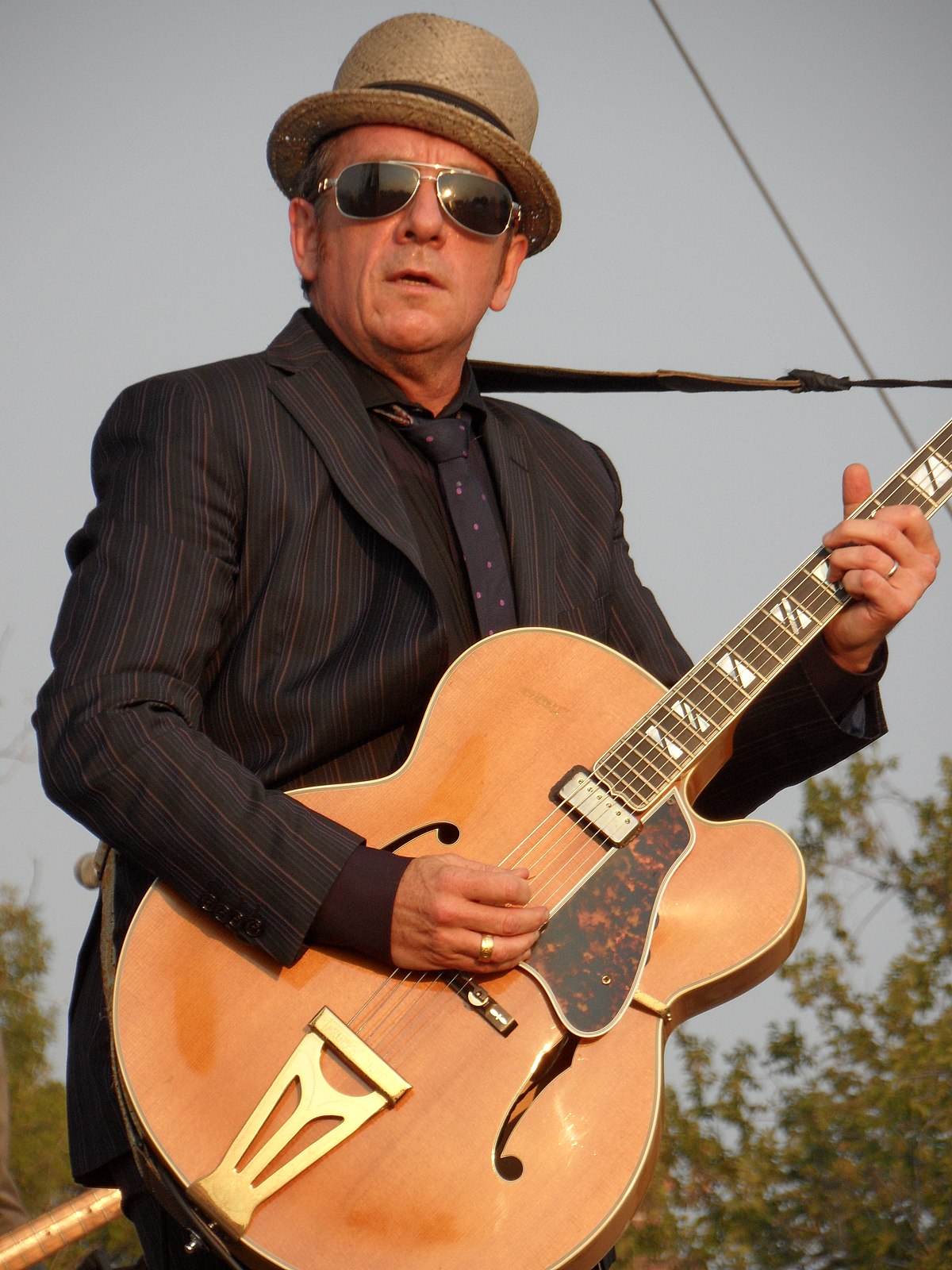
Elvis Costello
Singer-songwriter and record producer
10
APPEARANCES
10
PODCASTS
Oct 7, 2026

11:46

When it came time to record Alison, was there a specific approach that you wanted to take?
Elvis CostelloGUEST
This sounds like name-dropping, but the very first occasion I met Bruce Springsteen in Nashville in the middle of 1978- We said hello's, and then we were both of us, I think, actually weirdly shy, and we're looking at our shoes, and suddenly Bruce said, "How did you get the sound on I Am...
Elvis CostelloGUEST
Is True?" And I said to him, "No money" [laughs] Because that's the actual truth.
Elvis CostelloGUEST
You know, the reason why the record sounds immediate is because we didn't have either the means in terms of studio hours or even the format to over-elaborate the arrangements.
Elvis CostelloGUEST
This record, Awesome, was recorded in Pathway Studios in Highbury and Islington, which was an eight-track studio, tiny room.
Elvis CostelloGUEST
And by the time we put the full band in there, there wasn't a lot of space for air, let alone anything else.
7 MINS LATER
19:56
If there were a photograph of the scene where the song is taking place, what would it look like? What's the setting?
![What's In My Bag? [The Podcast]](https://particle.news/cdn-cgi/image/format=auto,width=128/https://cdn.particle.pro/url/media/bd298923-2c57-5527-a9cf-2a741f54ab14/68bcb0adca0c41238811b4ad0e4aa49cbd69b55352c3b6e33a17a91840ef9c54)
speaker_1SOUNDBITE_SPEAKER
broken toys and faded colors

Elvis CostelloGUEST
I'd spent a lot of time watching anime with one of my 19-year-olds who's really into it.
Q-TipSOUNDBITE_SPEAKER
This

Brian HiattHOST
It's one of those things where it upends any kind of preconceptions of where you were as an artist at that point, and it, it points to how important it was to sort of curate and shape and decide which of the many things you were doing was the thing you were doing.
Elvis CostelloGUEST
A number of the songs which have been heard before from that pre-profe- you know, pre-My Name Is True period do paint a very-- If you just take one group of songs, which is those recorded with my first band in London, Flip City, we weren't very-- We didn't have a, you know, we didn't ha- We weren't really technically that good, but we were very willing, and we really loved music, and we tried to play the best we could.
Elvis CostelloGUEST
And I was learning to write songs, not, not just to be heard in public, but also to be played with other people, 'cause prior to that, I'd had one singing partner in Liverpool or played on my own.
Elvis CostelloGUEST
And I began when I first came to London in 1973, went back to live in London, '73, trying to get booked, and I think I got one or two kind of solo bookings, but they were very modest.
Elvis CostelloGUEST
And then tried it in a band for a year or so, and then realized I was, you know, even including the recordings.
Elvis CostelloGUEST
And then I wrote the group of songs that opens The Blueprint, which you can hear have echoes of the first Bruce Springsteen album.
Brian HiattHOST
To jump back, I think the ragtimey stuff like Mercury Wings What intentions do you think you had for that material?

Elvis CostelloGUEST
I just figured they were something that didn't feature in my wardrobe and those angels would definitely want them.
Elvis CostelloGUEST
Whoever these people were, maybe they were fallen angels, maybe they were malevolent, I don't know.
Elvis CostelloGUEST
The rest of the song is really a dance hall tragedy, isn't it? You know, I said, I'm so happy I could die.
47 MINS LATER


Elvis CostelloGUEST
And now I was, I d- I was using my holidays, my holiday allowance from my day job, and I would go down and rehearse all afternoon into the evening, sleep on the couch in the, in, in the rec room, uh, where th- they were set up, and, uh, then go up to London and record.
Elvis CostelloGUEST
And we would, we did, I think, I can't remember whether it was four six-hour sessions or six four-hour sessions.
23 MINS LATER

Jacob GoldsteinADVERTISER
Mm.
Elvis CostelloGUEST
I got talking with him, and then I turned, then I became the guy that would turn up at their gigs and ask him questions.
59 MINS LATER


Elvis CostelloGUEST
Well, that's what you know by now from reading this book, that that is really my entire aim has been this.
Elvis CostelloGUEST
I, of course, the David Lee Roth, we've managed to mention David's name more often than mine.
16 MINS LATER

Jesse ThornHOST
When you're writing a song for somebody whose style, whose instrument is as distinctive as somebody like Solomon Burke or Johnny Cash, are you thinking of it the way, say, a comedy writer might think about, you know, writing a joke for David Letterman or Roseanne Barr, thinking about trying to capture something about their particular voice?


Elvis CostelloGUEST
If they'd come a year or two earlier, it would have worked, because they would have been the kings of the scene that went before.
50 MINS LATER


Tony AgnelloHOST
The fact that I could be in this room with a thousand people and we're all together singing that
Elvis CostelloGUEST
The thing with that hearing something, which is somewhere between the expressive nature and singing and the actual sound production with the mechanics, Of singing, it's something I've necessarily come to consider more as you get older.
Elvis CostelloGUEST
You have to make more provision for setting yourself up to have the same freedom as you may have had when you were younger.
Elvis CostelloGUEST
just instinctively, because you can become inhibited by different factors, either being self-conscious, which I'm not tremendously, or overthinking it, or just simply being aware that there are frequencies that you don't need in order to create the vocal sound that's in your mind.
15 MINS LATER


Elvis CostelloGUEST
I had thought myself to be a songwriter and I had actually gone around trying to... get my songs listened to by publishers as much as record companies, because I looked in the mirror and thought I don't look much like Roger Daltrey in his, you know, Greek, Greek God sort of period, you know, with the ringlets.
Elvis CostelloGUEST
And of course, once my first managers and the head of the record company had the had the crazy idea of giving me this name, or at least the first name.
19 MINS LATER