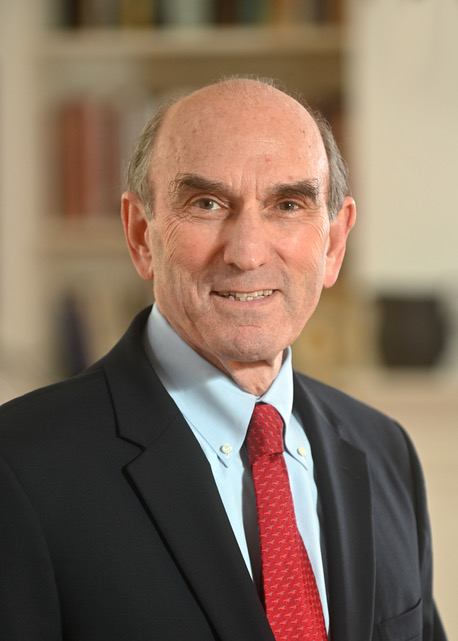
Elliott Abrams
Lawyer and former United States Assistant Secretary of State for Democracy, Human Rights, and Labor
11
APPEARANCES
10
PODCASTS
Sep 2, 2026

James MenendezHOST
Is there a danger, though, that this will entrench the current interim government?

Elliott AbramsGUEST
I think there is that danger because, uh, Trump has about two, two and a half years to go.
Elliott AbramsGUEST
If he wants a government in Caracas that will absolutely keep this deal, that is the government that's there now.
Elliott AbramsGUEST
If you have a free election next year, uh, it may well be that whoever is elected, uh, will say, "This is a bad deal.
Elliott AbramsGUEST
It's unconstitutional." Uh, so that gives the president, President Trump that is, uh, an incentive to try to keep Delcy Rodriguez in place.
James MenendezHOST
I mean, there is the danger too that it may get overturned by a different US administration in a few years.


Negar MojtahediHOST
So Elliot, after everything we've witnessed since January, the January uprisings, the massacre, the war, the blockade, and now a supposed ceasefire where there's still military strikes happening, what has Washington actually learned?
Elliott AbramsGUEST
Oh boy, what has Washington learned? I think we've learned that the policy making was sloppy.
Elliott AbramsGUEST
So you have to ask yourself, for example, Did the president not fully realize that Iran might try to close the Strait of Hormuz, for example? Did he not realize the desire of Iran to link Lebanon with the Iran conflict? What was in his mind at each of these stages in January and February and March? I think we've learned generally here that Iran, first of all, happy to close the Strait of Hormuz, unconcerned about the impact of that on other economies around the world, not just from petroleum, but from fertilizer, for example, on food supplies.
Elliott AbramsGUEST
We've learned that though there were some countries on the other side of the Gulf, primarily Oman and Qatar, that thought they were friendly with Iran.
Elliott AbramsGUEST
Iran was absolutely willing to hit them and hit them hard, as well as hitting the other countries in the Gulf.
14 MINS LATER
Negar MojtahediHOST
Why? Why does he really? What can he achieve? Why does he want a deal? Yeah, what could he achieve that would be different than what was already achieved?


Elliott AbramsGUEST
I mean, I think, [clears throat] I think in the old days, the right-wing military regimes learned from each other, and they helped each other.
Elliott AbramsGUEST
Um, it's, it's literally true if you think of, um, Venezuela under Chavez and Maduro and Cuba.
Elliott AbramsGUEST
I mean, Venezuela gave free oil and discounted oil to Cuba, so it was direct support.
23 MINS LATER


Elliott AbramsGUEST
Um, I think the Egyptians have, uh, shown themselves in this crisis to be feckless, useless.
Elliott AbramsGUEST
Um, if I were advising General Sisi, I would have said, "Day one of the war, you must announce and you must call, uh, the, the MBS, MBZ, the, the, the sheikh, the emir in Qatar, and you must say, 'The Egyptian Air Force is at your disposal, and we will put troops on the ground.
Elliott AbramsGUEST
And if you are short of this munition or that one...'" It's all meaningless, except symbolically it would have shown what side they're on.
Elliott AbramsGUEST
Now, they did in, in the end send some planes to the, the Emirates, too few, too late.
8 MINS LATER


Aaron MacLeanHOST
Um, why is it the UAE specifically that this particularly close relationship develops, even within a broader con-- I would assert, I'm curious if you agree, within a broader context of, of warmer Israeli-Gulf relations in general, that this is the particularly close one?
Elliott AbramsGUEST
They made a decision years ago, uh, to modernize, uh, the economy and society.
Elliott AbramsGUEST
That is, you see the, the skyscrapers, you see the, uh, international community that's there, you see the prosperity, um, you see the economic modernization, you see the, um, decreasing dependence on oil.
Elliott AbramsGUEST
They make more money now from their immense sovereign wealth funds than they do from, uh, if you will, merely, um, the sale of oil.
Elliott AbramsGUEST
Um, and they differ from the Saudis, who are also trying to modernize, in that they don't really have much of a domestic population.
16 MINS LATER

Lynn TomanHOST
How stable is the regime right now? How popular is the theocracy?
Elliott AbramsGUEST
It certainly was, I would argue, under the two supreme leaders, Khomeini first and then Ali Khamenei, who was recently killed.
Elliott AbramsGUEST
Today, the so-called supreme leader is, first of all, absent, and there's no real reason to think he's gonna make an appearance.
Elliott AbramsGUEST
People say he's disfigured, but that would not presumably prevent him from, say, a radio address.
Elliott AbramsGUEST
And even if he becomes supreme leader, he is younger, he's not an ayatollah, and he is appointed due to the dynastic principle which this regime, the Islamic Republic, has railed against for decades.
8 MINS LATER
Lynn TomanHOST
Elliott, what are the three takeaways you'd like to leave the audience with today?


Elliott AbramsGUEST
I really do believe that though they are not moving at all fast enough toward transition to democracy, there will be one, and there will be an election next year in Venezuela, and by the tri- time Trump leaves office, they will have restored democracy in Venezuela.
Elliott AbramsGUEST
In the case of Iran, you know, um, if two years from today there is, um, an uprising and the regime falls, I think we will all say, "Well, this would not have happened if it weren't for the events of 2026 and the damage that was done to the regime and its instruments of repression." So yeah, if you look at it from this week, it may seem as if, well, that's not working.
Elliott AbramsGUEST
The critical thing is what happens now over the next months and years in Iran and when does the regime fall?
9:56
Do you think that this administration has its eyes next set on Cuba, and will Cuba, uh, collapse?
Elliott AbramsGUEST
Well, uh, in, in the earlier period, uh, the United States did the reflagging of, uh, Kuwaity and other, uh, tankers, and Iran did not attack those American ships.
Elliott AbramsGUEST
I may be wrong, but it seems to me, um, that that's too dangerous for the US Navy, and he, he is actually, uh, better off, I would argue, trying some other things like insurance, uh, for ships going through.
Elliott AbramsGUEST
That doesn't then involve, um, American, uh, warships and the possible loss of life, uh, to American, uh, soldiers and sailors.
11:11
Again, why wasn't this factored in? And, and I have to say, I mean, Iran did telegraph exactly how it was going to respond.


Jonah GoldbergHOST
And now, I, I don't, I don't know that most people even really have a good concept of what human rights are.
Elliott AbramsGUEST
Well, I think that what the left was doing in the Reagan years was promoting, if you will, the left, that is, defending leftist regimes, whether it was the Cuban regime, which most leftist so-called human rights advocates wouldn't criticize, or the Sandinista regime, which most leftists, including leftist so-called human rights advocates, would not criticize.
Elliott AbramsGUEST
All they wanted to do is to attack US foreign policy and defend leftist regimes.
Elliott AbramsGUEST
I remember speaking, I guess it was at Colgate University a couple of years ago, and a student in the Q&A period said: "How can you sleep at night when you were part of an administration that gave US aid to the military junta in El Salvador?" And my answer to him was, "That's a good-- that's a perfectly fair question for a student to ask, but actually, it shouldn't be directed at me or Ronald Reagan.
Elliott AbramsGUEST
It should be directed at Jimmy Carter." We didn't invent the policy of supporting that junta.
21 MINS LATER

Elliott AbramsGUEST
Let me just go back to what happened in the rest of South America years ago.
Elliott AbramsGUEST
You do need a negotiation between the people in power and the democratic political forces, democratic parties.
Elliott AbramsGUEST
Another of them is, what's the trajectory here that gets you, in the end, to a full democracy? When are there municipal elections, state elections? When's the presidential election? When does the opposition start getting full access to, uh, state-run media? There are, there are a lot of questions to negotiate.

Ross DouthatHOST
We've already spent a year or so making those kind of approaches." How does that narrative compare to what you saw in 2016 to 2020 when obviously there was- there were efforts to achieve regime change then?

Elliott AbramsGUEST
He's been interested in, uh, Venezuela from the beginning of the first term and started putting more and more sanctions on, particularly in 2019 and '20, but the diplomatic and, uh, economic pressure wasn't enough to move the regime.
Elliott AbramsGUEST
Last year, there was a real election in Venezuela and Maduro tried to rig it and he failed and lost in a massive landslide, and the administration is now saying, "Well, um, this government really has to, has to change." They don't use regime change, and I think Trump is not going to put boots on the ground.
Elliott AbramsGUEST
Uh, but he does seem to have decided, "This is my hemisphere, this is our hemisphere.
Elliott AbramsGUEST
We can't have a hostile regime like this engaged in criminal activities, uh, hooked up with Iran and Russia and China, and we're going to change it."
5 MINS LATER

Fareed ZakariaHOST
Wh- what, what am I missing in seeing this as, as... 'cause you got a lo- lot of red lights blinking here.