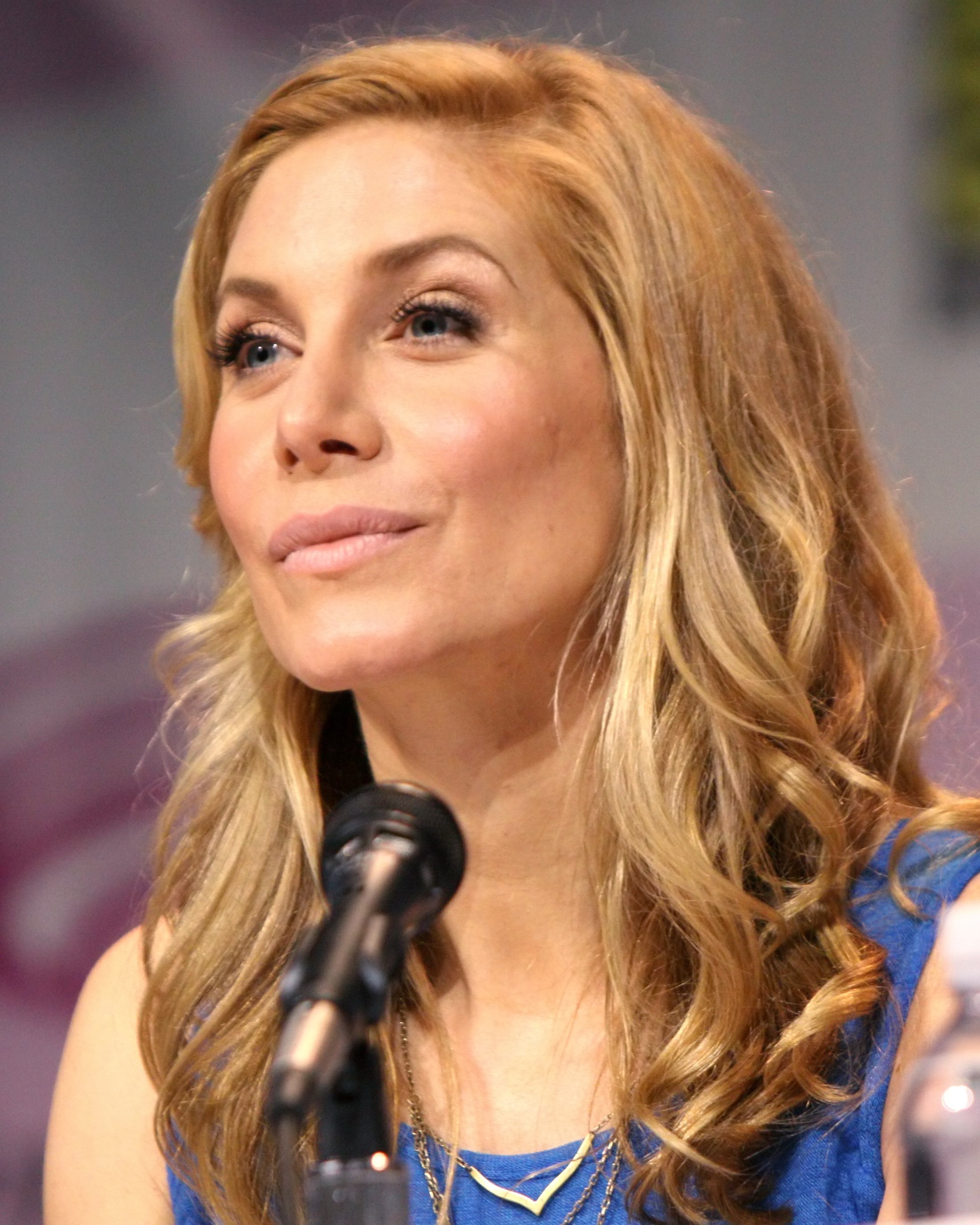
Elizabeth Mitchell
American actress
9
APPEARANCES
5
PODCASTS
Jul 16, 2026


Julie RovnerHOST
Where are large employers on that sort of, I assume they would like to keep some semblance of the system that we have now in a reform system, or am I wrong? Are they ready to give it up and let everybody fight it out for who provides health care?
Elizabeth MitchellGUEST
Well, I represent a subset of jumbo employers who are very progressive, very innovative, and very invested in fixing the system.
Elizabeth MitchellGUEST
And I would say jumbo self-insured employers are some of the best positioned actors to do something about that.
Julie RovnerHOST
How do we get back to a place where people who disagree can work together to address something that everybody agrees is a problem, like the state of our health care system? I realize that's sort of beyond your pay grade, but unless people think about it, we're not going to get there.


Steve BannonHOST
Number one, why does President Trump continue to make the case of how essential to the country this is, but particularly his political program, ma'am?

Elizabeth MitchellGUEST
So the question I wanted to answer here was, even though so many people have told the president that the Save America Act cannot pass, Thune has told him we don't have the votes, Cornyn has told him to let it go, move on.
Elizabeth MitchellGUEST
Why is it that the president has remained so committed to the Save America Act? And I think it's because of a couple different reasons.
Elizabeth MitchellGUEST
One, as you told me, is that he had that experience in the 2020 election that he saw that he believes that that showed him that there are a lot of insecurities surrounding elections.
Steve BannonHOST
Have you seen that this grassroots, the grass, particularly the grassroots leadership throughout the country? is absolutely 100% has the president's back on this, but they want it to happen, not just to be a rhetorical exercise, ma'am.

39:58
That to know that the young men and women on those, in those carrier battle groups don't have the full access to the blessings of liberty and the pursuit of happiness in their own country, ma'am.
Elizabeth MitchellGUEST
And when we're talking about young people who are about to graduate from college, particularly those who studied STEM, maybe they are prepared to do some coding, they're going to face perhaps a more difficult job market because of this Optional Practical Training program.
Elizabeth MitchellGUEST
So the way that this works, it was created in 1992, and it enables foreign students, foreign graduates to get jobs in the United States after graduating.
Elizabeth MitchellGUEST
Their visa has allowed them to stay, and both they and their employer benefit from a tax break where because of their visa status, they are not taxed for Social Security or Medicare for their first four years, for several years in the United States.
Elizabeth MitchellGUEST
And so this incentive would make it easier for tech companies, any kind of company to hire these foreign graduates than it would Americans.
Elizabeth MitchellGUEST
And so this is something that's causing a lot of concern for young people who are looking for jobs in a variety of fields and are going to know that even though this is their country, they're going to perhaps have less of an ability to get these jobs than someone who came here from another country.
7 MINS LATER
48:16
Why do we have this situation with OPT that now the Trump administration has had for 18 months or a year and a half and it's not shredded? Why are we allowing foreign students to come here and to compete with American kids, ma'am?

Elizabeth MitchellGUEST
I've been included on a lot of it because I was really worried about it.
Elizabeth MitchellGUEST
I think that our first season was so much about, if you're going to use the sports analogy, which I sometimes do, was so much about setting it up, setting up the playing field, making it all work.
Elizabeth MitchellGUEST
And unfortunately, I think some of that can sometimes just be dull for me.

Tony TalatoHOST
Was this a welcome change, playing an FBI agent that is a mother and is more grounded?


Ben MargiottHOST
Just tell me what it was like at South Valleys, because there's some decent lines, I think.
Elizabeth MitchellGUEST
I remember for the presidential election, that was one of the hot spots to go cast your ballot.
Elizabeth MitchellGUEST
We were on the wait tracker time app going all day long, figuring out which ones were the most backed up polling locations.
Elizabeth MitchellGUEST
South Valley's library really estimated between 30 and 50 minutes the entire time, the entire afternoon, really.
8 MINS LATER
Ben MargiottHOST
What was it like at that watch party? Did they have a sense that things were going in Wes's favor?
Elizabeth MitchellGUEST
And something that I talked to Senator Angela Paxton, something she pointed out is that because Texas has a citizen legislature, the representatives themselves are experiencing these issues.
Elizabeth MitchellGUEST
But I also talked to state rep Helen Kirwan, who's actually the mother of our agriculture secretary, Brooke Rawlins.
Elizabeth MitchellGUEST
And she represents a very rural district where data centers are popping up.
Steve BannonHOST
Is this now going to get up to the state level for legislation, or is this still down at the county commissioner level?
Steve BannonHOST
So what exactly happened? Did political people at the White House or David Sachs, who I thought had been given his walking papers, did they actually try to get in the middle of Tennessee and some of these other states that are coming forward with legislation to protect children, ma'am?

Elizabeth MitchellGUEST
I have written in the past about Utah and Florida where the Trump administration has gotten involved in these states in AI legislation, usually legislation that has safeguards for children and has called people in power or sent emails or memos that lead to the bill being killed.
Elizabeth MitchellGUEST
And it has been revealed now that this is happening in two more states, Tennessee and Missouri.
Elizabeth MitchellGUEST
In Missouri, I spoke to State Senator Joe Nicola, who introduced a bill to put a variety of transparency and safety limitations on AI, saying that AI doesn't have personhood, limiting potential deep fake videos made by AI and saying that the AI operator is the one who would have the responsibility for such illegal images.
Steve BannonHOST
You have an exclusive about this, about he's stepping up to say this is another program destroying American kids and American workers and we got to stop it.
Elizabeth MitchellGUEST
So the context here is that the White House Office of Science and Technology Policy is going to put forth a national framework on AI, and so any time that a state, particularly a red state, passes a law limiting AI in any way, that kind of raises the bar for that national framework on AI.
Elizabeth MitchellGUEST
And so we've seen the White House taking a stand against a couple of bills now that have limits on AI, and particularly protections for minors.
Elizabeth MitchellGUEST
We saw this in Utah last week with a bill that had child safety and transparency requirements, a pretty low bar in AI that the White House wrote a memo opposing.
Elizabeth MitchellGUEST
And then now I reported that the White House has also taken a stand against a Florida bill, the Florida AI Bill of Rights, which, as you said, uh, Governor DeSantis is responsible for, and it was introduced in both the Florida House and the Florida Senate.
Elizabeth MitchellGUEST
But what I'm reporting is that the White House has called the Florida Speaker of the House, Daniel Perez, as well as members of his staff, and encouraged him to oppose this Florida AI Bill of Rights, and this is something that the Per- the President's office has, in fact, opposed.
11:35
So y- you're saying that the White House efforts have, have essentially derailed this in Florida, even given how powerful DeSantis is, and he's not shy by saying, "This is, like, my number one priority," ma'am?
33:52
Uh, Elizabeth Walker Stewart, you're talking about this battle behind the scenes and the most important fight going on in Washington, DC, ma'am.
Elizabeth MitchellGUEST
So what we have here is, as you've said, some administration sources said, people close to the administration all agree that AI is one of the most controversial issues right now in the Trump administration.
Elizabeth MitchellGUEST
So we have four coalitions that are competing here for the President's attention.
37:04
But is this a traditional-- Are you seeing the traditional pro-life groups coming into this, or what are you seeing right now in this kind of family coalition?