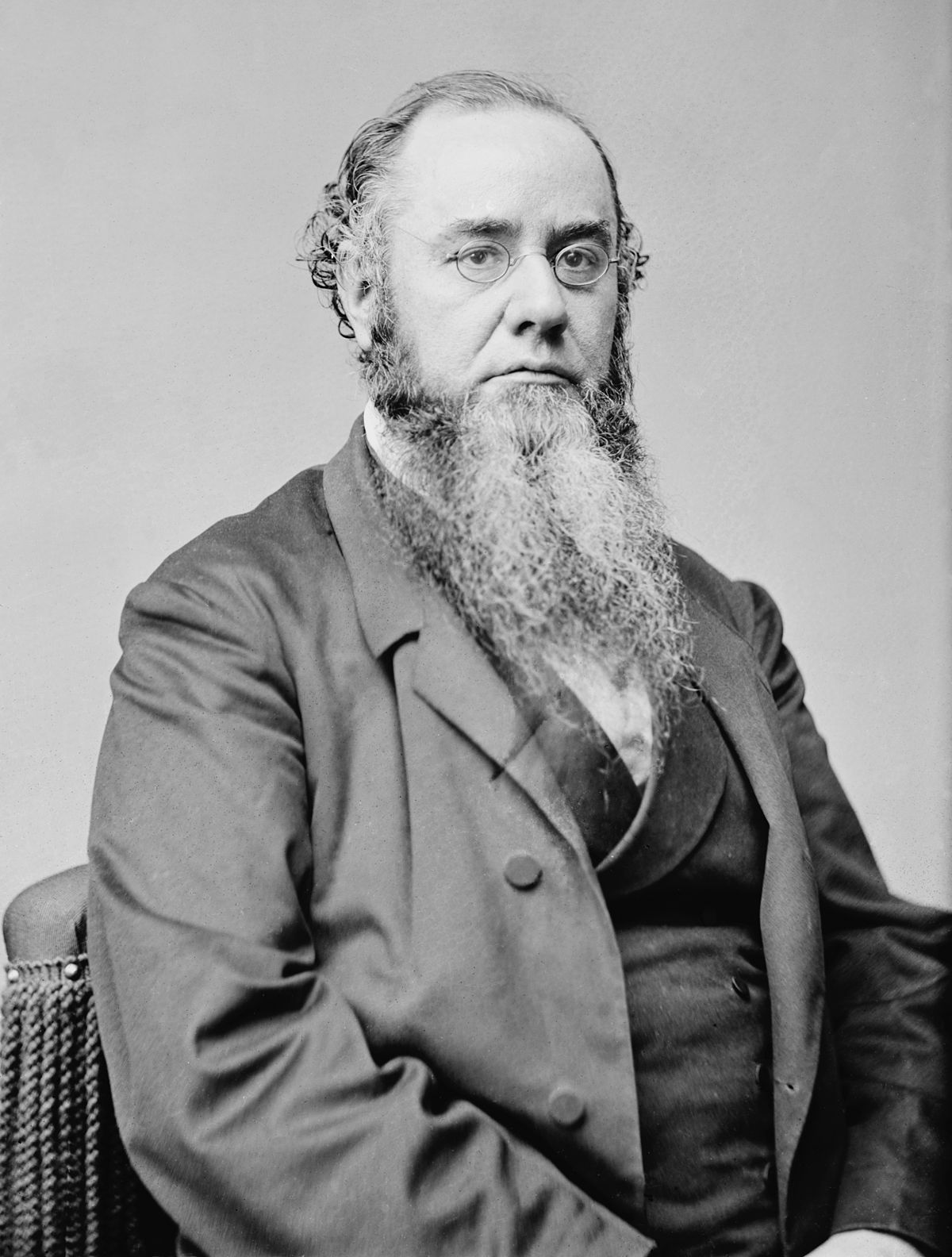
Edwin Stanton
Lawyer and former United States Secretary of WarWikipedia
25
MENTIONS
17
EPISODES
17
PODCASTS
Search complete. 25 mentions across 17 episodes found for "Edwin Stanton".
Sep 21, 2026

Harold Ford Jr.PANELIST
Uh, and all of the things that they were able to do because they had a good working relationship.
Harold Ford Jr.PANELIST
Even, people forget, Abraham Lincoln, I invoked his name, he had great Democrats he worked with, including, uh, his Secretary, his Secretary of State, Ed Stanton.
Harold Ford Jr.PANELIST
So there's a, there's a history of this.
Harold Ford Jr.PANELIST
There's a great book written on this, A Team of Rivals, by the great Doris Kearns Goodwin.

David BlightHOST
At any rate, in that film series you'll see that Burns chose to make George B. McClellan a kind of comic relief.
David BlightHOST
his vanity, his arrogance, his insubordination, his almost incredible, if complex, hatred of Abraham Lincoln, Edwin Stanton, and all the leadership of the federal government that he was commanding the army for.
David BlightHOST
Lincoln wanted a strategy in the wake of Bull Run, the disaster at Bull Run that summer in July.
David BlightHOST
He puts McClellan in charge of the Army of the Potomac, as I said the other day.
25 MINS LATER
David BlightHOST
He'd have 90,000 in the field, 100,000 troops under his command.
David BlightHOST
And he came up with a plan that Lincoln hated.
David BlightHOST
Edwin Stanton, Secretary of War, didn't like it.
David BlightHOST
Officers around him didn't particularly like it, but it was McClellan's idea.

Mark LevinHOST
Lincoln did not initiate press suppression and remained ambivalent about its execution, but seldom intervened to prevent it.
Mark LevinHOST
St. Michael's College professor David T.Z. Mindich adds that in 1862, after Lincoln appointed him Secretary of War, Edwin Stanton penned a letter to the president requesting sweeping powers, which would include total control of the telegraph lines.
Mark LevinHOST
By rerouting those lines through his office, Secretary of War Stanton would keep tabs on various amounts of communication, journalistic, governmental, and personal.
Mark LevinHOST
And on the back of Stanton's letter, Lincoln scribbled his approval.

Monica PerezHOST
Booth's Civil War finale appears to have involved the exchange of $85,000, an enormous sum, in 1865.
Monica PerezHOST
Lincoln's Secretary of War, Edwin Stanton, eight other co-conspirators, and more than 70 government officials and businessmen were involved.
Monica PerezHOST
Some of these people were connected to the Union Army and Confederate Secret Service, with whom Booth was in contact when he traveled to Montreal, Canada.
Monica PerezHOST
Montreal was a headquarters of the Confederate spy service headed by Jefferson Davis and the British Secret Service.
10 MINS LATER
Monica PerezHOST
Basil Moxley, a pole bearer at Booth's funeral, said years after Lincoln's death that the body buried in Greenmount Cemetery, Baltimore, was not that of Booth.
Monica PerezHOST
That man's hair was lighter than Booth's and his appearance was different.
Monica PerezHOST
Researcher John Daniel found that Edwin Stanton had arranged for a drunk man to be found, similar in build and appearance to Booth.
Monica PerezHOST
This man was to be murdered and his body burned in a barn adjacent to the only road not guarded by the military.

Sue AndersonNARRATOR
Chilpenry repressed, etc.
Sue AndersonNARRATOR
At this grammar school, my seatmate was Edwin Stanton, Lincoln's Secretary of War.
Sue AndersonNARRATOR
I do not remember meeting him since, but I remember him a boy delicate physically, grave, and studious.
Sue AndersonNARRATOR
As there were no Quakers at Steubenville, Father joined the Methodist Church and attended it with his family.
1 HR 45 MINS LATER
Sue AndersonNARRATOR
The plan was to make up a class which was usually instructed by some traveling teacher, the members studying the lessons at leisure times and reciting and practicing at a stated hour together, usually in the evening.
Sue AndersonNARRATOR
At the time I speak of, I remember as members of the class men of fifty and boys of thirteen or fourteen.
Sue AndersonNARRATOR
Perhaps the youngest of the class was Edwin Stanton, the well known Secretary of War.
Sue AndersonNARRATOR
The oldest was a justice of the peace and leading man in the town.

Sue AndersonNARRATOR
Chilpenry repressed, etc.
Sue AndersonNARRATOR
At this grammar school my seatmate was Edwin Stanton, Lincoln's Secretary of War.
Sue AndersonNARRATOR
I do not remember meeting him since, but I remember him a boy delicate physically, grave, and studious.
Sue AndersonNARRATOR
As there were no Quakers at Steubenville, father joined the Methodist church and attended it with his family.
1 HR 57 MINS LATER
Sue AndersonNARRATOR
The plan was to make up a class which was usually instructed by some traveling teacher, the members studying the lessons at leisure times and reciting and practicing at a stated hour together, usually in the evening.
Sue AndersonNARRATOR
At the time I speak of, I remember as members of the class men of fifty and boys of thirteen or fourteen.
Sue AndersonNARRATOR
Perhaps the youngest of the class was Edwin Stanton, the well-known Secretary of War.
Sue AndersonNARRATOR
The oldest was a justice of the peace and leading man in the town.

SageHOST
He became famous almost overnight.
SageHOST
The North celebrated him, and he was brought to Washington to meet President Lincoln and Secretary of War Edwin Stanton.
PipHOST
And he used that to do something.
SageHOST
So, he argued, directly to the men running the war, that black soldiers should be allowed to fight for the Union.

Anne Sarah RubinGUEST
And Davis doesn't really think much of it, but one of the, I think he was a captain or a, a lieutenant, I can't quite remember off the top of my head now, was so appalled by this that he wrote to his congressman in Washington describing what happened.
Anne Sarah RubinGUEST
And as a result, Secretary of War Edwin Stanton comes down to, at, by this point it's early January, comes down to Savannah to meet with Sherman.
Anne Sarah RubinGUEST
Because Sherman also, when he hears about it, he's like, "Eh, you know, it happens." He doesn't reprimand Davis or anything like that for it.
Anne Sarah RubinGUEST
And then Stanton comes down and meets with Sherman, and then he and Sherman actually have a meeting with a group of about 20 African American ministers in Savannah, and have this really fascinating exchange about what do African Americans want, and, and what should the government be providing for them, and things like that.

Jeremy KuzmarovGUEST
But, I mean, really, the evidence is clear, and there is some good scholarship on this.
Jeremy KuzmarovGUEST
And some are older books, and there are a couple good books that have come out in the last 10 or 15 years that show he was part of a huge network of that there are dozens of people who helped coordinate the assassination, that there was tens of thousands of dollars involved, which in 1865 money is millions of dollars, that, you know, after the assassination, I mean, the police allowed them to escape the city that they had been paid off, that, yeah, a figure like Andrew Johnson and Edwin Stanton, who were the war secretary, were clearly masterminds.
Jeremy KuzmarovGUEST
uh, had their own agenda, you know, the kind of political power play, uh, the strong possibility that, you know, banking interest, uh, you know, big banking interest didn't like Lincoln, uh, had a motive as well because, uh, he had put, uh, it was trying to, uh, Establish more congressional control over the money supply and as far as funding of the Civil War.
Jeremy KuzmarovGUEST
And then, you know, when Booth, well, there's actually strong evidence that Booth wasn't killed in the Garrett farm, that it was an imposter.

Warren GettlerGUEST
Well, one of the key members was John Wilkes Booth, of course.
Warren GettlerGUEST
We had Nathan Bedford Forrest, Confederate general who became the head of the KKK, John Calhoun in the earlier phase, who was the Vice President of the United States, maybe even Edwin Stanton, the Secretary of War.
Scott WolterHOST
What kind of power did these people have? Were they influential?
Warren GettlerGUEST
The Knights of the Golden Circle, in my view, were more powerful than the CIA or the FBI is today.
7 more episodes mention Edwin Stanton.
Create an account to see the whole feed, search across every transcript, and follow the entities you care about.