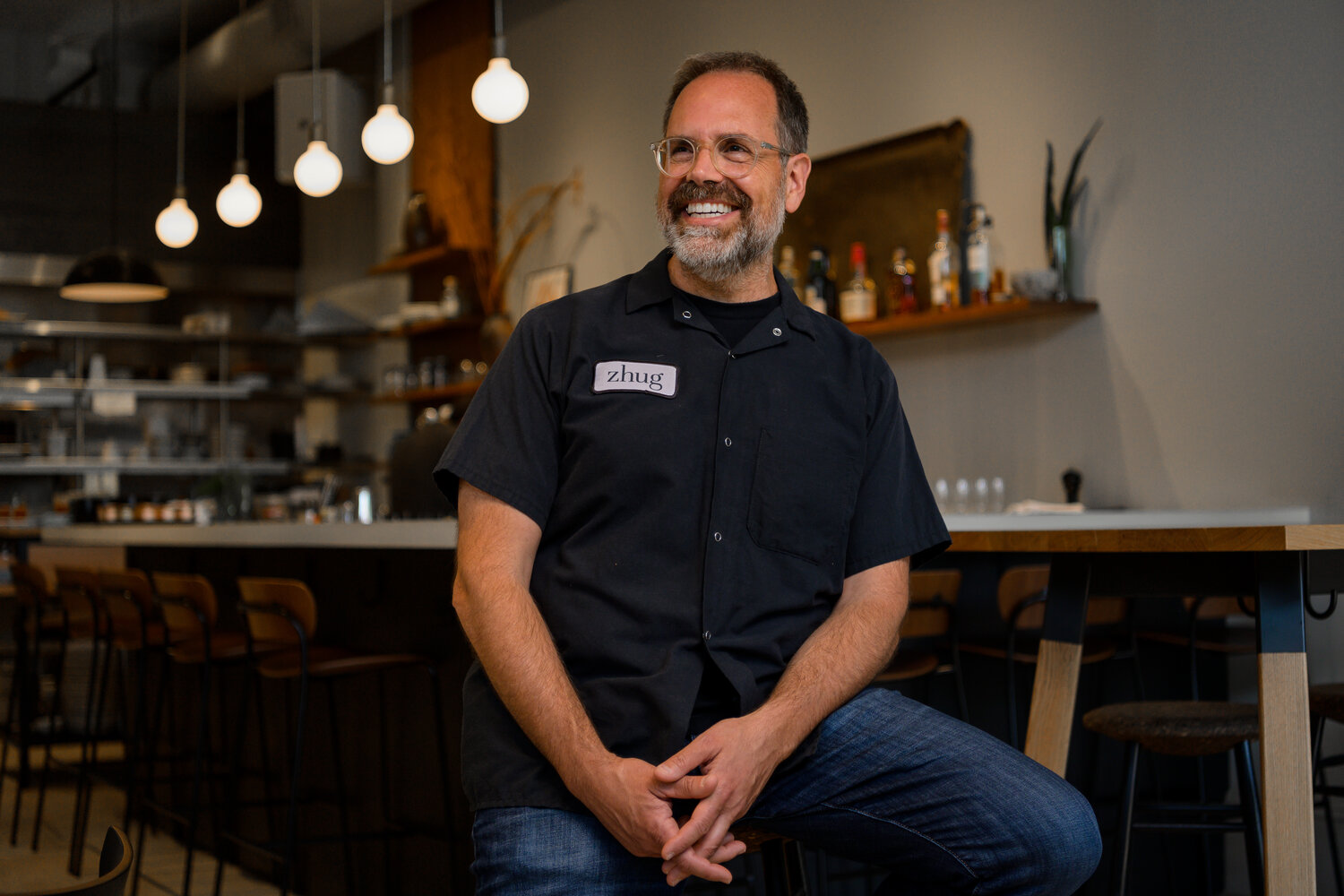
Douglas Katz
Chef
6
APPEARANCES
5
PODCASTS
Sep 14, 2026


Douglas KatzGUEST
And as I've studied different philosophies and all, and by no means an expert, I'm a, I'm a dilettante with that, but I have really begun to understand that a lot of challenges do come about when you're trying to fulfill a role that you were not necessarily suited for, or that is not the true you.
Douglas KatzGUEST
And I think a lot of times sometimes is wasted and energy is wasted trying to conform to a set of rules and norms and other components of things that we deal with.
Douglas KatzGUEST
But I think, as I said, when I talked about being tribal, There's a lot of that that isn't in the law and order category where it's really about trying to be accepted.
8 MINS LATER

BlessedHOST
Now, in a culture that often prioritizes aesthetics and novelty, what does truly human-centered design look like to
Douglas KatzGUEST
It's understanding how we work either cognitively or physically and optimizing that.
Douglas KatzGUEST
I wrote an article in the past that said, or the title was, if it were the subtitle, if you were designing a knife for a blade that a machine would cut with, it would not look like the knife that we use because that's just not how our bodies work.
Douglas KatzGUEST
So that's where I really tend to think of it in terms of how does our body work and then how do you align that with the task? In our case, it was approaching it very circular and in a manner where you could more easily or a user can more easily align their upper arm, their wrist, their forearm with the blade to transfer force the most efficient, pardon me, efficiently that they can.
5 MINS LATER
BlessedHOST
Now, how do you hope society's understanding of accessibility is going to evolve over the next decade?

AmosHOST
I have one right here.
Douglas KatzGUEST
So this is a knife I made and it's linear, right? Like it is handle, transition, which is either a handguard or a bolster, blade and tip.
Douglas KatzGUEST
Now this, if you think of any major culture, this is what a knife looks like in people's minds because this goes back thousands and thousands of years.
Douglas KatzGUEST
It's what allows you, if we didn't have this, you and I wouldn't be talking with technology right now because we never would have emerged from an evolutionary perspective.
Douglas KatzGUEST
But the problem is what makes this a great multitasker is that you can use the tip to hunt, defend yourself or do whatever, and the blade to cut.
10 MINS LATER
AmosHOST
So how do you design something that will restore functions without labeling the users?

OkoroHOST
still being, you know, 30
Douglas KatzGUEST
So that made me think, okay, the disabled space is comprised of the people who self-identify as disabled, meaning they may have a condition or something that's more part of their identity than somebody who's, let's say, just aging, which was more the case of my father.
Douglas KatzGUEST
then you look and you say, okay, disability is a different ball game that people are playing right now.
6 MINS LATER
OkoroHOST
Okay, so can you like share some light on Nulu? Something about it, just show it to us today.
Douglas KatzGUEST
And I don't want to sound Pollyanna-ish on that and that, you know, that, oh, you know, one little thing changes the world, but it really does.
Douglas KatzGUEST
My product, as an example, we make this ergonomic knife and it's for many disabled people use it.
Douglas KatzGUEST
And I feel more and more people need to understand that their small actions then become the stimulus that other people respond to.


A.D. EdwardsHOST
So what kind of household values or early influences shape the way you think about service, discipline and responsibility?
Douglas KatzGUEST
I, you know, I had a great upbringing, you know, middle-class taught you right from wrong and all that, but there's a magic that happens in the military, especially so at a service Academy that I kind of call it that control alt delete, right? It, it changes the BIOS behind the operating system and builds the a couple of things that have been essential to entrepreneurialism.
Douglas KatzGUEST
When you say that I'm a person who doesn't take no, a lot of that comes from mission-driven thinking that the military gives you.
Douglas KatzGUEST
And I would say, you know, looking back and, you know, not minimizing anything that family engagement and all had an influence or the degree that it had an influence, there's just something very... visceral about what happens to you at that institution.
56 MINS LATER
A.D. EdwardsHOST
But now with AI coming into play with different inventions, do you think that there will be an over-reliance on AI when there are certain things that they could have still done themselves? Is what I'm getting at.