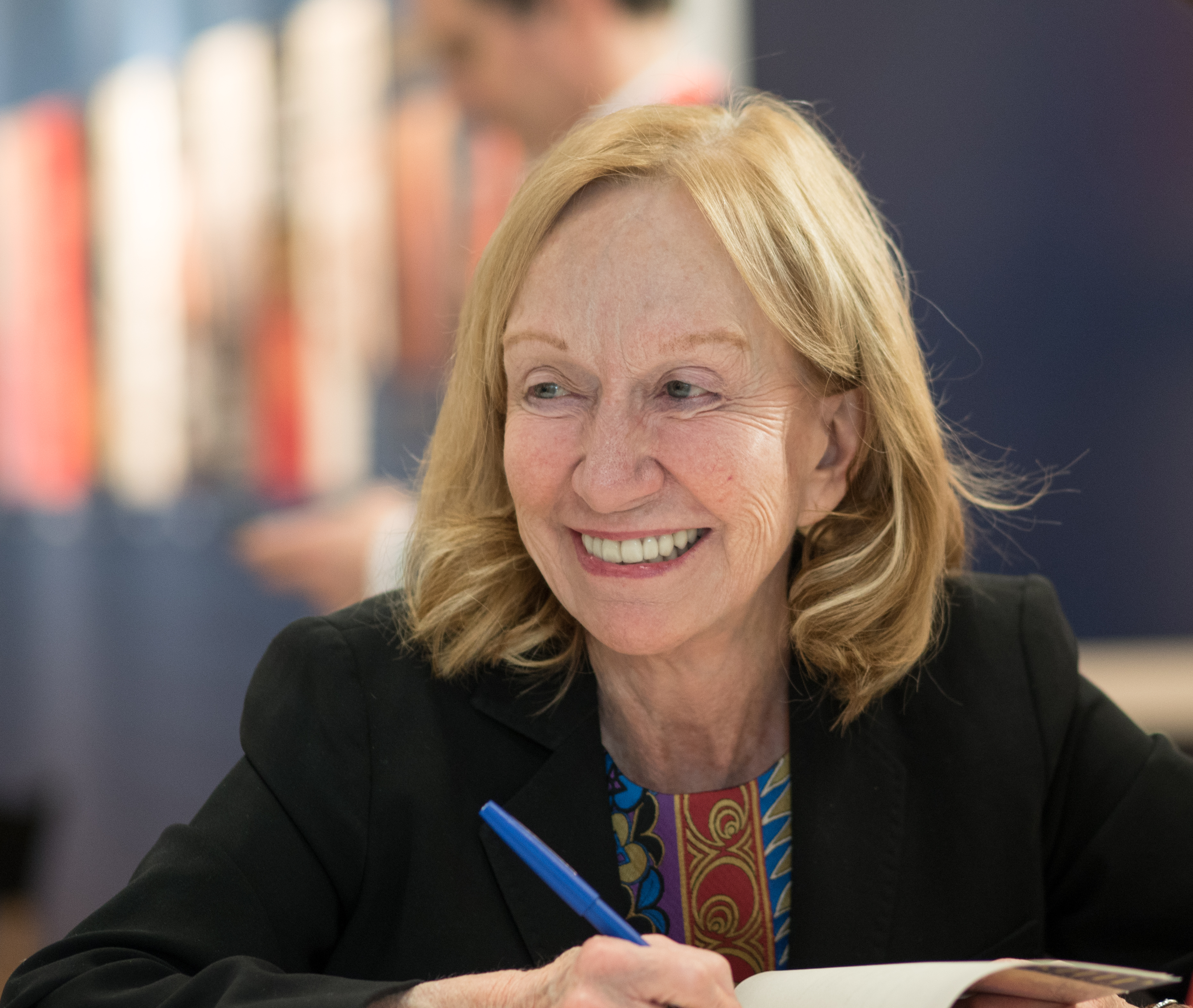
Doris Kearns Goodwin
American biographer and historian
16
APPEARANCES
11
PODCASTS
Oct 6, 2026


Blake ZanteHOST
Looking over that span, what patterns do you see in how the country has really renewed itself?

Doris Kearns GoodwinGUEST
itself?I think it's so important for us to understand the role that history can play.
Doris Kearns GoodwinGUEST
That's why I think I love it so much because we know we're living in a really tough time now, but we've lived in really, really, really tough times before, and we know that these people got through it.
Doris Kearns GoodwinGUEST
They didn't know when they were living through their era of crisis how it would end.
10 MINS LATER
Blake ZanteHOST
Uh, tying all of this together, Doris, how did the leaders that you've studied really think about their legacy and how they wanted to be remembered? Uh, could you just give us kind of an overview of what, what goes through a president's mind when they're thinking about their legacy?

speaker_0ADVERTISER
Think you have what it takes? [can opening]
Doris Kearns GoodwinGUEST
It carried him through the one significant depression that he suffered when he was in his early 30s.
Doris Kearns GoodwinGUEST
He had broken his engagement with Mary Todd, not certain he was ready to marry her, but knowing how devastating it was to her that he did that.
Doris Kearns GoodwinGUEST
His one intimate friend, Joshua Speed, was leaving Illinois to go back to Kentucky because Speed's father had died, and his political career in the state legislature was on a downward slide.
speaker_5ADVERTISER
Use as directed.


Kristen WelkerHOST
It's so wonderful to have you to talk about this huge milestone that the country is about to mark, America approaching its 250th birthday, and I wonder, what are your thoughts as the country prepares to celebrate this significant moment?
Doris Kearns GoodwinGUEST
I think the most important thing is to remember the difficult times that we've lived in before.
Doris Kearns GoodwinGUEST
We're living in a tough time right now, but history can give us perspective.
Doris Kearns GoodwinGUEST
I mean, just imagine what it was like to live through the Civil War, more than 600,000 people were dead, or live through the Great Depression, one out of four people out of work, the banking system collapsed, or to live through the early days of World War II when it was unclear that Hitler might conquer the rest of the world.
Doris Kearns GoodwinGUEST
And the important thing to know is that in each one of those times, the people who lived then, they didn't know the end of their story.
35 MINS LATER
Kristen WelkerHOST
I just wanna ask you, as a final thought as we prepare to mark America's 250th birthday, what does the story of our country, everything that you and I have just discussed, ask of these citizens today?

Ryan NoblesHOST
As America marks its 250th anniversary and confronts deep political divisions, Kristen asked her what lessons our history may hold for this moment.
Doris Kearns GoodwinGUEST
I think the most important thing is to remember the difficult times that we've lived in before.
Doris Kearns GoodwinGUEST
We're living in a tough time right now, but history can give us perspective.
Doris Kearns GoodwinGUEST
I mean, just imagine what it was like to live through the Civil War, more than 600,000 people were dead, or live through the Great Depression, one out of four people out of work, the banking system collapsed, or to live through the early days of World War II when it was unclear that Hitler might conquer the rest of the world.
Doris Kearns GoodwinGUEST
And the important thing to know is that in each one of those times, the people who lived then, they didn't know the end of their story.
speaker_9ADVERTISER
What is the role that citizens can play right now based on what you've witnessed in history?


Jonathan LemireHOST
Um, tell us about what lessons of, from TR, what parts of the TR resume or legacy or character do you think would be most useful for our country today as we head into the 250th anniversary?
Doris Kearns GoodwinGUEST
You know, in so many ways, I think the time in which he gr- he was, he was president is much like our own because you had the Industrial Revolution had shaken up the economy, much like globalization and the tech revolution and AI today.
Doris Kearns GoodwinGUEST
You had people who were rich and people who were poor, a massive gulf.
Doris Kearns GoodwinGUEST
New inventions were making people a little scared about the change of the pace of life.
Doris Kearns GoodwinGUEST
And capitalism had no regulations from the time of the Civil War until Teddy Roosevelt, so there was a feeling that there was no control over the economy.
Doris Kearns GoodwinGUEST
And he comes in, and he comes in with this perfect slogan, which is more than that, it's his whole legislative program, "A square deal for the rich and the poor, the capitalist and the laborer." And he had rational regulations that d- did not break up these big companies unless they were not doing well, that allowed them to move forward, but with more concern for making sure that they were treating their workers right and they were lowering prices as a result of efficiency that came from bigness.
9 MINS LATER

Doris Kearns GoodwinGUEST
What happened was that he had written a speech for Kennedy in the campaign calling for an alliance for progress.
5 MINS LATER

David RubensteinHOST
He also wrote some speeches relating to voting rights, did he not? And in the end, he had some very powerful words that Johnson delivered in the Capitol, right?

Doris Kearns GoodwinGUEST
What happened was that he had written a speech for Kennedy in the campaign calling for an alliance for progress.
7 MINS LATER
David RubensteinHOST
He also wrote some speeches relating to voting rights, did he not? And in the end, he had some very powerful words that Johnson delivered in the Capitol, right?


Donny DeutschHOST
famous behind-the-scenes person, or not famous, and that's kind of the irony of the book, interestingly enough.
Doris Kearns GoodwinGUEST
I mean, he had some moments when people who knew who he was, when he graduated from Harvard Law School, he was first in his class, and then he investigated the rigged television quiz shows.
Doris Kearns GoodwinGUEST
And then he went on to clerk for Justice Frankfurter and become the first young person in the, not the first young person, but become a young campaign person with JFK on the Caroline Plain during the 1960 campaign.
27 MINS LATER
Donny DeutschHOST
I mean, you kind of have done that already, but I'd love to kind of hear it in that thought.

Joe ScarboroughHOST
Um, what did John Kennedy learn from those mistakes? How did th- he take those mistakes on board, and what lessons can we take out of Kennedy's response to the Bay of Pigs failure?
Doris Kearns GoodwinGUEST
I mean, what he understood, in fact, during that week after the Bay of Pigs, he was so sad.
Doris Kearns GoodwinGUEST
He said, "How did I believe what the experts were telling me? I've known all my life not to do that." And actually, Jackie Kennedy said he came to her room and he actually cried in her lap because he had been so stupid.
Doris Kearns GoodwinGUEST
So what he realized when he changed his decision-making structure, you're right, he grew from understanding that mistake.

Doris Kearns GoodwinGUEST
I mean, one of the things I think about him, at the beginning of his life, he had that humility.
Doris Kearns GoodwinGUEST
Really, even early young, he was able to say, "I don't know grammar." I mean, he was embarrassed, and then he found out that there was this book he could get that he would learn grammar.
Doris Kearns GoodwinGUEST
And, and more importantly, I think that humility, as we say, is combined with confidence.
Doris Kearns GoodwinGUEST
But then at the end of his presidency, that's where you see the empathy really come out.
7 MINS LATER

Ryan HolidayHOST
You know, like so, so there's something too about Lincoln where he's having the, the fundamentally human response, but then he's got the self-mastery to stop himself before he, you know, hits send.
Ryan HolidayHOST
A- about as remote as you could get in the 20th century, and what, what are the, what do these, uh, distant tribespeople ask him?
Doris Kearns GoodwinGUEST
Yeah, these distant tribe people in somewhere in the Caucuses, seemingly very far away from any kind of civilization, are so excited that he's in their midst that they ask him to tell stories of the great men of history.
Doris Kearns GoodwinGUEST
So he told them about Julius Caesar and Alexander the Great and Frederick the Great and, uh, and he, and Napoleon, and they seemed to love it, he said, but then they stopped him, the chief, and he said, "But wait, you haven't told us about the greatest ruler of them all.
Doris Kearns GoodwinGUEST
We want to hear about that man who spoke with a voice of thunder, who laughed like the sunrise, who came from that place called America that is so far from here, that if a young man should travel there, he'd be an old man when he arrived.
Doris Kearns GoodwinGUEST
Tell us of Abraham [laughs] Lincoln." And Tolstoy was stunned to know that Lincoln's name had reached this remote corner, but then he told them everything he knew about Lincoln, and then the reporter said, "Okay, so what made Lincoln so great after all?" And Tolstoy said, "Well, he wasn't as great a general as Napoleon, not as great a statesman perhaps as Frederick the Great, but his greatness consisted altogether in his character and the moral fiber of his being." Is that great? I mean, that's what we need in everybody, in our kids, in our, what our st- teachers teach our students, what our leaders should be made of.
Ryan HolidayHOST
But, but there's something about the decision to say, "Hey, I'm gonna, I'm gonna have a, a hero origin story rather than a villain origin story."

Ryan HolidayHOST
And I think the earlier you can kind of pick up that bug, one, the smarter you'll be, but two, like the more interesting your life will be.
Doris Kearns GoodwinGUEST
I mean, one of the reasons why I think I wanted to write a book for young children today is just that there's a sense of history being diminished in schools at all level.
Doris Kearns GoodwinGUEST
And it's my heart to think about that, because for me, I had a teacher in high school, Miss Austin, who really made us feel like she knew the people she was telling us about from the past.
8 MINS LATER

Anderson CooperHOST
Um, Doris, as someone who worked in the W- the White House, y- as, as you did and who's written about it so much, I'm wondering what was it like to see the East Wing completely torn down?
Doris Kearns GoodwinGUEST
Yeah, there was something about that picture of destruction and the wrecking ball that really is more visceral than words could say.
Doris Kearns GoodwinGUEST
The sailor kissing the girl at the end of World War II was the spontaneous joy of World War II.
Doris Kearns GoodwinGUEST
And with that destruction that we saw, without any previous planning, without educating us as to what was being done, why it was being done...
Doris Kearns GoodwinGUEST
In all these other cases, mostly you had congressional appropriations so they would have to go through an argument.
Doris Kearns GoodwinGUEST
There'd be debates and you'd understand, why do we need this? We did need a lot of those other renovations, that's absolutely true.
Doris Kearns GoodwinGUEST
I mean, when you listen to him at the rally or you listen to the Cabinet members coming around him, he'll say, "This is the most successful 100 days." People are talking about it as the best 100 days.
Doris Kearns GoodwinGUEST
In fact, he's even been likening himself recently to FDR, you know, saying that FDR created this political coalition that lasted for decades, and now, he has a new political coalition from this huge race that he was able to win that will now last for decades.
Doris Kearns GoodwinGUEST
He's been through so much before, and that first term having to live with the prosecutions and the potentiality of jail in the second, these last, these last years, that I think he really can believe that, with conviction, that he's doing great.
Anderson CooperHOST
FDR, though, was working with Congress and really explained things to the American people.

Anderson CooperHOST
Doris, what's been going through your mind as you've been seeing this, this rewriting of American history or the, the, the striking down of difficult parts of American history?
Doris Kearns GoodwinGUEST
Yeah, I mean, I feel like I wake up every day worrying about what new executive order is gonna come out, because individually they're really adding up to some cumulative attack on really the nature of history itself.
Doris Kearns GoodwinGUEST
If we don't talk about Jim Crow, if we don't talk about slavery, if we don't talk about Birmingham and what happened at the Children's Crusade in 1863 which fired the conscience of the country that produced the Civil Rights Act, if we don't talk about what happened at, at the bridge at Selma where the Alabama troopers hurt the peaceful marchers, it's disturbing to watch that, yes.
Doris Kearns GoodwinGUEST
But the great achievement that President Trump keeps talking about wanting to talk about came from that, because the conscience of the country was fired and the Voting Rights Act gets passed.
Doris Kearns GoodwinGUEST
If we don't talk about what women did for 72 years to fight for organizing and marching to get the Women's Amendment passed, you, it's not like some day a benevolent king woke up and said, "Oh, I think I'll give women the rights today." Struggle is the, is the part of what's made our country great, leading up to those ideals.

Anderson CooperHOST
It seems like you found that not only writing about your husband, but also then talking about him and telling stories about him has actually helped.
Doris Kearns GoodwinGUEST
It's not whether the person's on Mount Rushmore or a president that you're telling stories about them as a historian.
Doris Kearns GoodwinGUEST
We wanna tell stories about the people we loved, and they're no longer there, and that's what everybody wants.