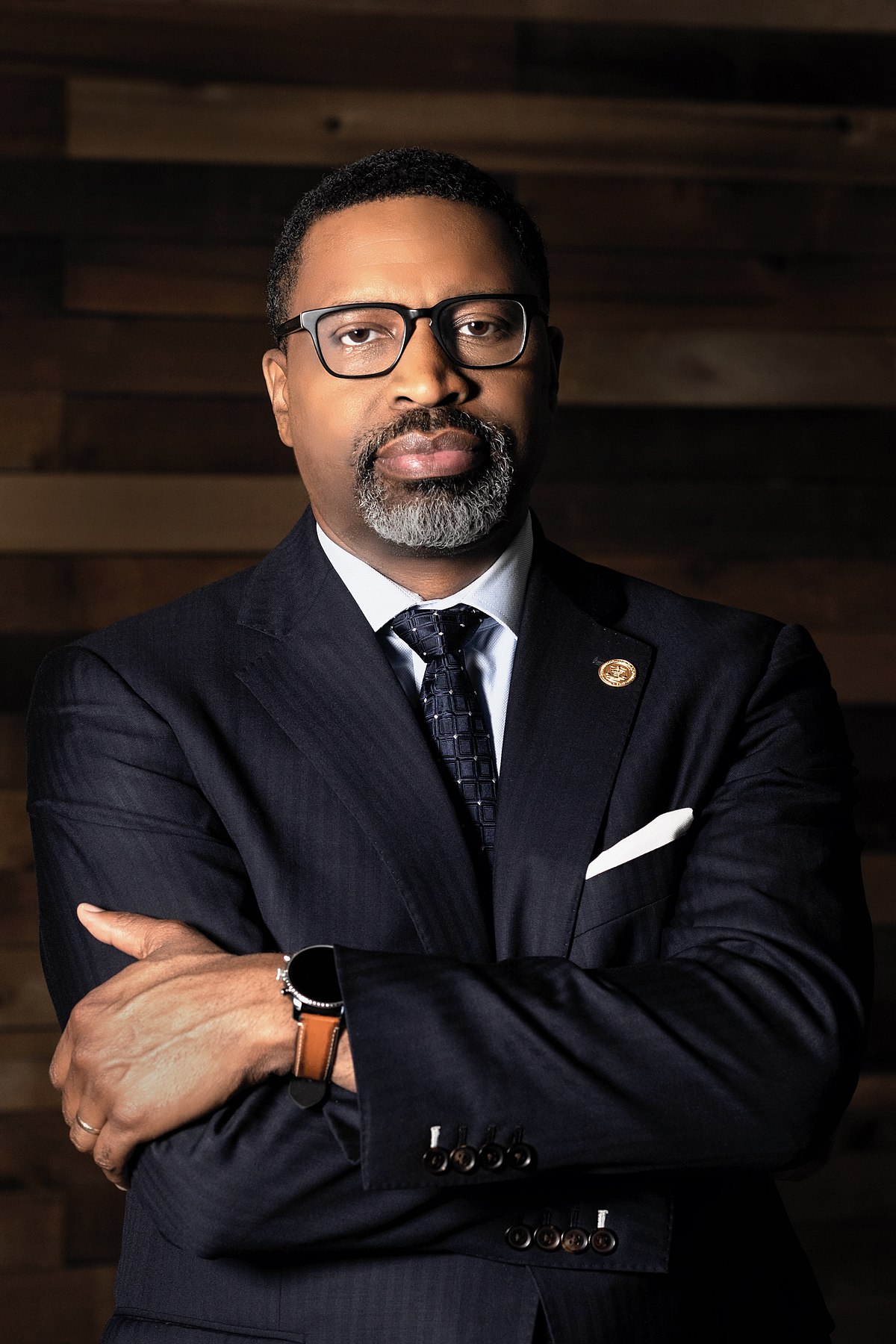
Derrick Johnson
CEO of the National Association for the Advancement of Colored People
27
APPEARANCES
14
PODCASTS
Nov 16, 2026


Errin HainesHOST
Tougaloo College became a safe haven for civil rights activists and organizations.

Derrick JohnsonGUEST
We should be proud of how far we have come, because in no one's wildest dream Will we have a magic that will be on the verge of making history? Peace and power.
12 MINS LATER
Max MyersGUEST
And again, it is also providing quite a bit of clarity for what we want to prioritize after the election moving forward.
Derrick JohnsonGUEST
So any questions? If not, I want to thank all of you for what you have done.
Derrick JohnsonGUEST
And we anticipate a peep calling the race within the next 30 minutes or so.

Derrick JohnsonGUEST
It was one of the two gathering places where civil rights workers could meet in safety.
7 MINS LATER

Alicia MenendezHOST
What is then the mandate on voting rights? What is the action that you want to see in the next two years?


Derrick JohnsonGUEST
I can recall when the MW Stringer Lodge, which is the headquarter for the state NAACP, we always use that as our place to gather as we're watching the outcome of elections.

9:41

Just tell us from your vantage point how this victory, how Scott Colom's victory feels to you right now.
Derrick JohnsonGUEST
What we are seeing on stage is the work product and the long fight that Congressman Thompson have had to ensure we had true representation in this state.
38 MINS LATER

Derrick JohnsonGUEST
He went away to law school, did exceptionally well, came back as a scat art fellow.
Derrick JohnsonGUEST
We put him ahead of a... a piece of legislation dealing with unemployment benefits.
5 MINS LATER

Joy ReidHOST
Can you just reflect on that? Because Medgar Evers is probably smiling real big from the outer universe in this moment.


Maggie McGrathHOST
So I'm going to start with a basic question, but for those of us who live in states whose races were called on Tuesday night, the day we voted, why exactly has the vote counting effort in Mississippi extended to today, Monday, November 9th?
Derrick JohnsonGUEST
If you go to the polls, and for whatever reason your name isn't on the poll book, you fill out what's called here an affidavit ballot.
Derrick JohnsonGUEST
And when election officials count everything else, they then go and resolve whether or not your affidavit ballot is a legitimate ballot.
Maggie McGrathHOST
Was voter turnout an issue here? Was the state prepared for the number of people who voted? And is that playing into the situation at all?


Anthony DavisHOST
Just explain which of the votes are yet to be counted and why there is this kind of differential between certain types of votes that are delayed in the count.

Derek JohnsonGUEST
Well, under Mississippi law, if a voter go to the poll and for several reasons their name isn't on the voter roll, they have a right to request what's called an affidavit ballot.
Derek JohnsonGUEST
And in that process, the election poll workers are required to provide said ballot.
Derek JohnsonGUEST
And it goes into an envelope for the election commissioners who oversee elections in all 82 counties.
Derek JohnsonGUEST
to review the voter's name and determine whether or not their name was not on the voter roll because they hadn't voted in the last two federal elections, meaning they were inactive.
Derek JohnsonGUEST
And so the casting of the ballot for that election will activate them being placed back on the active roll and their ballot would count.
Anthony DavisHOST
But why is it so important that an African-American is representing the people of Mississippi?


Angela RyeHOST
But I will ask you, D, what do you think has happened since that 2007 very, you know, dramatic ceremonial burial of the N-word?
Derrick JohnsonGUEST
And in uses of the word, we're given license to folks outside of our community, whether we realize it or not.
Derrick JohnsonGUEST
And so when we give that license and then we hear it back and we get angry...
Derrick JohnsonGUEST
Should we be getting angry or should we monitor how we want to be reflected? You know, Birth of a Nation was mentioned earlier.

128:40

What do you think is going to be the NAACP's role or NAACP, whatever we're calling it now? What do you think is going to be the NAACP's role in helping to bring back the black radical tradition into our politics so that we can have progress and not just be stagnant?
Derrick JohnsonGUEST
My response to you is where did it go? I'm watching individuals talk about DSA as if it's something new.
Angela RyeHOST
What else can people do in this moment in addition to voting? Not besides, in addition to.


Tavis SmileyHOST
Those guardrails that you spoke of, Mr. Johnson, a moment ago are exactly what? Give me some sense of the guardrails that you think are missing.
Derrick JohnsonGUEST
The sitting president encouraged the governor of the state of Texas to do something that is completely unprecedented.
Derrick JohnsonGUEST
Typically, the drawing of political body lines is done after the taking of the census every 10 years.
Derrick JohnsonGUEST
But this president, out of fear of not being able to maintain controls of the House of Representatives, pursued a course of action that no one expected or seen before.
Derrick JohnsonGUEST
Because he wants to choose the elected officials as opposed to the people choosing the elected officials.
7 MINS LATER
Ed MarkeySOUNDBITE_SPEAKER
perfection of law.


Derrick JohnsonGUEST
I'm still a resident of Mississippi, and the state need to deal with the perception with some real actions.
Derrick JohnsonGUEST
Uh, the initial response to the case was from the sheriff who took the words of the four young men, uh, as if it was fact, and had not done a true investigation.
Derrick JohnsonGUEST
We're entering this conversation with no preconceived notions of anyone's, uh, involvement.
Derrick JohnsonGUEST
But what we are saying is, up to this point, the family have not gotten the type of support and transparency from local or state law enforcement agencies.

Derrick JohnsonGUEST
There's more time been spent on deflecting the fact that there has not been a thorough investigation that the public have trust and believe in.
Derrick JohnsonGUEST
If there's a grand jury where information is going to be provided, that's great.
Derrick JohnsonGUEST
But at this juncture, a local official should not be deflecting what's really taking place.
Derrick JohnsonGUEST
We're talking about a state with a history of not valuing of African-American life.
Derrick JohnsonGUEST
We're talking about a state that spend more time worried about the perception of his past as opposed to reconciling the current reality and doing what's necessary.
5 MINS LATER

Derrick JohnsonGUEST
That, what Angela was talking about, that, probably a year and a half ago, and she was on, and she was on 10.
Derrick JohnsonGUEST
And when you compound all of that and you realize that the foundation that you normally go to, now they're looking for you to be the foundation on top of all your work, anytime you should have to pull back.
Joy ReidHOST
Should we broaden this out, not just to the SEC, but really to treating all these states the way they're treating us?
Derrick JohnsonGUEST
We should be looking at, you know, this recent announcement about the Super Bowl going to Nashville in 2030.
Derrick JohnsonGUEST
This is a opportunity for, uh, many of us to begin to force, uh, NFL to reconsider that decision.
Derrick JohnsonGUEST
In this moment, we are at war because, uh, southern Confederates have declared war on Black rights.
Derrick JohnsonGUEST
And so we have to fight with all the tools that we have at our disposal, and we should do it strategically, we should focus, we should double down in areas where we can make some true headway.
Joy ReidHOST
Again, I have to big up DL Hughley who did come w- uh, come and bring this idea to us as well, that we have to do something, right? Are you in conversation with some of these parents, and are people willing? Like, are people open to it as you talk to them?


Rickey SmileyHOST
Talk to us and let the people know what they need to know and what they need to do.
Derrick JohnsonGUEST
In this moment, the rights of African Americans in this country is under direct attack.
Derrick JohnsonGUEST
They're trying to minimize our input, suppress our vote, and remove our voice in policymaking.
Derrick JohnsonGUEST
We call for individuals who are some of our top performing athletes coming out of high school to think hard about their choice.
Derrick JohnsonGUEST
We should not be recruited to be on the fields of state schools when the very states the schools are a part of are seeking to strip away our voting rights.
Derrick JohnsonGUEST
These are athletes who are making profits on the field, but they don't want their voice in the mix for policymaking.
Black TonyUNKNOWN
Okay, so this current voter rights bill that was recently passed, in a nutshell, can you explain how this affects black voters and what makes this boycott so important?
Rickey SmileyHOST
Talk to us and, and, and let the people know what they need to know and what they need to do.
Derrick JohnsonGUEST
Well, in this moment, uh, the rights of African Americans in this country is under direct attack.
Derrick JohnsonGUEST
Uh, they're trying to minimize our input, uh, uh, suppress our vote, and remove our voice in policymaking.
Derrick JohnsonGUEST
Uh, we call for, uh, individuals who are some of our top performing athletes coming out of high school to think hard about their choice.
Derrick JohnsonGUEST
We should not be recruited to be on the fields of state schools, uh, when the very states the schools are a part of are seeking, uh, to strip away our voting rights.
Derrick JohnsonGUEST
Uh, these are athletes who are making profits on the field, but they don't want their voice in the mix for policymaking.
Rickey SmileyHOST
Okay, so this current, uh, voter rights bill that was recently passed, in a nutshell, can you explain how this affects Black voters and what, what makes this boycott so important?
speaker_4UNKNOWN
[clapping]
Derrick JohnsonGUEST
November's election is only the stopping point to stop the bleeding, but the power of the Black community rests in each one of us.
Derrick JohnsonGUEST
Step away from the egocentric leadership model where my title and my charisma is it, and, and lean into the community-centric leadership model that will protect all of us.
Derrick JohnsonGUEST
In this moment, we must demonstrate the wrongness in a Supreme Court decision by overwhelming the polls in November as we march to the power that we already have.
speaker_4UNKNOWN
Come on.
Derrick JohnsonGUEST
'Cause it's with integrity that Henry Kirby created the whole landscape that got those Black elected officials into place.


Ben MeiselasHOST
Talk to us about first why that's so, and then how do you combat it at the NAACP?
Derrick JohnsonGUEST
So first of all, the SAVE Act, when you look at the details of the bill, is a solution in search of a problem.
Derrick JohnsonGUEST
There isn't a problem that this, uh, piece of policy will save, fix, or secure.
Derrick JohnsonGUEST
And the top line, as you said earlier, everyone will say we want safe elections.
Derek JohnsonGUEST
the NAACP? So first of all, the SAVE Act, when you look at the details of the bill, is a solution in search of a problem.
Derek JohnsonGUEST
And the top line, as you said earlier, everyone would say we want safe elections.
Derrick JohnsonGUEST
I think it's really important at this moment, uh, that we lean into our platforms, because as other communities are seeking to erase us, we have to be more affirmative around seeing one another, and that's why our theme this year is we see you, uh, despite what other people are seeking to do.
Derrick JohnsonGUEST
But the parallels between what's taking place now, what has taken place in history is also important, that in the, in the founding of the NAACP in 1909, it was about people being targeted because of their identities.
Derrick JohnsonGUEST
Uh, and those founders, many of whom may not l- look like you or I, were not considered white in 1909.
Derrick JohnsonGUEST
They recognized that the attacks on the Black communities will be attacks on immigrants, on Irish Catholics, on the Jewish community, on all of the unique identities that in 1909 that was not considered white.
7 MINS LATER

Charles BlowGUEST
You know, I grew up in Detroit, and I, I lived through the time where a million white people left the city because you had a Black mayor.
Derrick JohnsonGUEST
When I'm saying you run out of white people, when that happens, when you're outnumbered, where you cannot, you can no longer dominate and control, you begin to remove all of the power outside of the system.
Derrick JohnsonGUEST
Leading up to that point, there were massacres, armed resistance in the streets between Black former, uh, Union soldiers and white folks, and a deal was cut, only for the Black folks to be betrayed.
Derrick JohnsonGUEST
And the reason why is because they was running out of white people in Mississippi, because Black folks was the majority, and we began to govern.
27 MINS LATER

Derrick JohnsonGUEST
Uh, you know, entertainers, they have the discretion to pursue whatever avenue they seek, uh, to promote their, uh, their, their work, uh, to talk to the communities they care about and to really advocate on behalf of the communities they come from.
Derrick JohnsonGUEST
Uh, I'm not aware of, of Kanye doing any of those things, and I'm not suggesting he hasn't done it, because we're not a monolith as a community.
Derrick JohnsonGUEST
Uh, and I'm not here to punch down on him, uh, when he's saying that, you know, he's struggling with, uh, mental health challenges.
14 MINS LATER
speaker_17UNKNOWN
[laughing]
Derrick JohnsonGUEST
If you was anything other than Anglo-Saxon Protestant, you was not white, because race is a social construct, and each one of those individuals were not doing this to save Black people.
Derrick JohnsonGUEST
But then, when La Guardia gets elected in '34 in New York, who was Italian, and they begin to carve up the city of New York and say, "These are the Irish districts, and here are the Italian districts.
Derrick JohnsonGUEST
In Harlem, you get the Black district." And then World War II happened, and then the WASP class begin outta- begin to run out of white people.
1 HR 8 MINS LATER

Derrick JohnsonGUEST
It wasn't until the late '20s, '30s, and then after World War II that people we see now as white were, are considered white.
Derrick JohnsonGUEST
And so this concept NAACP was started by white folks, no, we were started by a group of people who were othered.
Derrick JohnsonGUEST
Now, be very clear, Black folks created NAACP with the Niagara Movement, with, uh, uh, W.E.B. Du Bois, Ida B.
Derrick JohnsonGUEST
They came to a meeting that next year as a result of a racial incident that happened in Springfield, Illinois, and they agreed collectively to start an organization that was national scope- That represent colored people across the spectrum, whether you was Irish Catholic or Jewish or Black, whatever, because democracy was not being applied to all of those communities.

Derrick JohnsonGUEST
The images of Nebraskan farmers-... crops rotting in their fields because we have, uh, took on a tariff war that we should not have taken on.
Derrick JohnsonGUEST
The images of us sending $20 billion to Argentina so those farmers can sell the same crop to China that our farmers could not, the images of white farmers losing their farms, the images of- of people losing healthcare as a result of this Congress un- unwillingness to have a continual resolutions that is inclusive of the Affordable Care Act, those are much more compelling and powerful images in this moment.
Derrick JohnsonGUEST
Uh, we're not... we can't save America, but we can give them a moral compass on what direction they should go in.
Derrick JohnsonGUEST
And at some point, they're gonna have to take our moral compass and go in that directions.
8 MINS LATER

Don LemonHOST
I, look, you, uh, you, you gave me something today that I hadn't really thought about much, and I agree with you on that, but what if it was Black folks out there being brutalized like this? And wouldn't you want someone to stand up for us?
Scroll for more appearances