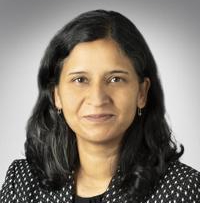
Deepa Rajan
PhD candidate in Tetrad program at UCSF researching origins of intelligence in single-cell organisms; scientist and poet
2
APPEARANCES
2
PODCASTS
Jul 30, 2026


Clarinda CerejoHOST
But we've gotten ahead of ourselves and I would like to talk about your own story and what brought you into this space.

Deepa RajanGUEST
Well, I mean, my background is in medicine, and then I also worked clinically for a couple of years.
Deepa RajanGUEST
But then I was in South Africa for some time, and then in India as well, where I started getting more and more into public health work.
Deepa RajanGUEST
And just seeing that, you know, clinical medicine is great, but there's so many things that you can't address just through the clinical part.
Deepa RajanGUEST
That there's, you know, in South Africa at the time, with HIV being the main issue, outreach was really, really key.
12 MINS LATER
Clarinda CerejoHOST
But you mentioned that the gap between the adoption of the principle which is easier and then the implementation that's huge so what are some of the barriers you did touch upon a couple and i think some are obvious so for example policymakers needing training civil society needing training the mindset or the willingness maybe for policymakers to share that power and bring people into that space where you know they've traditionally held that power and been able to wield it in whatever manner they would like to so being collaborative suddenly is like a huge mind shift i think those might be some of the obvious ones that come to mind and some that you mentioned as well but what are some of the others and then i'd also like to tie that to the progress that has been made since the resolution was signed perhaps and how some of those barriers might tie to that


Itai YanaiHOST
Yeah, but she also has a really special program for kids to teach aspects of the creative process, in particular exploration.
Deepa RajanGUEST
I study how single cells can learn and make memories even without having a brain.
Deepa RajanGUEST
First, I'm a longtime listener, and I've been listening to this podcast throughout my PhD, and it definitely has influenced my own creative process, so thank you.
Deepa RajanGUEST
And when you asked me on Twitter what is my creative process, so it got me thinking: what is my creative process? And I guess I would say it's something like a crop rotation system in farming.
Deepa RajanGUEST
Not that I know a ton about farming, but the idea of you have different plots of land, and then on one season you plant one plot of land with a set of crops, but then the next season you rotate the crops to the next plot of land, and you let the first plot of land lie fallow so that it can replenish its nutrients and get more fertile soil.
Deepa RajanGUEST
And that's how I think my mind has worked best in my PhD, that, yes, there is a time and place for steady attention and obsession, but that only works when it's temporary and for a season, and then when the time comes, that, um, frame of obsession has to switch to the next plot of land, leaving the first one fallow so that it can just get ready for the next bout of obsession.
9 MINS LATER