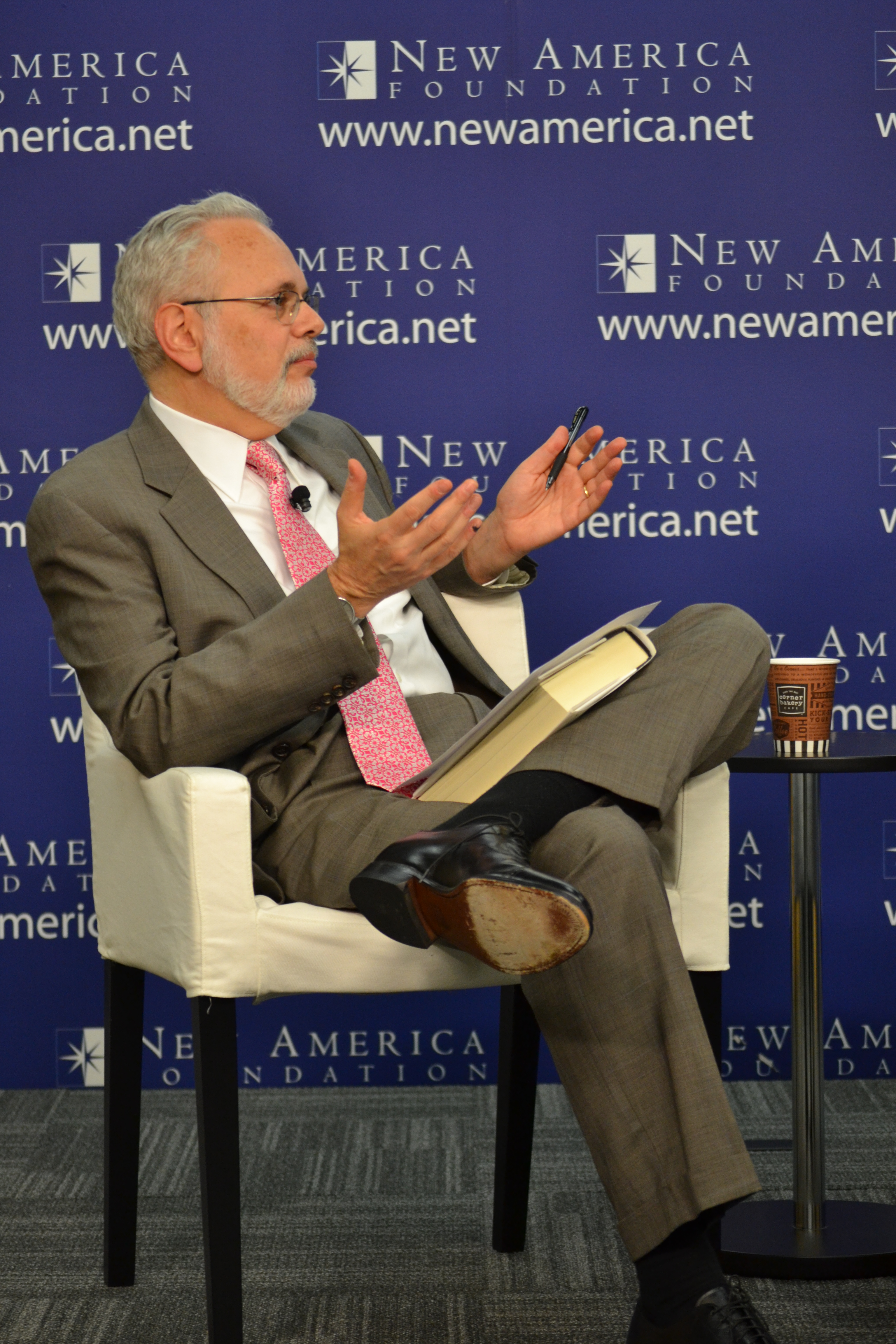
David Wessel
American journalist and writer
29
APPEARANCES
10
PODCASTS
Oct 6, 2026

speaker_0HOST
[audience clapping]

David WesselGUEST
Jonathan and I worked together both at The Boston Globe, at The Wall Street Journal, and then I elected not to follow him to Bloomberg News.
David WesselGUEST
[laughs] Um, and, uh, you know, you know you're old when people write books about a decade that's forty-five years ago, and you actually remember it.
33 MINS LATER


David WesselGUEST
So, the supply of borrowing is how much money the Treasury borrows, and the demand is how much investors are willing to pay for it.
David WesselGUEST
And what's happened is the Treasury is borrowing more and more because we're running big deficits, and now there's a new player.
David WesselGUEST
All these hyperscalers are borrowing a lot at the, at long maturities, 10-year, 20-year, 30 years.
David WesselGUEST
And that used to be the place where the, where the, um, where the Treasury had wo- didn't have much competition.

David WesselGUEST
Well, actually today, according to Bankrate, which is the daily thing, it's up to 7.2% today.

David WesselGUEST
Well, actually today, according to Bankrate, which is the daily thing, it's up to 7.2% today.


David WesselGUEST
One is when interest rates are low, you don't worry about how much you're borrowing.
David WesselGUEST
And it turns out that even if sometimes we think our economy is a mess or the debt's a mess, It looks relatively good compared to other countries, so people kept investing their money in the U.S.
David WesselGUEST
And what's frightening, so we know we could borrow more than we used to think, but when you look at the projections, and the projections are based on we're an aging society, we have low fertility rates, healthcare continues to rise faster than other things, this thing goes up and up and up, and you say to yourself, okay, this can't go on forever, and it can't.


David WesselGUEST
So in one respect, in a way, the economy made things a little easier for Kevin Walsh because there's no chance of cutting rates anytime soon.
16 MINS LATER


Kelly EvansHOST
You know, he a- was actually very collegial in his approach and kind of teasing with them and being very playful, and he also said, "Look, it, we all need to work in concert to really get inflation down."
David WesselGUEST
Well, I think that, I agree with Claudia that he's very disciplined and he's determined not to give very many signals.
David WesselGUEST
On one hand he said inflation risk has come down, but of course a lot of that is oil prices.
David WesselGUEST
On the other hand, he reiterated that we're gonna deliver price stability and anybody who thinks otherwise will be disappointed.
David WesselGUEST
Um, I think, yeah, it, what we learned about his style is he's v- he's willing to poke at the reporters, he's very comfortable doing that, um, and he kept invoking how he's now one of this small band of central bankers and we were all together during the global financial crisis.
David WesselGUEST
He didn't make any mistakes, but he's very reluctant to show anything about what he thinks about monetary policy, which, as you pointed out, that nine of the 18 people who put dots on their projections, Kevin Warsh didn't, see a rate increase in the next year, in the, before the year's over.
David WesselGUEST
So Warsh's attempt to "We're not gonna tell you what we're gonna do" was kind of undermined by the fact that they have a system where the other people are telling the markets what they think that they're gonna do.
David WesselGUEST
Well, the, um, the members of the e- Federal Open Market Committee who put projections down said they expect inflation to be worse than they had expected when they did it three months ago.
David WesselGUEST
And what the Fed is saying is right now we seem to be at full employment and inflation seems to be a problem.
David WesselGUEST
And I think that if inflation doesn't come down, they will have to raise rates.
speaker_3UNKNOWN
task forces.

Kelly EvansHOST
But then to Larry's point, if things look a little bit better in a meeting or two, maybe we can start to bring back and pivot back more towards rate cuts.
David WesselGUEST
The FOMC is pretty evenly divided here, and what will determine is not Kevin Warren's charisma, but what happens to the economy.
David WesselGUEST
If inflation does come down, if the labor market softens, then they won't raise rates.
David WesselGUEST
One point I think you haven't talked about yet is the sentence where they're reaffirming the policy of maintaining ample reserves in the banking system.
David WesselGUEST
So it'll be really interesting to hear how Kevin Walsh talks about the balance sheet if he does in the press
David WesselGUEST
It will not be a non-event, uh, because everybody will wanna see is he really starting to change anything.
David WesselGUEST
Will he put in the dot? Will he not talk about the dots? But I think Steve's point is a good one.
David WesselGUEST
It's, it's really hard to appreciate how much power your words have when you stand up at that microphone.
David WesselGUEST
And even though you're prepped for it or something, there's nothing like actually having...
David WesselGUEST
All of a sudden, Kevin Warsh is in a position where his opinions really matter.
David WesselGUEST
For 15 years, he's been ranting about the Fed, and some people listened and some people didn't.
Jason ThomasGUEST
And, and I do think that getting inflation to target at this point, given the cumulative increase in prices, is, is, shows accountability to voters given how, uh, disenchanted they are with, with the last five years.
Kelly EvansHOST
David, if I were going to press the point a little bit, and I'm tempted to, I would say, well, defending the Fed's independence, is that kind of easy? You know, is it kind of easy to say, you know, I will not bow to pressure from the president when maybe he perhaps doesn't feel any real pressure, while at the same time their real job was to make sure inflation didn't happen and that score he was asleep at the switch?
David WesselGUEST
And when they realized they had misread it, they reacted very swiftly, much faster than anybody thought.
David WesselGUEST
I don't see how you can say it is easy when you're in the gun sights of Donald Trump.
Kelly EvansHOST
And yet I would be sympathetic to the idea that if you tighten in response to an oil price, a supply shock, you could make the economy a lot worse.

Nick SchifrinCORRESPONDENT
So what is your sense of when he might feel satisfied that things, as he puts it, things have calmed down, that he can step down?
David WesselGUEST
Well, the US attorney has said that she's waiting for a report by the Fed's inspector general, which actually is something that Powell himself initiated several months ago.
David WesselGUEST
He says he's gonna keep a low profile, and that sometime later this year, the IG will report, and the IG will say, "Eh, it wasn't well managed, but there were no criminal charges, or no criminal wrongdoing." And at that point, Powell will go.
Nick SchifrinCORRESPONDENT
They have, they can move the board, but all the board members have to vote on the changes and the policy.Based on the current board makeup, are there people there who will disagree with Warsh, who would push back on some of these changes?
David WesselGUEST
And remember, monetary policy's made by a committee, the seven governors in Washington and five of the 12 Reserve Bank presidents out in the region.
David WesselGUEST
He didn't even mention the Fed's mandate to maximum employment in his opening statement.
David WesselGUEST
And the second thing was he seemed to be performing for an audience of one, Donald Trump.
David WesselGUEST
He would not agree that the president's f- flippant demand that we cut interest rates to 1% would lead to, uh, higher prices.
David WesselGUEST
the President on CNBC this morning does not sound like he's backing off on this building thing.
David WesselGUEST
I think that Kevin Warsh believes that he's so good at managing up and so articulate that even though he can't cut interest rates as fast as President Trump wants, he can somehow talk him down and make him quiet down, and, "You gotta understand, Mr.
David WesselGUEST
President, I'm doing the best I can." And I think that's naive, that Washington is littered with bodies of people who thought they could calm down Donald Trump.
David WesselGUEST
So I think, as I said in my piece in the Times, Kevin Warsh is gonna be judged by how he responds if the President attacks him, as I personally expect he will.
5 MINS LATER
Kelly EvansHOST
What would be your, your best guess right now as to how this all plays out in the next few weeks?
David WesselGUEST
He was appointed to the Federal Reserve Board by George W. Bush at age 35, younger than anybody else.
David WesselGUEST
He's very good with people, I think that'll serve him well, and he has sort of changed his stance on monetary policy over the years.
Kelly EvansHOST
So he would probably say, you know, he's argued both sides of this for longer than people are giving him credit.
David WesselGUEST
Well, I think, first of all, you can't ask somebody to hold the exact same views on monetary policy today that they did 10 years ago because the world is different.
David WesselGUEST
But he has turned more dovish as he's been campaigning, as he has for the last decade, to be the next Fed chair, and he's succeeded.
David WesselGUEST
I think the big question is, which Kevin Walsh will arrive as chair of the Fed? Will it be an independent-minded guy who has some strong views about the balance sheet, who thinks that the economy is able to grow faster without inflation than we used to think because of AI and will do things guided by the Fed staff that's really independent of the president's wishes? Or will he be susceptible to the kind of criticism that Trump will undoubtedly give him that he's not cutting rates low enough, fast enough? And we don't really know yet.
Kelly EvansHOST
But do you think that's the right expectation, David, that that's a lever they're going to use?
Ali RoginCORRESPONDENT
He said that if the president alone can determine whether somebody can be removed for a cause, and what that cause is, that that could, quote, "Weaken, if not shatter, the independence of the Fed." Why is the independence of this body so important?
David WesselGUEST
So the ar- argument is that politicians, if they set interest rates, will tend to set them too low in order to get more growth now, and mo- and at the cost of more inflation later.
David WesselGUEST
And so the US and other major capitalist democracies have decided it would be better to have an independent central bank that is insulated from that political pressure.
David WesselGUEST
The Fed has a mandate set by Congress, maximum employment and price stability, and Congress has said, "You guys decide what's the best interest rate to achieve that goal."
David WesselGUEST
I mean, as Amy pointed out, the court has a hard time here to explain why the Fed is special.
David WesselGUEST
I can argue why the Fed is special, but I don't have to make a legal argument.
Kelly EvansHOST
I mean, what do you think the response should be to those who feel that there's no independence to be lost because there wasn't any independence there?
David WesselGUEST
I think we have seen that over the last several years, the Fed has made some mistakes, but they've done it all in service of achieving their goals of maximum employment and price stability.
David WesselGUEST
He is challenging the notion that the economy works better when the Fed can set rates independent of political pressure.
Kelly EvansHOST
But could Powell then make the case that that he's acting politically by sticking around?

Geoff BennettHOST
So, what does that mix say about the economy and President Trump's stated desire to rebuild domestic manufacturing?
David WesselGUEST
Well, in the good news department, we did see that private sector employment was steady and it's actually increased, the pace has increased a little bit through, since the summer.
David WesselGUEST
Manufacturing, as you point out, continues to lose jobs, despite all the President's promises to bring it back.
David WesselGUEST
I think that has to do, some of it has to do with tariffs, some of it has to do with automation.
David WesselGUEST
And so what it suggests is that the economy is a little bit un-, it's un-, very uneven.
David WesselGUEST
Healthcare, education, social services, they've been strong, but the private sector, manufacturing, and other service jobs have not been.
David WesselGUEST
Well, we lost 168,000 jobs at the federal level in, over the last couple of months.
Kelly EvansHOST
How much does speculation, David, over Powell's successor kind of overshadow the meeting or does it?
David WesselGUEST
I think it gives Fed Chair Jay Powell just a little less clout than he would have had six months or a year ago.
David WesselGUEST
I think you see he'll probably be able to get some people who are uneasy about a rate cut to go along just to stand behind him.
David WesselGUEST
But I do think the Fed bank presidents are trying to send a signal that they're not going to be a pushover for Kevin Hachette or Scott Besson or whoever else takes Powell's job.

David WesselGUEST
Um, as you say, she's provided, her team has provided, obviously, to the press these documents that say she told him it was a vacation home.
David WesselGUEST
It's a condo in Atlanta, which she doesn't appear, from her financial disclosures, to be renting out.
Geoff BennettHOST
Looking ahead, if the Fed cuts rates tomorrow, as expected, what does that mean for everyday Americans?

David WesselGUEST
So, coffee prices are up almost 15% year over year, so we are beginning to see the effect of the tariffs.
David WesselGUEST
One is maximum employment and one is price stability, and it ha- when everything's pointing in the same direction, you or I could set interest rates, right? This is where judgment really matters, and they have to decide which goal are they further away from? And until now, they've been able to say, "Look-...
David WesselGUEST
inflation is coming down gradually, we're a little worried about what the tariffs will do, the job market is very strong, we're gonna sit tight.

Jen WhiteHOST
And so, I mean, David, when we talk about how Americans are feeling in this moment, what are you hearing?


Michel MartinCORRESPONDENT
So this was the Bureau's biggest revision in jobs numbers since 2000, so what's going on here? I mean, it seems like they got it pretty wrong.
David WesselGUEST
Well, it was an unusually large revision, although economists at Goldman Sachs predict that the final numbers, which we get in February, will actually reduce the size of the error.
David WesselGUEST
The Bureau of Labor Statistics surveys a sample of 120,000 employers each month to produce the jobs report, but they don't all respond on time, so it revises the numbers as more of them do respond.
David WesselGUEST
Then, once a year, it compares those monthly tallies to the unemployment insurance records, which cover nearly all employers, not just a sample.
Michel MartinCORRESPONDENT
So what, if anything, does this tell us about the state of the economy?
David WesselGUEST
This is just another move by the president to assert control over every single aspect of the federal government.
David WesselGUEST
Uh, he clearly wants to get control of the Federal Reserve Board, the seven governors in Washington, because he would like to see lower interest rates.
David WesselGUEST
Importantly, there are... monetary policy is made by these seven governors, but also the presidents of five of the 12 Reserve Banks.
David WesselGUEST
All 12 Reserve Bank presidents are up for reappointment at the end of February.

Amna NawazHOST
They did block one of President Trump's picks back in his first term, but do you see that happening in a second term? Would Republicans push back on a nominee they view as partisan or someone who's not qualified for the role?
Scroll for more appearances