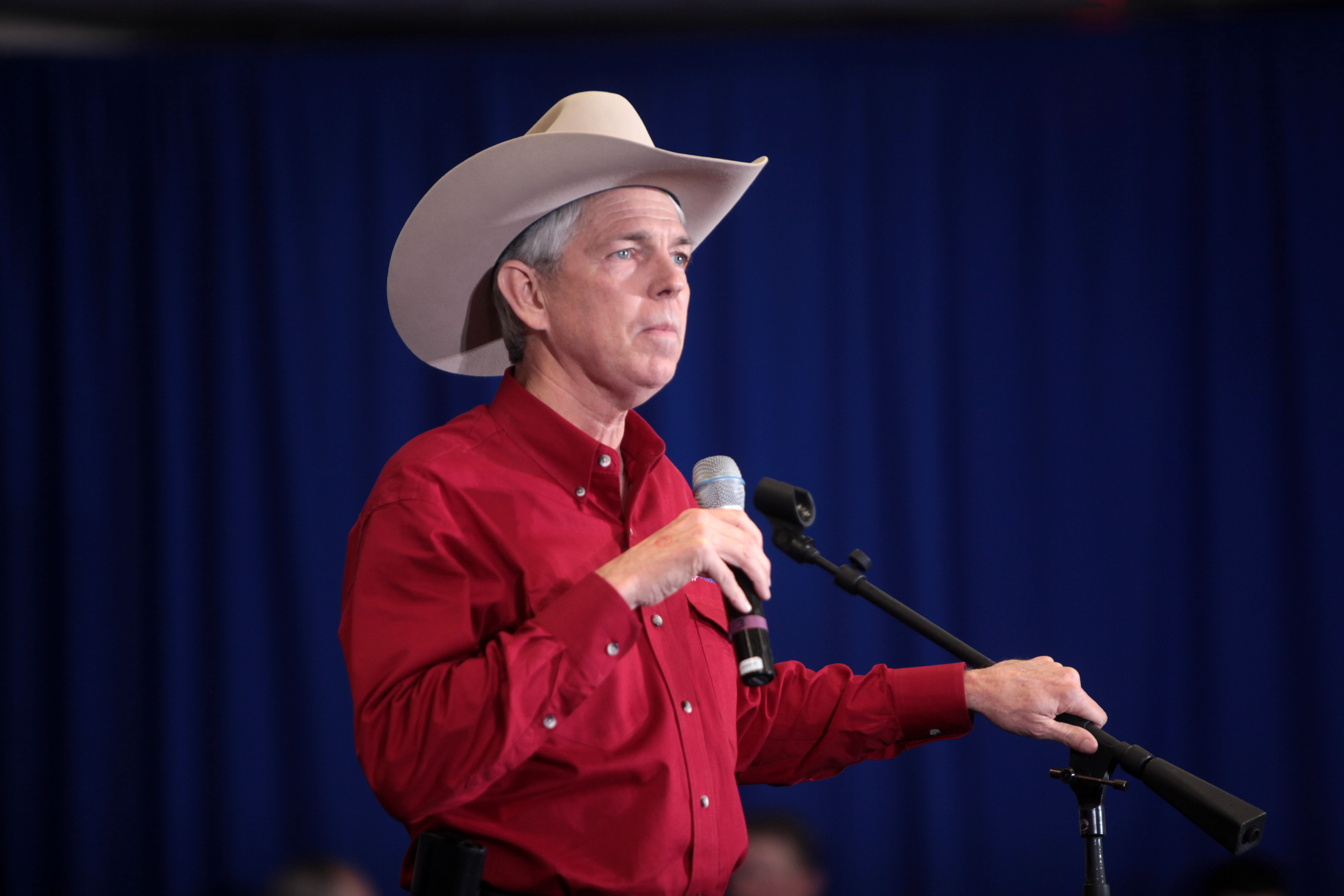
David Barton
Activist and author
33
APPEARANCES
15
PODCASTS
Nov 2, 2026


Mac HammondHOST
So as he comes to minister, would you please give him a warm welcome to Minneapolis? Thanks, bro.
28 MINS LATER


David BartonGUEST
So what happens is you have about, over the last 30 to 40 years for public schools, there's been basically six major publishers of textbooks, whether it's Scott Forsman, McGraw-Hill, whoever it is.
David BartonGUEST
And for them to make money, which free market, they need to make money to produce, and so that's fine.
David BartonGUEST
But for them to make money, they need to make sure they can sell their books in some of the biggest states.
26 MINS LATER


Alex McFarlandHOST
Do you have a feeling about this? Um, how confident or y- are you that the Republicans will keep one or both houses?
David BartonGUEST
Now let me, let me put a bigger perspective on that, is right now we have five states that are displaying the Ten Commandments in public school classrooms.
David BartonGUEST
We have 27 states who have introduced bills to put the Ten Commandments back in classrooms.
David BartonGUEST
In the state of Texas, they've already passed laws to put prayer and Bible back in schools.
David BartonGUEST
Uh, all these things we haven't been able to do in 60 years we're doing again because the court at the Supreme Court level has reversed all this nonsense.
10 MINS LATER

David BartonGUEST
is where you saw the article last night, the founding fathers were not Christians.
David BartonGUEST
You may have never heard of Abraham Baldwin, but he's the youngest theologian in America.

Andrew WommackHOST
I'll be back at the end of the program to encourage you once again to please get these materials and share them with other people.
David BartonGUEST
Last night talked about, I talked about the Declaration of Independence, and those 56 signers that most of us don't know called by name, it's kind of like the American version of Hebrews 11.
David BartonGUEST
Remember Hebrews 11 is all the great heroes of our faith? And there's good, bad, and ugly in there.
David BartonGUEST
I mean, there's some guys in there that are great warriors, but you wouldn't want, want them for your pastor, you know, Samson and people like that.


Susan LapinHOST
It was coming for a long time just from one side, the, "Leave God out of this, and don't talk to me about being a Christian country," and now it's coming from the other side saying, "No, it actually needs to be a Christian country, and only welcome to Christians."
David BartonGUEST
Yeah, that is a historical argument, and it's only an argument because Americans don't know their history.
David BartonGUEST
Um, there were over 300 court cases that declared America to be a Christian nation.
David BartonGUEST
Uh, the Founding Fathers repeatedly in their writings declared it a Christian nation.
David BartonGUEST
But you have to understand that, that being a Christian nation in their definition was not the historic Christian nations of Europe, um, where you had a king, you had a parliament, and we will kill anyone who is not of that flavor.
David BartonGUEST
Uh, for the Founding Fathers and as the courts explained in those more than 300 rulings, it is the value system.
38 MINS LATER


David BartonGUEST
I'm gonna answer your question by going in a different direction and eventually coming back to it.
David BartonGUEST
So what we face in America right now, I mean, it is the wildest thing to me that the people who most support Islam right now are progressives.
David BartonGUEST
And the problem with that is the very first group that Islam wipes out after it gets control is progressives.
David BartonGUEST
And with progressives having taken education now, did you know the only major academic course in America now in high schools, all 50 states that does not have an end of course test is history.
14 MINS LATER
Susan LapinHOST
I remember Madeline Murray O'Hare's son writing about his mother saying, I'm going to use their laws to destroy them, meaning the United States.
David BartonGUEST
Benjamin Rush is probably the most unknown founding father who deserves really to be known.
David BartonGUEST
As a matter of fact, John Adams right there said of all the founding fathers, he said the top three are George Washington, Ben Franklin, and Benjamin Rush.
David BartonGUEST
Now, we go, Benjamin Rush? Who's he? Well, Benjamin Rush is amazing for many, many reasons.
11 MINS LATER
David BartonGUEST
Now, what we celebrate is the Declaration of Independence, and it's interesting, in recent years, as we've become more secular, we've tried to separate the Declaration from the Constitution.
David BartonGUEST
Now, we are celebrating 250 years of the Declaration, but the founding fathers did not see those two items as being separable.
David BartonGUEST
It's like if you create a corporation day, you have the Articles of Incorporation, you have the bylaws.
David BartonGUEST
The Articles of Incorporation call you into existence, the bylaws tell you how to function under the Articles of Incorporation.

39:56
What was it, what was it, since you were kinda raised and, and trained or educated in, in s- i- in a secular way, what event, what it was caused you to go back and actually do all this core research to find out that the, the Revolutionary generation and the founders were actually deeply Christian?
David BartonGUEST
You know, the, the thing that got me, Steve, I, I came through college and, and high school and even elementary...
David BartonGUEST
I remember my sixth grade, [laughs] my sixth grade elementary school history teacher told me that George Washington had 26 illegitimate children, giving new meaning to the phrase, "Washington slept here." So I came through school not liking the founders much at all.
David BartonGUEST
Thought, "Boy, if that's Washington, I, I can do without that." A- and so this is what I had been taught, and what happened was, later in life, as I was an educator, I was a school principal, I taught math and science, um, I actually came across two very old documents.
David BartonGUEST
I came across George Washington's 1796 farewell address, and as I read that, this, this guy who supposedly had 26 illegitimate children spends all...
David BartonGUEST
In his farewell address, he gives a dozen phenomenal warnings to America how to keep us on track.


Steve BannonHOST
What was it, what was it, since you were kind of raised and, and trained or educated in, in s- i- in a secular way, what event, what it was caused you to go back and actually do all this core research to find out that the, the revolutionary generation and the founders were actually deeply Christian?
David BartonGUEST
You know, the, the thing that got me, Steve, I, I came through college and, and high school and even elementary...
David BartonGUEST
I remember my sixth grade, [laughs] my sixth grade elementary school history teacher told me that George Washington had 26 illegitimate children, giving new meaning to the phrase, "Washington slept here." So I came through school not liking the founders much at all.
David BartonGUEST
Thought, "Boy, if that's Washington, I, I can do without that." And so this is what I had been taught.
David BartonGUEST
And what happened was later in life as I was an educator, I was a school principal, I taught math and science, um, I actually came across two very old documents.
6 MINS LATER
speaker_15ADVERTISER
This is putting Ten Commandments in schools, correct?

Anthony StrelpothGUEST
Uh, that's the New South Wales, uh, context, and I'll hand over to David Barton for Victoria.
David BartonGUEST
As I was just introduced, my name is, uh, David Barton, and I'm the chief engineer for roads at the Department of Transport and Planning here in Victoria.
David BartonGUEST
When DTP commenced this process, we, we canvassed key stakeholders on the preferred approach and of, of how we would implement the ATS here in Victoria, and we adopted the following key principles.
David BartonGUEST
The first is which-- the first of which would be that we would retain our existing, uh, specification numbering system.
David BartonGUEST
And this was chosen to limit any downstream contractual impacts or cross-referencing issues that would otherwise have, uh, cropped up if we'd changed the system completely.
34 MINS LATER

Sulo ShanmuganathanGUEST
So, for example, in ATS fifty-three ten, um, which is the supply and placement of steel in the reinforcement of concrete, um, we now allow the use of grade six hundred, um-


Dan PatrickHOST
And I want you to talk about it because I don't think people understand what Obama and Biden did to erase God Christianity and all faiths because we cover a lot you know we had a lot of different witnesses that they just erased them all so let's talk about this so where did God play a factor in our military in the beginning
David BartonGUEST
when you go back to the very beginning the whole doctrine that we taught military was based on two theologians what they did in 300 AD and 1200 AD Augustine and St. Thomas Aquinas on just war theory.
David BartonGUEST
So all of Western civilization has been taught just war, which is a biblical approach to when is it okay to take lives in battle, when is it not okay, and that defined what a war crime was, was really those biblical standards.
David BartonGUEST
If you're fighting a preemptive defensive war, if you're fighting a life that saves someone about to be killed, that's okay.
David BartonGUEST
But if you're fighting a war of aggression to expand your territories up, that's not okay.
7 MINS LATER
Dan PatrickHOST
Um, So where did the Word of God and the Bible and the government, what role did they play in backing our soldiers? You know,


David BartonGUEST
And the University of Illinois and the University of Chicago Law School said, hey, what is the average length of a nation in the history of the world? And they did the research, and for all those 6,000 years, the average length of a constitution or a governing document is 17 to 19 years.
David BartonGUEST
So we're celebrating 250, and we've got 40 percent of them—excuse me, only 40 percent of Americans that are celebrating the 250th.
8 MINS LATER
Dan PatrickHOST
So how have we gotten to this extreme And do you see it coming back? Do you see it coming back with a new, younger generation?

20:35

And then as you were researching it, what did the British think of these men who signed the documents?
David BartonGUEST
And the answer to that today is different from what if you'd asked me two months ago.
David BartonGUEST
And the reason is that one of the things President Trump is doing right now is he's bringing back monuments to help us remember.
David BartonGUEST
You know, in the Bible, when Joshua went to the promised land, God said, hey, you guys build a really big monument so that when your kids see that and say, what's that all about? You can tell them the story.
David BartonGUEST
And so there are 400 statues now going up in Washington, D.C. that haven't been there before.
29 MINS LATER
49:55
So if they can think, then they can look at the different the different principles and think for themselves about whether they make sense or not.


David BartonGUEST
He signed the Declaration, ratified the Constitution, served in three presidential administrations, was director of the US Mint.
13 MINS LATER


Dustin OlsonHOST
But it seems to me, I would like to get your thoughts on what were the moments leading up to the Declaration? And Jefferson was the author, but he isn't just the only person who brought these ideas into the document, right?
David BartonGUEST
Yeah, and responding to a comment you just made too, Alice Mary Baldwin, And she came out with a book in 1928 called The New England Clergy and the American Pulpit.
David BartonGUEST
And she pointed out that of the 27 grievances that appear in the Declaration of Independence, and just to put in context, the Declaration starts with 161 words that support six principles of government.
David BartonGUEST
It then gives 27 grievances showing how those principles have been violated by Great Britain.
David BartonGUEST
We pledge our So when you go to the 27 grievances showing how the Great Britain had violated those six fundamental principles of government, she documents that every one of those grievances had been preached from the American pulpit prior to 1763. has been hearing for 20 years.
David BartonGUEST
It's interesting, on the 4th of July, when we voted and officially approved the wording of the declaration, at that point, they assigned a committee of three to come up with a new seal for the United States.
15 MINS LATER
Dustin OlsonHOST
But correct me if I'm wrong, but the great awakening in many ways kind of started to create a cohesive culture within the United States or the colonies at the time.

8:25
W- what is the appropriate way to think back on these men who sacrificed so much to establish our country?
David BartonGUEST
We all hope that we're all not judged by subsequent generations by mistakes that we made in our life or by things that we believed at one time in our life that we didn't believe later.
David BartonGUEST
We all hope that our descendants, our, our family descendants, our, our great-great-great grandkids don't look at us and, and hold us up by something that they no longer believe then in the future that we believed here today, whatever that may be.
David BartonGUEST
You cannot find a nation that did not have slavery and actively participate in slavery at the time of the Founding Fathers.
12:58
How much of, of a role did Christianity play and, and those men's faith play in the founding documents?
David BartonGUEST
Uh, she is the youngest member of the administration as far as that goes, and she is so...
David BartonGUEST
And so there is, there is something coming that's clearly not your typical public school graduate, you know? And I'm seeing that with Hegseth and what Hegseth doing with the Department of War, and the boldness he has, the, the stuff that he's doing, faith stuff, but also just the woke stuff.
David BartonGUEST
And, and Marco Rubio, I mean, I've seen Marco, I've known Marco a long time, and he has flowered into, man, maybe the next president.
11 MINS LATER
David BartonGUEST
Yeah, it, it is tough overseas, and this, this is a reflection of the growing secularism that's taking countries across the world.
David BartonGUEST
A- and I, I think at some point America's gonna ha- have to get back to being very interval, individualistic rather than groups.
David BartonGUEST
A- and let me throw out, th- this is probably the biggest thing that, that I am concerned about, and concern's not the right word, that, that I would like to see addressed.
David BartonGUEST
And that is that for the first three centuries of America, from the time of the Pilgrims, which we covered them a- and what they did, the time of the Pilgrims coming up until about 1900, our whole emphasis in education was teaching students how to think.
David BartonGUEST
You will find that prior to the 1910, '20 kind of frame, you cannot find a multiple choice test, you can't find a fill in the blank, you can't find a true false.
David BartonGUEST
And this is where so many pe- That's where the Underground Railroad gets started.
David BartonGUEST
You gotta get them out of the US, out of the jurisdiction of the federal government.
David BartonGUEST
Lincoln, um, good, glad you raised that, 'cause Lincoln's a product of the Second Great Awakening.
David BartonGUEST
So the Second Great Awakening kinda starts in about 1790 and goes up maybe 1830 or '40, depending on how you break it.
David BartonGUEST
And so Lincoln born in 1809, born into a family, a Christian family, went to church, did all the religious stuff, except his dad is an abuser that gets drunk when they come back from church and beats up the family and the wife and the kids.
David BartonGUEST
So Lincoln, going to church and seeing this and coming home to Dad, decides, "I don't wanna be a Christian." So he becomes an atheist young, young on.

Tim BartonGUEST
And America has become a very secular nation as a result of absolute untruths, because we didn't get this in school, we weren't taught this, and we didn't seek it out for ourselves.
David BartonGUEST
Well, and one of the things the Founding Fathers did to try to make sure we wouldn't become secular is part of what's on the table here in front of us, which I, I do wanna go through some of these because this, this right here is a great example.
David BartonGUEST
When people talk about Jefferson or Franklin and they say, "Well, those guys weren't really religious," and, and I wanna contrast it and say, "Okay, so tell me about John Witherspoon." "Uh, I, I don't know who that is." Oh, okay, well, interesting you don't, because John Witherspoon was actually a pastor at the time he signed the Declaration.
David BartonGUEST
He was part of the Scottish Enlightenment, the Scottish Great Awakening happening before the American Revolution.
David BartonGUEST
He'd been recruited by some alumni from Princeton, which was a Presbyterian school, and, and, and back then, every university had to have a pastor to be the president of the university, and they needed a new pastor, and some of the alumni had heard about this incredible minister over in Scotland, John Witherspoon.
16 MINS LATER

David BartonGUEST
Just by way of background, December the 7th, 1941, Japanese attacked Pearl Harbor.
David BartonGUEST
They also, at the same time, attacked the Philippines and they attacked the island of Midway.
David BartonGUEST
As it turned out on Midway, there was a Marine, Lieutenant George Cannon, who organized the defenses, was able to keep the Japanese from taking Midway on that day.
7 MINS LATER
Franklin RooseveltSOUNDBITE_SPEAKER
steadfastness in their faith they will need thy blessings their road will be long and hard
Scroll for more appearances