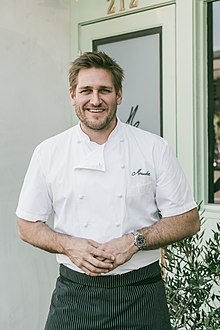
Curtis Stone
Australian chef and author
22
APPEARANCES
13
PODCASTS
Nov 17, 2026


Curtis StoneGUEST
You know, look, what I'm embarking on is a really small venture, but, you know, one that's extremely hard to make money out of.
Curtis StoneGUEST
I miss that camaraderie between... a group of young people who, you know, work really hard and produce something beautiful at the end of it.
Curtis StoneGUEST
So I'm going to open a 25 to a 30 seater restaurant, which, like I said, it doesn't make much financial sense, but I miss those kind of restaurants too.

Doug BopstHOST
Do you ever have conversations with him about like betting on himself and fear? Does he ever talk to you about that stuff?
Curtis StoneGUEST
Even back further, they were playing the Pumpkin Patch in Hollywood for Halloween.
17 MINS LATER
Doug BopstHOST
Is there a story that sticks out of somebody who's come to you from the program and has ended up in your restaurants?

Lindsay LuttrellHOST
Were those your early were they your earliest influences? Like who taught you to cook?
Curtis StoneGUEST
Look, I spent a lot of time with my grannies because mum was at work a lot, and they were both good cooks.
Curtis StoneGUEST
One came from the country, and she was like a country baker, total Aussie, and lived on a farm, market gardener, so they grew their own veggies.
Curtis StoneGUEST
My mum got electricity for the first time in her farmhouse when she was 14 years old.
15 MINS LATER
Lindsay LuttrellHOST
What was it like opening a restaurant here after never having done the restaurant world here? Like you never even worked in a restaurant here, right? Yeah.

Diego FooterHOST
Where the first year you kind of got to back off a little bit and say, I can kind of see a trend here.
Diego FooterHOST
How do you start to make up that shortfall, meaning you could take on more land so you can just grow more, but say you didn't take on more land, how would you then approach... tweaking your rotations to get more lettuce? Do you start to look at some of the crops that are smaller contributors to total sales and just say, well, I'm just going to have less beds of carrots or radishes or something like that?
Diego FooterHOST
Given that, what are all the different crops that Curtis grew on his urban farm this year in 2015?
Curtis StoneGUEST
I don't grow a ton of basil, but it's there because I can, I can grow it without it occupying space on my farm, because it's kind of interplanted with tomatoes.
33 MINS LATER
Diego FooterHOST
Is it just several seasons of doing that until you really start to see trends appear and then look back through your numbers and, and say, "Okay, where was I short? I can start to dial this up."

speaker_1MODERATOR
Classic Aussie Christmas day, right? What are you doing
Curtis StoneGUEST
with them? I'm just cooking them in my brand new cast iron skillet, which is an item that you can pick up for free at Coles right now.
Curtis StoneGUEST
card and with 20 credits with 20 bucks spend you get a credit and then you can redeem all of these products including my new air fryer air fryer so with the prawns I'll put some fennel seed a little garlic goes in I mean a lot of garlic parsley so very very simple and easy to do and great inside or out so which is great about that cast iron skillet you can use it out on the barbie as well as inside on induction I notice you put
speaker_0HOST
Also a bit later, and then
Curtis StoneGUEST
A couple of knobs of butter, and then that'll give you the colour, it'll give you the flavour, which is exactly what you want.
Diego FooterHOST
For a lot of people, it's one thing to go to a farmer's market and take cash from a customer that walks up and hands it to you, but it's a whole other layer of complexity to start dealing with bigger checks from corporate entities who are restaurants, and now they're on terms and the checks are lagging when the produce is delivered if you're on terms.
Curtis StoneGUEST
And in our main season, from July till September, I am spending probably two hours, I'm kind of just guessing, but I feel like it's around two hours a week in communication with restaurants.
Curtis StoneGUEST
So that's making my fresh sheet, that's text messages back and forth, phone calls, emails back and forth, coordinating orders, Do you have this? Yes, I have all of that except this.
10 MINS LATER
9 MINS LATER
Diego FooterHOST
I think you need to have some money but not too much because if you can start to slowly build something from the ground up, then I think that will be much more resilient in the end than if you just throw a whole bunch of money at everything, buy it, you don't understand how any of it works, how any of the parts fit together, and then you're just left with a big expensive mess.
Curtis StoneGUEST
But the other thing I wanted to say, going on what you were saying there too, is the advantage with paying for consulting.
8 MINS LATER
Diego FooterHOST
So if you can do that while you start something up that you're learning on the side, I think that also has a whole bunch of added benefits in that it's starting to build up some economic resilience in your life you're not going at this with a gun to your head mentality of I have to make this work and it allows you to really go in with your whole concept of work to learn not to earn and the other thing is it forces you if you're doing one job and funding another one on the side you're probably going to be pretty diligent with how you spend that money and one thing I've heard over and over again is don't start a farm with a whole pile of money I think you need to have some money but not too much because if you can start to slowly build something from the ground up, then I think that will be much more resilient in the end than if you just throw a whole bunch of money at everything, buy it, you don't understand how any of it works, how any of the parts fit together, and then you're just left with a big expensive mess.

Curtis StoneGUEST
And then, uh, shelter, and so with shelter it's, I would include heat into that.
Curtis StoneGUEST
So you need to have a place to live that's sheltered and comfortable, but you need to have multiple ways to heat.
Curtis StoneGUEST
So on my homestead, when in, like, say, uh, when I've got lots of electricity, sunny part of the winter from January till February, I can actually run a heat pump.
1 HR 6 MINS LATER
Diego FooterHOST
Comparing those two, like what's been the time savings there and how beneficial has that been?
Curtis StoneGUEST
There's a couple different ways we do radishes and a couple different ways I've done it in the past.
Curtis StoneGUEST
What I have done that's really saved a lot of time now as far as radishes go is that I just no longer sell bunches.
Curtis StoneGUEST
I used to sell them by the bunch, and so we would just pull them all out and then bunch them on a table, which was a total waste because it's kind of like you hear this in office consultants will say, you know, you never want to handle the same piece of paper twice.
Curtis StoneGUEST
If you're harvesting something and you're handling it in the field and then you're packing it and then you're going to handle it again to bunch it, then you're going to handle it again to wash it, that's a lot of excess movement that doesn't necessarily need to happen.
Diego FooterHOST
So is that the approach there? You're looking at kind of the overall picture going from field to sold, where it's being sold, and just say, okay, how can I optimize this flow as best as possible at all, at every touch along the way, I guess you could say?
Diego FooterHOST
Can you talk about the importance of having a walk-in, and do you think you could have ever gotten by without one?
Curtis StoneGUEST
If you're farming commercially, like this is your job, this is how you make your living, you have to have a walk-in cooler.
17 MINS LATER
Diego FooterHOST
What do you think is the bare minimum that you need to get by and how should you even approach buying a tiller?

Curtis StoneGUEST
And you start with a theme or a script, but then you interpret it however you want as an actor.
Curtis StoneGUEST
You start with a bunch of sounds and you put them together and layer them over the top of each other and have a narrative and you develop it.
Curtis StoneGUEST
And then I think about food and I think it's quite a similar construct in many ways.
13 MINS LATER
30:47
And I imagine that's probably very much the same in the restaurant industry.

Curtis StoneGUEST
Yeah, look, it was one of those restaurants we did a different menu every month and it always revolved around a special ingredient.
Curtis StoneGUEST
You know, I'd never experienced a restaurant like that before, but it meant that we had to develop a 10-course menu every 30 days.
Curtis StoneGUEST
It was a joy to do, but I always knew that I couldn't do it forever because it just took so much of me and the team.
16 MINS LATER


Curtis StoneGUEST
I ran into the CEO and he said, we just booked your son's band to play bottle rock.
Diego FooterHOST
You leave it on until the grass completely dies off, and then what are the next steps? Is it always just pull, tarp, till, and start laying out your beds, or are you ever doing any sort of, I don't want to say sod removal because the grass is dead at that point, but do you ever strip off the top layer, or is it always tarp and then till?
Curtis StoneGUEST
Yeah, there's a variety of different ways you can do it just depending on your own circumstances.
Curtis StoneGUEST
So in this case, if I killed, just like the one we're talking about, if I killed the grass all summer and it was dead, then I can just go in and rototill it.
Curtis StoneGUEST
Depending on, like if I have to fork out roots and rocks and things like that, then I do that till it one more time and then form the beds But I suspect since this one's been covered all summer that we can go in and grind it up and then form out the beds right away.
25 MINS LATER

SmallzyHOST
... setting, uh, big challenges for the contestants, yes? Quickly tell me about that because then when I've got like a world-renowned chef on the show, I got a lot of questions that I just gotta hit you with.
Curtis StoneGUEST
I've, I've been lucky enough to be involved with the show for 18 years, and it's such a great show, super positive, and, and this is a really fun one this weekend.
Curtis StoneGUEST
We've, uh, Sunday and Monday we're setting a challenge that the contestants have to come up with a pie and an, and an ice cream, so we're very excited to see what they can come up with and someone's gonna re- win a, uh, a life-changing prize.
SmallzyHOST
Mm
Curtis StoneGUEST
... and as soon as they put it in the pan, they wanna touch it and poke it and prod it.

Curtis StoneGUEST
Yeah, look, it's one of those things that as a kid, you work in these incredible restaurants and you sort of, you look up to the chefs that you work for and they're the ones that win the stars.
Curtis StoneGUEST
And I think there's a part of it that's, there's this mystique to it because you never know when the inspectors come in.
Mark LevyHOST
What was he like and what did he do for you in terms of you becoming a chef and improving the way you cook beautiful food?
Curtis StoneGUEST
Yeah, look, it's one of those – As a kid, you work in these incredible restaurants and you look up to the chefs that you work for and they're the ones that win the stars.
Curtis StoneGUEST
And I think there's a part of it that there's this mystique to it because you never know when the inspectors come in.

Curtis StoneGUEST
No, I, well, I do in that, you know, it's funny 'cause I, I mean, at this point, my, my law, quote-unquote, "law practice," it's, a- again, I'm just a conspiracy theorist who started reading the law.
Curtis StoneGUEST
But that, but, and that's what I tell people i- if, if I ever do rub shoulders with people who don't really understand how I learned this stuff and they ask what are your credentials, that's what I tell them.
Curtis StoneGUEST
I'm just a guy who was paranoid about the New World Order, and then I just started reading statutory law, and it, and I, I found an ab- absolute obsession with it because I, like you just highlighted with the definitions.
Curtis StoneGUEST
I remember the first definition that I read that just blew my mind was the word includes.In legalese, the word includes comes from a Latin maxim inclusio, which means that and only that.
Curtis StoneGUEST
So, and that's why when you read like, say, a contract, you'll see it'll say, including but not limited to.
25 MINS LATER
Charlie RobinsonHOST
You, you could launch a business, right? You're getting, you-- What, what's this, I mean, with, with your group at Freedom Farmers, kinda like a makeshift network, right? Like, kinda like a, your own little community there?

Curtis StoneGUEST
Well, I went to a fundraiser and I listened to the story and this guy got up and he spoke and he spoke about being in jail and he spoke about coming out of jail and that experience and not knowing how to, he changed his life in jail.
Curtis StoneGUEST
So he ended up, you know, back in the same sort of situation because he has no choice.
17 MINS LATER

Karl StefanovicHOST
Yeah, tell me about how heavy that was because that's a full mind shift for you and dealing with something that you probably hadn't before then.

Gabriel OrnelasHOST
So what part of yourself are you still learning to bring to your leadership that doesn't always come naturally?
Curtis StoneGUEST
Oh, God, you're a leader in lots of different ways, right? When you run a business, because you have to mentor people, you have to help them through their struggles and challenges.
Curtis StoneGUEST
And we work with a company called Chrysalis who give people a second chance in life.
Curtis StoneGUEST
You know, a lot of times they've come out of jail and they're looking for a job, they want to turn their life around.
Curtis StoneGUEST
So I've hired a bunch of those Chrysalis clients, dishwashers, So you can imagine the kind of baggage that comes with some of those guys because they have constant problems.
Curtis StoneGUEST
They don't earn enough money to be able to pay the child support that they need to pay and still pay their rent and they might make mistakes with their car and get it impounded or fined or whatever, right? So from the very rudimentary level of you've got to be a shoulder to cry on sometimes and you've got to be there to help them through.
34 MINS LATER