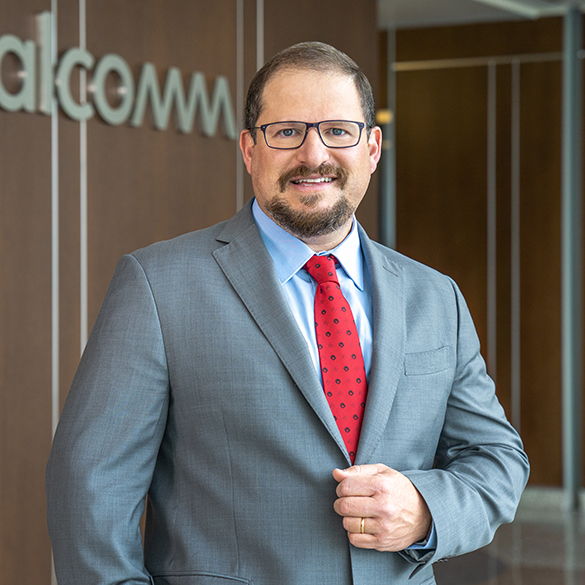
Cristiano Amon
CEO and President of Qualcomm
26
APPEARANCES
15
PODCASTS
Oct 25, 2026

speaker_0ADVERTISER
Hiring now? Then this is a job for Indeed Sponsored Jobs.

Cristiano AmonGUEST
For example, what I like about what Meta is doing, they saw early on that you're going to have devices that you can wear like glasses because of the simple concept of which started as a conversation about the metaverse, which is, can I merge the physical and the digital world? Can I superimpose, you know, is that gonna be important for the future social, for example, in the future how people communicate with each other and call and messages like you think about WhatsApp.
Cristiano AmonGUEST
an example but then also about this agent that where you see uh the devicee and there's no legacy there's nothing to worry about you can start with the new and i think that's what we see the excitement and the focus of meta uh how they started with glasses and the ray-ban meta is an overwhelming success uh you know i think exceed everybody expectations and i think show what's possible but For companies to continue to be in the lead, you have to keep going.
8 MINS LATER
speaker_0ADVERTISER
Hiring now? Then this is a job for Indeed Sponsored Jobs.

Cristiano AmonGUEST
At the end of the cycle, right? You do get, um, a portion that's, you know, the market gets to a state of maturity, become more of a placement rate market.
Cristiano AmonGUEST
Even if you don't want any new feature, you use your phone a lot, after two, three, four, five years, you're gonna buy a new one.
Cristiano AmonGUEST
However, within that base, there are a couple things that happened, which has been, um, very telling.
Cristiano AmonGUEST
The premium and the high tier as a percentage of the total market continue to expand, and it's been like clockwork year over year.
25 MINS LATER

Alex HeathHOST
And I'm curious how much of that strategy that he had at Modular is now the Qualcomm chip and data center strategy.

Cristiano AmonGUEST
Yeah, look, what we did in the automotive sector, I think, to be honest, we're very proud of it and positively surprised about how fast what we did became very successful.
Cristiano AmonGUEST
I think we're now kind of marching towards probably being the largest supplier of semiconductor to the car industry.
Cristiano AmonGUEST
And what we did was understanding about where the auto industry was going and develop really a platform.
Cristiano AmonGUEST
What makes us really unique in this field is we understood that we had capabilities in all domains that were relevant to the car.
Cristiano AmonGUEST
And we could bring the combination of the best of consumer electronics and our experience in consumer electronics and mobility, as well as deliver a platform that is really industrial grade with the reliability that is required in the automotive industry.
6 MINS LATER
Ejaaz AhamadeenHOST
How do you think about this? How does Qualcomm's kind of strategic design build around this huge constraint, which is like driving prices up pretty massively.


Cristiano AmonGUEST
The data center is going to have to evolve, and it's already on its way to do that into a heterogeneous compute.
Cristiano AmonGUEST
CPUs are going to be very important for orchestrator and agents, and CPU demand will continue to rise, and that's also true on the other side of data center, phones.
Cristiano AmonGUEST
But you're gonna have different engines for different things, right? For example, for inference, we see there's engine now for prefill, engine for decode-


Jon ForttCORRESPONDENT
How do you fit that into the conversations now about AI safety and efficiency?
Cristiano AmonGUEST
Look, the main announcement that we have on this Snapdragon Summit right now is actually we have now clarity what an AI smartphone look like.
Cristiano AmonGUEST
there has been a number of technologies in ai that made it possible and we started to see this become a reality you have a lot of phones now that are basically ai smartphone they have agents and those agents start to operate the phone for you the way for you to think about this john is the phone has been designed for you to operate you go to the apps you do things yourself but then there's also agents they're going to go to your apps for you it's going to go to the cloud and it's going to do things for you on your behalf it's very interesting engineering challenge we now have to design chips to allow the phone to be working even when you're not operating it and with an all-day battery life and a lot of ai at the edge but for those things to be possible There are two things going to be very, very important.
Cristiano AmonGUEST
You have to trust the agent and the AI is going to be working on your behalf.
Jon ForttCORRESPONDENT
What do you think happens now? Does this kind of new wave in foldables provide some upward pressure? And how are you preparing?

Cristiano AmonGUEST
The middle and the low part of the market, it's, uh, significantly contracted.


Sam JacobsHOST
Looking back on that period, is there anything that you would have done differently?
Cristiano AmonGUEST
Like what? At that time, we were starting the process of transforming the company.
Cristiano AmonGUEST
We just had some challenges that we had to overcome on a legal battle, overcoming a hostile acquisition attempt.
Cristiano AmonGUEST
And one of the things I did at that time was I said we needed to accelerate the technology transition to be able to change the direction of the company.

Cristiano AmonGUEST
So when I say I have now $5 billion of revenue, uh, projected for fiscal '27, uh, with those customers, for that $5 billion, I have secure the capacity from the manufacturer as well as memory.
Cristiano AmonGUEST
So we're excited about that, and I think, you know, uh, we're very confident in the forecast we're providing.
Cristiano AmonGUEST
Given our scale, I think if you look, uh, to our, to our history just the past few years, we have been doing long-term agreements, uh, both with customers as well on the supply side.

Cristiano AmonGUEST
But if I step back, you know, we have been diversifying the company, going to new industries.
Cristiano AmonGUEST
And in, in those new industries, we're actually been building a combination of silicon software.
Cristiano AmonGUEST
For, for, I'll remind you that we, you know, as we talk about we're going to industrial, we bought companies like Edge and Pulse, we bought Arduino, which is one of the largest, I think, hardware, uh, developer community with 32 million developers.
Cristiano AmonGUEST
And then as you would imagine, as we go to data center, we have to build a full stack solution.
Kristina PartsinevelosCORRESPONDENT
Is that gonna be the strategy for Qualcomm going forward? You gotta buy the whole stack.


Arjun KharpalHOST
Um, when it comes to agentic experience on consumer devices, what does that look like in your view?
Cristiano AmonGUEST
This is actually one of the questions I love answering because, you know, even though we have been changing the Qualcomm and we're becoming a much more diversified company, we're still, uh, you know, one of the biggest providers of mobile technology.
Cristiano AmonGUEST
And it's fascinating now to see what's happened with those agents and what's happened with the mobile phone.
Cristiano AmonGUEST
When those-- When we talk about agents, and I'm kinda convinced 2026 gonna be the year of agents.
Cristiano AmonGUEST
And, and those things became really popular and went viral, I think, on the internet when, uh, OpenClau was launched.
9 MINS LATER
Arjun KharpalHOST
Um, do you believe this is still gonna be, you know, central to the world of agentic AI, and how do you expect our relationship with our smartphone to change?


Cristiano AmonGUEST
pins, pendants, things that you wear, and it can connect you to an agent and now have this conversation.
Cristiano AmonGUEST
If the AI understands what we write, can read everything we read, see everything we see, the type of use cases are going to be a lot more personal, needs to have a lot more context and needs to happen a little different because if it not you just pull up your phone and you do it today so how do i describe that i think for you like for example you'll be walking around and you have a glass and you're going to see i really like this i like to buy this how much is it on amazon and it's going to say oh it's just how this is this is how much it is amazon and they're going to say can you Can you render how I'm going to look with this? And it's going to get rendered.
22 MINS LATER

Caroline HydeHOST
What sort of tam, what sort of expansion of Q- Qualcomm's business will this mean for you?
Cristiano AmonGUEST
you?Yeah, look, uh, y- you know, this is a great question, and I wanna maybe start the answer by saying, uh, you know, why would not anybody, uh, you know, bet on Qualcomm diversification efforts? We started as a mobile company.
Cristiano AmonGUEST
We're going to broadband and networking, and I think, um, the data center was a natural thing.

Ed LudlowHOST
So you are not doing your own chip, you're not doing merchant silicon, your own designs for market, you're doing an ASIC with someone.
Cristiano AmonGUEST
So we have said that our data center product, and I need to make sure I don't front run my investor day.
Ed LudlowHOST
But actually, Qualcomm's story has really changed in that time, right? So in this world where we're moving to inference and we're moving to a GenTik, how are you positioning Qualcomm, right? The CPU is important, but you must think differently to how you did three years ago.
Cristiano AmonGUEST
That's why I think there's a lot of unnecessary, I think, speculation right now.
Cristiano AmonGUEST
OEMs, the first thing they're going to do, they're going to prioritize premium and high tier because those are more resilient, I think, to price increases.
Cristiano AmonGUEST
That's why I think there's a lot of unnecessary, I think, speculation right now.
Cristiano AmonGUEST
OEMs, the first thing they're going to do, they're going to prioritize premium and high tier because those are more resilient, I think, to price increases.
Ed LudlowHOST
But how do you see that translating from your order backlog to revenue growth and hitting milestones like a billion dollar quarter?

Cristiano AmonGUEST
But, uh, but, but here's, uh... y- you- we need to be thinking ab- about this a little bit different, right? Um, wearable is one of, one of the things.
Cristiano AmonGUEST
Uh, this whole category of personal AI devices, it's- humans already decided what they're gonna wear a long time ago, right? So, uh, uh, I don't think we, you and I, are gonna be wearing, like, a big helmet.

Alex KantrowitzHOST
So Cristiano, when you think about, "All right, I'm gonna put chips in glasses and maybe some other different formats, uh, and people will use them and have X experience," what is that experience?
Cristiano AmonGUEST
This is a new chapter, I think, of the Qualcomm expansion and diversification.
Cristiano AmonGUEST
We like robotics a lot because by definition it's an edge AI problem to solve.
Ed LudlowHOST
How soon is that reality? Already we have robots in manufacturing and industrials, but how soon is it fully autonomous robots? How soon do we start to have the humanoid versions in our houses? Look,
Caroline HydeHOST
How soon is that reality? Already we have robots in manufacturing and industrials, but how soon is it fully autonomous robots? How soon do we start to have the humanoid versions in our houses?
Cristiano AmonGUEST
Look, the way we think about this is things that you didn't thought were possible to do with a robot, you can do it right now using AI.
Cristiano AmonGUEST
I think industrial robot is the big, largest opportunity that we see in front of us, and it's probably starting as early as 2026.
Cristiano AmonGUEST
When you use AI to train a robot on one given task, it's a very well-defined problem, and you can do this and you put it into production.
Cristiano AmonGUEST
Consumer robot, the one that is gonna be in your house and do everything for you, it's gonna take a little bit of time, but it's going to happen and it's gonna be a big opportunity.
Cristiano AmonGUEST
When we start talking about autonomous cars, A lot of companies went in and said, we're just going to get this full-autonomous robotaxi.
Cristiano AmonGUEST
Look, right now, what you probably see in terms of the speed, it's automotive.
Cristiano AmonGUEST
And most of our growth, again, like the conversation with handsets, has nothing to do about the market size.
Cristiano AmonGUEST
And we build a digital platform for the car industry, which is the Snapdragon digital chassis.
Ed LudlowHOST
How is it different from an NVIDIA or AMD GPU, a Broadcom Marvel XPU, or this large body of startups that are basically chasing rack-scale solutions for AI?
8 MINS LATER
Jon ForttHOST
Do you think it holds firm? Do you think positions get loosened up? Do you think you have opportunities to gain share?
Cristiano AmonGUEST
First, the architecture is scalable, starting from basic level ADAS all the way to multiple cameras and multiple sensors for you to do navigation on autopilot in urban environment and highway environments.
Cristiano AmonGUEST
That means it can scale to... entry-level ADAS systems and entry-level cars, all the way to the full capabilities.
Cristiano AmonGUEST
The other thing is, has been certified now in 60 countries, and it's launching, and a lot of people will be able to see the performance.
Cristiano AmonGUEST
And one thing that is great about this, we've done this with BMW, but it's available for the entire industry.
Caroline HydeHOST
How much is this going to drive growth for you, for the business in the longer term?
Ed LudlowHOST
So I thought that a good starting point would be to ask when smartphone and handset is no longer the majority of revenue and when that kind of tipping point or how close toward that tipping point is where your diversification efforts have shifted the business model.
Ed LudlowHOST
May I ask what you think investors need to understand and remodel for? Or even what is it that investors are misunderstanding about that process, Cristiano?


Andy SerwerHOST
And who are some of your customers, Cristiano, both on the licensing side and on the direct chip manufacturing side?
Cristiano AmonGUEST
I love it, because part of the transformation of Qualcomm, our customers are changing.
Cristiano AmonGUEST
Every year, we get a whole new suite of customers that will go to different industries.
Cristiano AmonGUEST
All of the smartphone OEMs, we license all the standard essential patents for phones.
9 MINS LATER


Brian SozziHOST
As someone that started as an engineer, to be there in that moment, what was that
Cristiano AmonGUEST
like? The whole thing for me, look, I'm incredibly proud and I feel privileged to have the trust of our board, our investors, and most importantly, all the Qualcomm employees to lead this company.
Cristiano AmonGUEST
Never expected that we will be relevant and an important partner to so many industries, so many countries.
Cristiano AmonGUEST
At the same time, it comes with a huge IT'S REALLY HUMBLING AND THAT WAS A GREAT MOMENT FOR ME.
Cristiano AmonGUEST
WHAT DID QUALCOMM SECURE FROM THAT TRIP? Look, as you know, we just released a little bit of some, I'll say, data points.
Brian SozziHOST
So the data center push, there's an AMD in there, there's an Intel, and if I'm right, didn't Qualcomm try data centers in the past? How do you make this successful this time?
Scroll for more appearances