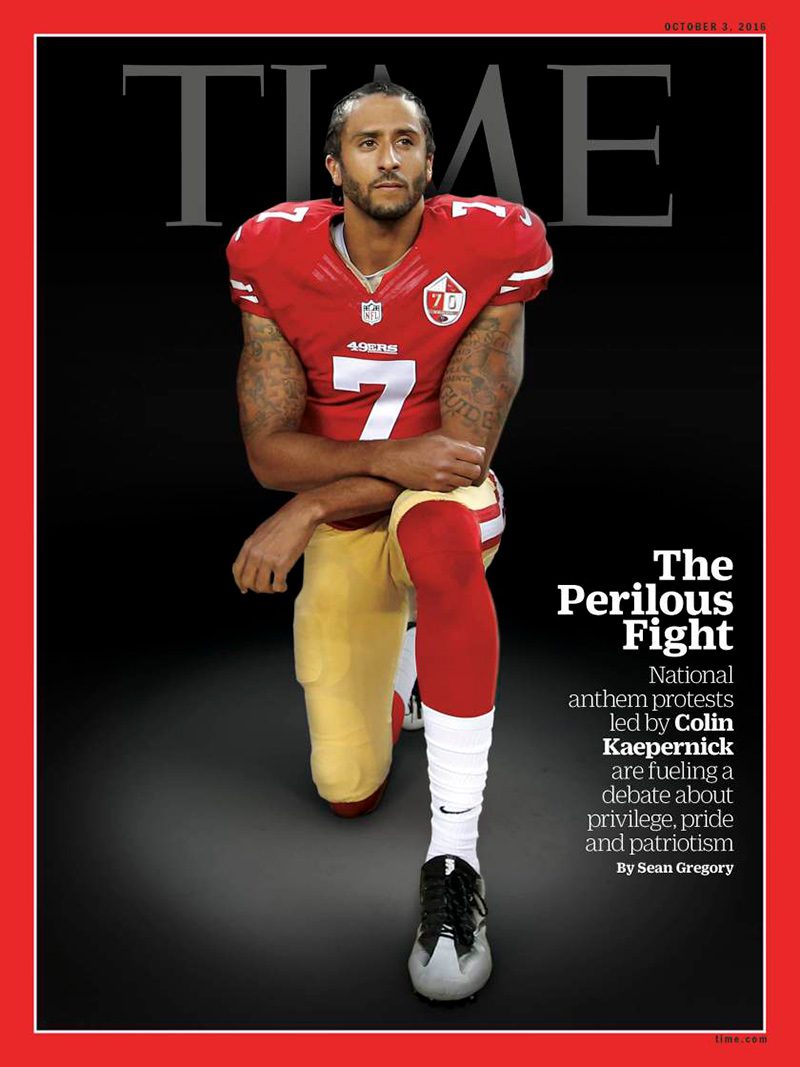
Colin Kaepernick
American civil rights activist
37
APPEARANCES
34
PODCASTS
Oct 7, 2026


Colin KaepernickGUEST
This is, this is probably the area that, how I view things may be a little bit different, is like I understood my parents love me, but whether or not they love my Blackness and how that showed up felt like another conversation.
Colin KaepernickGUEST
And having that understanding also became a space of like, well, that is part of who I am.
18 MINS LATER
Colin KaepernickGUEST
And that's not saying, like, it shows up holistically that way everywhere.


Colin KaepernickGUEST
... like, we didn't expect this." But it was actually years and a lifetime in the making.
Colin KaepernickGUEST
And I say that through, through my lived experiences, um, growing up Black in a predominantly white community, growing up Black in an adoptive family.
Colin KaepernickGUEST
And the experiences navigating police, the experiences navigating racism, um, having to educate myself and, and learn and do research, and auditing graduate classes at Berkeley, like, all of those experiences ultimately led up to that moment of protesting in 2016, in addition to seeing the, the political climate of what was happening.
Colin KaepernickGUEST
You know, this is on the back of, of Mike Brown being killed and Eric Garner and Tamir Rice, and then more recently into 2016 was Mario Woods, Freddie Gray, Alton Sterling, Philando Castile, and that, that's the backdrop that leads into the protest.
Colin KaepernickGUEST
Similarly to the football side, like when I first start in the NFL, that's 15 plus years in the making.
40 MINS LATER

Deontay KyleHOST
How did you rec- reconcile with that? Like, did you feel guilt behind it or did you feel, like, supported?
Colin KaepernickGUEST
The, the first thing that I think about in relation to that is Curt Flood.
Colin KaepernickGUEST
And Curt Flood had a, a quote when he was fighting for free agency, and he was fighting for free agency because at that point in time, if you were a player and a team drafted you, that team owned your rights for your lifetime.
Colin KaepernickGUEST
And he fought against that, and one of the quotes that he had was something to the effect of, "A well-paid slave is a slave nonetheless." And [audience clapping] And I think about this in relation to the, the parallels.
Colin KaepernickGUEST
Um, the NFL Combine in many ways becomes a space where they are testing your obedience.
Colin KaepernickGUEST
Um, what you see or what is broadcast publicly are the moments of players going out and running the 40, doing the vertical jump, doing all of their skills and the drills.
Colin KaepernickGUEST
There, there's three days prior to that, that you're doing interviews, you're doing medical tests.
Deontay KyleHOST
How did that moment show you how powerless players felt to the system of the NFL?


Colin KaepernickGUEST
So going back to 2016, um, a lot of what I had seen in politics and also looking at, um, some of the historical pe- perspectives around politics was politics hadn't changed a lot for the Black community.
Colin KaepernickGUEST
Um, there, there are pockets where you see this show up, but largely see people's needs being unmet.
Colin KaepernickGUEST
And also getting into a space of, uh, constantly talking about like, "What are the lesser of two evils?" And that's a, a very typical conversation.
Colin KaepernickGUEST
And in 2016, I was like, "Well, I don't, I don't wanna throw my support behind people that I don't believe in fully." And so 2016, I didn't vote.
Colin KaepernickGUEST
Um, I've since changed that, that perspective, and look at voting as a, a tool for us to be able to use.

Colin KaepernickGUEST
So going back to 2016, um, a lot of what I had seen in politics, and also looking at, um, some of the historical pe- perspectives around politics, was politics hadn't changed a lot for the Black community.
Colin KaepernickGUEST
Um, there, there are pockets where you see this show up, but largely, you see people's needs being unmet.
Colin KaepernickGUEST
And also getting into a space of, uh, constantly talking about, like, what are the lesser of two evils, and that's a, a very typical conversation.
Colin KaepernickGUEST
And in 2016, I was like, "Well, I don't, I don't wanna throw my support behind people that I don't believe in fully." And so 2016, I didn't vote.
Colin KaepernickGUEST
Um, I've since changed [chuckles] that, that perspective, and look at voting as a, a tool for us to be able to use.


MJHOST
what was that turning point and like recognize that even just football, like, you know, I'm more than just, you know, each snap.
Colin KaepernickGUEST
So that, that was a place culturally that I was like, Oh, I see more of myself here.
Colin KaepernickGUEST
Um, You can get to a place where you can have success and be in a great position and also look around and be like, why can't everybody else have an opportunity to do this? And that may not be football, but they should have the opportunity to go out and thrive and feel safe and not be threatened by police.
MJHOST
What do you know? Why not speak up? Why not speak up?


Josh JohnsonHOST
And I'm, I guess I'm curious on your end, like, what would you say to people who have that fear that is so purely about what the cost will be versus maybe what the outcome will be?
Colin KaepernickGUEST
I, I think we have to reframe the risk assessment, and oftentimes it's, "What do I have to lose?" But there's also the question of what do we have to gain? And within that risk, the opportunity for that outcome, to your point, that is significant.
Colin KaepernickGUEST
And in many ways the parallel of that risk is while there may be personal risk in this, what is the risk to the rest of our community if we don't take action? Like, does that mean another person doesn't make it home? Does that mean another person doesn't have healthcare? Another person's incarcerated? Um, another person isn't able to put food on the table? All of those become risks of inaction.
Colin KaepernickGUEST
So I think taking it from that perspective and that standpoint allows you to go out and say, "Well, I don't want that risk.
Colin KaepernickGUEST
I'm not, I'm not accepting of that, so I'm gonna go take action against it." Now, on the personal side, this is where I think the collective action becomes important.
Colin KaepernickGUEST
To your point, if everybody steps back, then it's like, "Oh, well you did this, so we, we can isolate you." If everybody steps up, then it becomes, well, we can't single anybody out.


13 MINS LATER


Colin KaepernickGUEST
So for me, having that understanding of Malcolm's journey, his father being a Garveyite and a follower of Marcus Garvey, him growing, developing, um, joining the Nation of Islam, but constantly seeking truth in how he advances Black people, how he addresses systemic issues, and having pride in that, being bold in that.
Colin KaepernickGUEST
That took me down a path that led me to discover Fanon, um, starting to dive in and research Huey and the Panthers.
Colin KaepernickGUEST
It took me down a long lineage of Black revolutionaries and Black leaders that put into context all of my experiences that I'd had to that point, that previously I had a very high level understanding of, but I didn't have the depth and the historical perspective to be able to put it into context.
21 MINS LATER


Colin KaepernickGUEST
Was thinking about all the people before me and the sacrifices that they had made, how far they were willing to go, whether that's the Montgomery bus boycotts, whether that's Rosa Parks, whether that's Malcolm X, whether that's MLK.
Colin KaepernickGUEST
We saw people willing to go extraordinary lengths because they believed that we could be better, and they believed that we could bring about rights and equity and justice for everyone.
Colin KaepernickGUEST
And to think about the sacrifices that people before us had made, if they're willing to go that far, how far should we be willing to go? What is the cost and the expense of doing nothing? I got to see different cities respond differently to me.
Colin KaepernickGUEST
We went to Buffalo, New York, saw people light my jersey on fire and throw it in front of our bus as we're pulling in for the game.
Colin KaepernickGUEST
I saw people with shirts that they were selling that had me within the scope of a sniper rifle.

Lester HoltHOST
What did it feel like to be the brunt of such anger and, and real-life death threats?

Colin KaepernickGUEST
very specifically fighting against police killing Black folks, but also looking at systemic oppression holistically to get society thinking and moving in the direction of addressing these issues to create a better society.
Colin KaepernickGUEST
We have to do something different, and there has to be motion and momentum and movement around that.
Colin KaepernickGUEST
I was thinking about all the people before me and the sacrifices that they had made, how far they were willing to go, whether that's the Montgomery bus boycotts, whether that's Rosa Parks, whether that's Malcolm X, whether that's MLK.
Lester HoltHOST
What did it feel like to be the brunt of such anger and real-life death threats? I


Michel MartinCORRESPONDENT
Can you just briefly tell us what happened and why you wanted to open the book with this story?
Colin KaepernickGUEST
We opened The Perilous Fight with this moment from my childhood where, you know, like any kid in the, in the middle of summer, you are outside in the neighborhood running around, and some of the neighbor kids, uh, were staying at their house as I was walking home.
Colin KaepernickGUEST
And being this, uh, eight-year-old kid, um, walking down the street, and the kids were a little bit older than me.
Colin KaepernickGUEST
And, um, I, I realized as I was trying to get closer to, to see if they were still playing and if I could play with them, um, they grabbed me and tied me to a rose tree, um, in the front yard.
Colin KaepernickGUEST
Um, I hadn't been taught about this as a, a young Black boy in a white family.
8 MINS LATER
Michel MartinCORRESPONDENT
But that you do owe something to everybody else who's wearing that uniform and, and to your employer." What do, what do you say to that?


Colin KaepernickGUEST
Um, to give a little bit of context, I mean, leading up to that point, uh, he had worn my jersey on Saturday Night Live, publicly had been supportive.
Colin KaepernickGUEST
Um, I had reached out and got connected to him, um, and tried to meet with him, tried to get on a phone call.
Colin KaepernickGUEST
Um, they had tried to recruit me to Roc Nation, um, which ultimately didn't do, and some of that is covered in the book as well.
14 MINS LATER

Colin KaepernickGUEST
very specifically fighting against police killing Black folks, but also looking at systemic oppression holistically to get society thinking and moving in the direction of addressing these issues to create a better society.
Colin KaepernickGUEST
We have to do something different, and there has to be motion and momentum and movement around that.
Colin KaepernickGUEST
I was thinking about all the people before me and the sacrifices that they had made, how far they were willing to go, whether that's the Montgomery bus boycotts, whether that's Rosa Parks, whether that's Malcolm X, whether that's MLK.
Lester HoltHOST
What did it feel like to be the brunt of such anger and real-life death threats? I

Colin KaepernickGUEST
very specifically fighting against police killing Black folks, but also looking at systemic oppression holistically to get society thinking and moving in the direction of addressing these issues to create a better society.
Colin KaepernickGUEST
We have to do something different, and there has to be motion and momentum and movement around that.
Colin KaepernickGUEST
I was thinking about all the people before me and the sacrifices that they had made, how far they were willing to go, whether that's the Montgomery bus boycotts, whether that's Rosa Parks, whether that's Malcolm X, whether that's MLK.
Lester HoltHOST
What did it feel like to be the brunt of such anger and real-life death threats? I

Colin KaepernickGUEST
I mean, a normal scenario is your agent is reaching out to a team, typically the GM or the coach.
5 MINS LATER

Brian SozziHOST
But did you ever just feel for your safety? And the safety of your family, for that matter.
Josh JohnsonHOST
And I'm, I guess I'm curious on your end, like, what would you say to people who have that fear that is so purely about what the cost will be versus maybe what the outcome will be?
Colin KaepernickGUEST
Uh, I think we have to reframe the risk assessment, and oftentimes it's, "What do I have to lose?" But there's also the question of what do we have to gain? And within that risk, the opportunity for that outcome, to your point, that is significant.
Colin KaepernickGUEST
And in many ways, the parallel of that risk is while there may be personal risk in this, what is the risk to the rest of our community if we don't take action? Like, does that mean another person doesn't make it home? Does that mean another person doesn't have healthcare? Another person's incarcerated? Um, another person isn't able to put food on the table? All of those become risks of inaction.
Colin KaepernickGUEST
So I think taking it from that perspective and that standpoint allows you to go out and say, "Well, I don't want that risk.
Colin KaepernickGUEST
I'm not, I'm not accepting of that, so I'm gonna go take action against it." Now, on the personal side, this is where I think the collective action becomes important.
Colin KaepernickGUEST
To your point, if everybody steps back, then it's like, "Oh, well you did this, so we, we can isolate you." If everybody steps up, then it becomes, "Well, we can't single anybody out," so there's, the risk becomes drastically less because they can't target everybody.


Megan RapinoeHOST
I feel like it was so... clear to me i i feel like my experience being i think a female athlete but being a woman and being being gay i was like okay i get what we're like i feel like the flare went up and we're like got it we we got i i get what's happening um we're this is a mechanism that you gave us to talk about this thing that is true and that we all know is happening because we've been seeing this happen for, you know, definitely just the string of high-profile murders that you just named, you know, Trayvon and Mike Brown and the uprising and Ferguson and Black Lives Matter and then so many more murders Did you mean it like that? Or was this more of like a personal, like this is just what I'm going to do? Did you mean for this to be collective? I
Colin KaepernickGUEST
Like you have to have conviction and belief before you can ever step out in that way.
Colin KaepernickGUEST
You are trying to build movement around it because that's how you affect change.
27 MINS LATER


Colin KaepernickGUEST
Um, and I tried to create space for other people to be able to step into that.
Colin KaepernickGUEST
Is that a area that things could have diverted and, and gone a little astray at times? Yes.
Colin KaepernickGUEST
But the, the implication that I was thinking through around that is like, I know they're trying to attack me individually and discredit me individually to try to discredit the movement, the issues that are trying to be addressed, and like, is that the best approach? Um, so that's one piece.
Colin KaepernickGUEST
And the second piece is in having detractors and people that weren't moving in good faith, I tried to be very intentional in not going tit for tat publicly around it, because I didn't want that to become the conversation.
9 MINS LATER
Colin KaepernickGUEST
... [laughs] like you have an incentive to make sure that people are taken care of so society continues if you're looking at it from a purely self-interested standpoint.


Colin KaepernickGUEST
And so I, I, I wondered, did your, did your mom ever say what she felt in that moment? She didn't say what she felt.
Colin KaepernickGUEST
But it was, what she shared was it was a quick response of like, "Hey, don't say that." And that was like the end.
Colin KaepernickGUEST
So but to your point around, like, how you internalize that or how you take that with you- Yeah ... makes me think of when I was older and, uh, reading Fanon and Black Skin, White Mask.
Colin KaepernickGUEST
And he talks about it through a lens of colonization and how predominant culture, in this instance white culture, the impact and influence that has on identity.
19 MINS LATER


Colin KaepernickGUEST
The autobiography of Malcolm X was a huge turning point for me that opened a lot of doors to knowledge and discovery.


Ben MeiselasHOST
Let's go there, and then I have another question about how that's probably starting earlier because of NIL and college, but let's start with the first piece over
Colin KaepernickGUEST
I have had a lot of those conversations directly with players, and I think the piece that comes to mind here is Players need to be able to take collective action.
Colin KaepernickGUEST
When you see an issue and you know it exists, and when you want to go out and address it, you have to take action against that.
Colin KaepernickGUEST
If you have integrity, if you are the person that you say you are, if you are a person that wants to work to the benefit of everyone collectively and not just your own self-interest.
17 MINS LATER
Ben MeiselasHOST
They gave me the answers that I was looking for during the most tragic time in my life.
Colin KaepernickGUEST
Um, I have, I have had a lot of those conversations directly with players.
Colin KaepernickGUEST
And I think the piece that, that comes to mind here is players need to be able to take collective action.
Colin KaepernickGUEST
Um, when, when you see an issue, and you know it exists, and when you wanna go out and address it, you have to take action against that.
Colin KaepernickGUEST
Um, it-- If you have integrity, if you are the person that you say you are, um, if you are a person that wants to work to the benefit of everyone collectively and not just your own self-interest, you should be taking action right now.
Colin KaepernickGUEST
Um, now, you should organize around that because the part that, that the ownership class does not want you to understand or fully appreciate, which is why they take targeted actions like the ones they took against me, um, and in the past have taken, um, against others, is they don't want you to realize the power that you collectively have.
16 MINS LATER
Ben MeiselasHOST
They gave me the answers that I was looking for during the most tragic time in my life."


Colin KaepernickGUEST
But then when you actually get into organized sports and you start competing, you have people that you're looking up to and trying to understand what does competing and what does being great look like? And you get to see it show up in different facets.
Colin KaepernickGUEST
And for me, seeing an Allen Iverson and a Randy Moss and a Ken Griffey breaking barriers both on the field in their respective sports, but also culturally, was something I was like, oh, this is a model that I can build off of.
17 MINS LATER


Rachel LindsayHOST
What are some one or two moments within this book or stories that you tell that made you ready for the moment that happened in 2016?
Colin KaepernickGUEST
Um, one is the story that we open the book with, um, where, uh, neighborco- neighborhood kids tie me to a rose tree.
Colin KaepernickGUEST
Kids that I thought were my friends, um, throughout the neighborhood, um, ultimately did this.
Colin KaepernickGUEST
And in that moment, and in the moments after that, was the realization of, oh, you have to navigate this by yourself, and no one is going to look out for you and protect you in this.
Colin KaepernickGUEST
And having that awareness and being able to navigate society in that way became really important.
57 MINS LATER
Scroll for more appearances