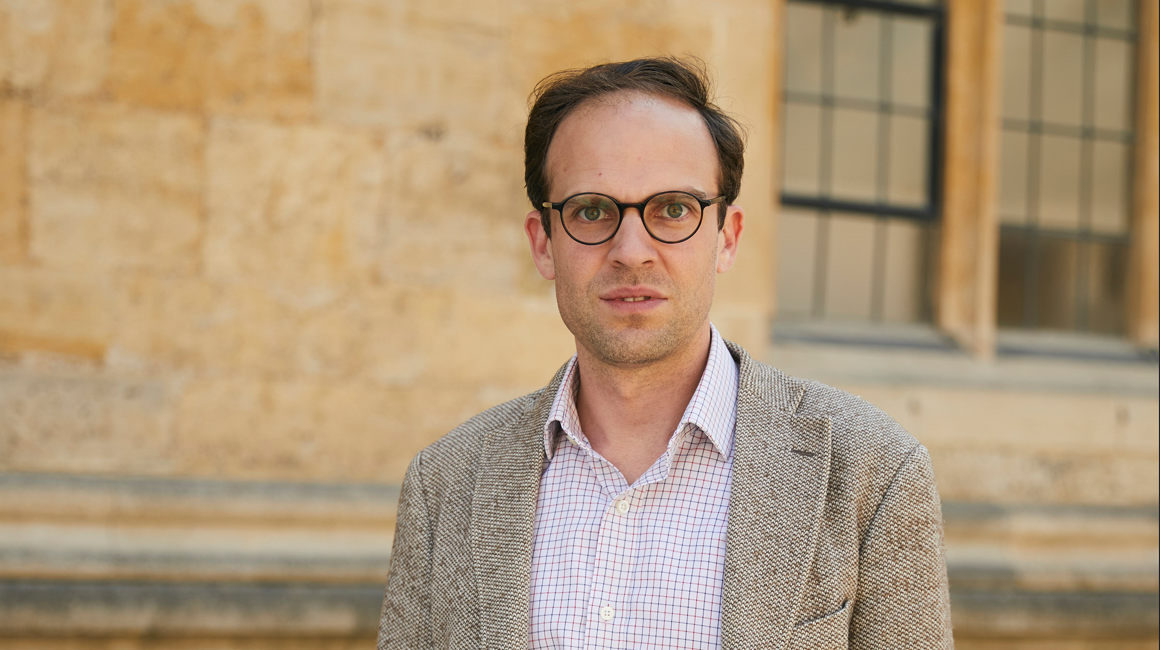
Carl Benedikt Frey
Economist
15
APPEARANCES
14
PODCASTS
Aug 13, 2026


Stephen HornHOST
So are we likely to see the same thing with AI, where it takes a long time for society as a whole to benefit, but there's income inequality on the way.

Carl Benedikt FreyGUEST
We've been through very different episodes of technological change in the past as well.
Carl Benedikt FreyGUEST
And so the first industrial revolution that you mentioned in its early days essentially centered on the mechanization of textile productions.
Carl Benedikt FreyGUEST
There were many people that lost out and what you see on the macro scale is that the labor share of income declines during this period and wages at the lower end of the income distribution are probably declining as well.
Carl Benedikt FreyGUEST
And so what you see is that technology, electricity and the internal combustion engine is almost lifting all the boats.
12 MINS LATER
Stephen HornHOST
So how hopeful are you that we will see the benefits of AI in our societies and in our economies sustainably?

7:25

If you just look at the title of your book first, anyone looking at that, particularly this year, How Progress Ends: Technology, Innovation and the Fate of Nations, you'd have to think, "Well, however it ends, it doesn't seem to be ending at the moment." So what's your take on, on the world we're looking at now? Are we at the end of progress or just the beginning of amazing progress?
Carl Benedikt FreyGUEST
Well, the title of the book is not meant to suggesting that progress is inevitably about to end.
Carl Benedikt FreyGUEST
It's more of a reflection of the fact that progress is unnatural, right? If progress was inevitable, it would not have taken 200,000 years to have an Industrial Revolution.
Carl Benedikt FreyGUEST
If progress was inevitable, most of the world would be rich and prosperous.
Carl Benedikt FreyGUEST
If progress was inevitable, Britain, the country where I live, would not have suffered two decades of productivity stagnation.
Carl Benedikt FreyGUEST
So progress is clearly not inevitable, and it's clearly not inevitable, uh, even despite the acceleration we've seen in innovation that you mentioned, right? So if you look at patenting, if you look at scientific publications, any measure of, you know, inventive output, all those indicators are up.
Carl Benedikt FreyGUEST
Yet, if you look at the economy, that's pointing in a very different direction, and even measures of research productivity and breakthrough innovation are down.
20 MINS LATER
28:44
You know, what are the, the lessons from your analysis for governments that want to try and make the most of these, uh, technological advances f- and translate them into growth?


Greg LaBlancHOST
Can you talk a bit about that? Because it seems like the policy in Germany was very different, where the government seemed to encourage consolidation rather than discourage it.
Carl Benedikt FreyGUEST
And so as businesses grow larger, often they became part of the political system because their influence on policy i-increases as they grow.
Carl Benedikt FreyGUEST
And so they usually don't just sit back and take the rules that are handed out to them.
Carl Benedikt FreyGUEST
And so when the state is strong, it has better capacity to resist that for good and for bad.
5 MINS LATER
Greg LaBlancHOST
And so how did the catch-up model of industrial policy of, of those two countries bring them to the state that they're currently in? And why this divergence in ultimate outcome in the recent decades?

Paul SampsonHOST
What do you think of that thesis? And maybe you can talk more about your broader thesis about that all these models have to adopt regardless of how well they do at a certain point.
Carl Benedikt FreyGUEST
Yeah, so key theme of the book is that the institutions need to adjust as technology changes, right? And so, as we mentioned earlier, the Soviet Union was doing very well for some time, at least, you know, paper.
Carl Benedikt FreyGUEST
Economically, of course, a lot of that growth focused on heavy industry.
Carl Benedikt FreyGUEST
It didn't really improve standard of living for Soviet citizens the way that you might expect in more open, decentralized countries.
Carl Benedikt FreyGUEST
The Soviet Union grew around 6% per year, and then it slowed down and eventually collapsed.
31 MINS LATER
Paul SampsonHOST
Are we seeing a similar pattern now? Is it somehow different because algorithms can scale immediately as opposed to hardware? What's your view on how much of an opportunity there is here for countries that don't have a lot of these cutting-edge technologies to get in the game, or is there a high risk of them being captured or left behind?


Carl Benedikt FreyGUEST
Yeah, so the point I'm trying to make in the book is that institutional change, institutional flexibility is really important because technological change entails two very distinct phases.
Carl Benedikt FreyGUEST
And some places might be good at scaling, exploiting technological opportunities.
Carl Benedikt FreyGUEST
And some people have the institutional flexibility to move between places.
Carl Benedikt FreyGUEST
And so if you go back to the 1950s, 1960s, a lot of people in Washington were concerned that the Soviet Union would overtake the United States.
Carl Benedikt FreyGUEST
The Soviet Union, we sort of look back at it as a failure, but it was actually growing quite respectably, you know, 6% per year for around four decades or so.
11 MINS LATER

2:36
Um, and you notice how many of these surged ahead and then stalled, right? So is there a common pattern in how the transition from the rise to sta- stagnation plays out, and perhaps some lessons learned or elements we should keep our eyes open for?
Carl Benedikt FreyGUEST
So the case I make in the book is that moving between decentralization and centralization means that you need some institutional flexibility, and that is hard to do over the long run because you need to change your institutions, and you often have incumbent interests that have a stake in the exist- existing order of things.
Carl Benedikt FreyGUEST
But you can grow quite quickly for a fairly long period of time without being at the forefront of technology.
Carl Benedikt FreyGUEST
And so if you take the Soviet Union, for example, we tend to look back at it as a failure now, and obviously in many ways it was, but it was also growing at six percent per year o- over a period of around four decades or so, which is quite respectable.
Carl Benedikt FreyGUEST
And it did so basically by taking technology invented elsewhere and scaling it domestically, and so took ample advantage of the Ford Motor Company's open door policy, sent delegations to Detroit to look at, uh, the Ford factories, learn from that, then build a, a vehicle industry in the Soviet Union.
Carl Benedikt FreyGUEST
And in the age of mass production, the authorities could, could hold factory, uh, managers accountable by simply benchmarking, uh, performance across plants.
8 MINS LATER
12:29
I'm not saying we should, we should have a recipe, but what, according to your studies, what could be a way to catch up in, in the current system?


Geoff NielsonHOST
And so I, I'm curious, when you look at the historical context, do you see, you know, more of a case for bringing in a breakup of some of the, the big tech players now? Or do you think actually that the consolidation is good if the object is, you know, for a given, you know, state or society, uh, you know, to get ahead and stay prosperous?
Carl Benedikt FreyGUEST
So a key theme of the book is that, uh, technological progress entails both experimentation, exploration v- and then, you know, execution, exploitation, which sort of essentially amounts to, you know, getting things done, scaling up, uh, what, what, what you invented.
Carl Benedikt FreyGUEST
And institutions that support those different, uh, phases ca- can be quite, quite different.
Carl Benedikt FreyGUEST
And so at the frontiers of innovation, I think decentralist competition is really important, right? And so if you take the Soviet Union as an example, right, it was the most centralized economy the world had ever seen.
Carl Benedikt FreyGUEST
If you were an aircraft engineer in the Soviet Union and you wanted funding for your project, you could go to the Red Army.
11 MINS LATER


Carl Benedikt FreyGUEST
If you look around the world today, productivity growth has been rather disappointing.
Carl Benedikt FreyGUEST
After a brief uptake in the US between roughly '95 and 2004, productivity growth has been disappointing.
Carl Benedikt FreyGUEST
It's been disappointing in Europe, and it's even been disappointing in China, not least since the Great Recession, whereby some estimates it's even turned into negative territory.
Carl Benedikt FreyGUEST
And I think what US and China obviously has many differences, both in, you know, economic and political systems, but they do, I think, share a common feature in that more power is being centralized.
Carl Benedikt FreyGUEST
And so in China, I think after the opening in the late 1970s, it's fair to say that much of the growth was facilitated by the fact that provincial governors had large degree of autonomy, and so they could experiment with different institutions.
18 MINS LATER

Luigi ZingalesHOST
So to what extent, and not, not just his election, but his behavior in the first year in office, made things worse, and is there any sort of positive sign that we say maybe it's not as bad as we think?

Puja ChhabriaCORRESPONDENT
When you look at it historically, what do you think happens when technological change outpaces institutional adaptation? And do you think we're seeing some early signs of that right now?
Carl Benedikt FreyGUEST
now?So if we go back to the 1990s with the personal computer and the internet emerging, it's absolutely astounding to me that all we get from that is a decade-long productivity upsurge mostly confined to the United States.
Carl Benedikt FreyGUEST
Because if you think about it, what the computer revolution did was giving us the world's stored knowledge in our pockets, connected the best scientists and inventors around the world.
Carl Benedikt FreyGUEST
And so you would have expected a tremendous and sustained upsurge in productivity growth because what we invented was a tool for innovation.
Carl Benedikt FreyGUEST
And what it should tell us is that the technology itself is not all that matters.
5 MINS LATER
Puja ChhabriaCORRESPONDENT
But if future historians were to look back at this period, this particular point in time, how do you think they would describe this period that we're now entering? How would you define it?

Caleb ZakarinHOST
And what were some of the sources of Japan and Western Europe's development, especially in the context of this kind of question of centralized planning versus a more free market approach?
Carl Benedikt FreyGUEST
Yeah, so I think, you know, it's fair to say that, you know, the Rad Lab advanced radar technology, the Manhattan Project, you know, delivered the bomb.
Carl Benedikt FreyGUEST
And so you can't, you know, set aside a decade to explore some, you know, completely new trajectory.
5 MINS LATER

Leo BaderHOST
And when we draw this into the present day, where a lot of economic growth is concentrated in big multinationals, does that change sort of the nature of competition? And does that create any more of an opposition? Do you think between states and companies, because companies are no longer so bound within one state, even if they're headquartered in one?
Carl Benedikt FreyGUEST
And so you need large corporations to leverage technologies like factories, bring down costs and make sure that your products are widely accessible.
Carl Benedikt FreyGUEST
to the population and so there is no people's car there's no t ford without the ford motor company and the assembly line and some other technologies that gave rise to mass production That said, consolidation can inhibit innovation.
Carl Benedikt FreyGUEST
And we've seen with various antitrust initiatives that subsequently you tend to see an upsurge in patenting.
11 MINS LATER
Leo BaderHOST
What relationship do you see between the public and private sector across the historical record, both in the exploration and exploitation phase? Is it mostly a productive, cooperative one, or can there be conflicts that hinder innovation?


Adam JobHOST
So the natural question to me is, what are the systems that are conducive to these two modes of exploration and scaling up, as you described them? Like what institutions are needed to make each of those happen?
Carl Benedikt FreyGUEST
The reason for that is you cannot know upfront which technological pathways be successful so you need different people to explore different pathways so if you take the soviet union as one extreme right if you were an aircraft engineer and you conceived a new engine you could go to the red army to ask for funding if they declined we maybe had two or three other options if they declined two you wouldn't be funded and of course If what you did didn't align with national priorities to begin with, you wouldn't be funded at all, right? That's quite different in the United States, where, for example, Bessemer Ventures declined to invest in Google, which was at the time not a sure bet.
Carl Benedikt FreyGUEST
Alta Vista, Internet Explorer were key competitors, but other venture capital firms took the risk to invest in Google.
Carl Benedikt FreyGUEST
Katalin Kariko, who laid the foundations for the mRNA vaccines that allowed us to escape the pandemic.
Adam JobHOST
Would you agree that that's like a happy medium system? Or are there other examples of this?


Carl Benedikt FreyGUEST
And so post-war growth in the United States relied to a large degree on state capacity, on building highways to exploit the automobile revolution, on creating educational institutions like the GI Bill to educate veterans to become professional managers and civil engineers and other things that firms required for scaling.
Carl Benedikt FreyGUEST
And so United States has historically, as I pointed in the book, been very good at adjusting its institutions to new challenges, right? So back in the 19th century, innovation primarily came from independent inventors who traded their ideas in the market for technology.
Carl Benedikt FreyGUEST
most firms, whether it was DuPont or AT&T, they essentially focused on buying up technologies from independent inventors and then incrementally proving them and scaling up and bringing those technologies to market.
Carl Benedikt FreyGUEST
And, you know, that eventually gave a rise to the era of mass production and we saw that peak of that in the post-war period when much of the productivity gains from these new discoveries in electricity and internal combustion engine that were made by independent inventors in the 19th century when they were finally exploited at full scale but the returns of those inventions then eventually petered out and then you needed something new to come along and that was the computer of revolution and I point out that in the book that you know Quite similar to today with the rivalry with China, there was a lot of concern in the 80s in particular that Japan would overtake the United States and become the predominant technology leader of the world.
Carl Benedikt FreyGUEST
And Japan was outcompeting the United States in hardware, similar to what it done to cars with lean production a decade earlier.


Carl Benedikt FreyGUEST
So I argue in the book that technological progress involves two very different phases.
Carl Benedikt FreyGUEST
So before you produce something, you need to explore and develop a new technology and product.
Carl Benedikt FreyGUEST
And when you then settle on what it is you want to do, Technological efforts become more focused on scaling and bringing that product to the market at lower costs.
Carl Benedikt FreyGUEST
Effort shifts more from exploration to scaling, more from product innovation to process innovation.
15 MINS LATER