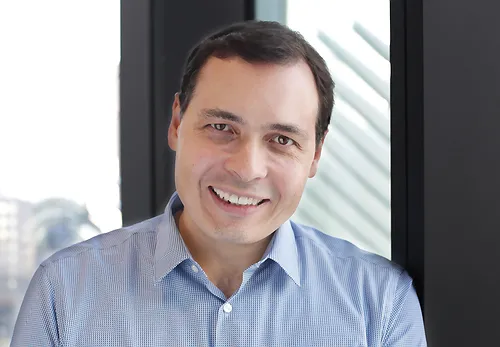
Brian Wieser
16
APPEARANCES
9
PODCASTS
Sep 21, 2026


Dan FayHOST
Do you want to talk a little bit more about that and your thinking around the outlook for national broadcasters?

Brian WieserGUEST
Yeah, as you say, I'm now reminded of a clip Sir Mark Stroll used to make about agencies, two drunks holding themselves up at a light post or something along those lines.
Brian WieserGUEST
It's not that bad though, but I think there's, Certainly in the markets that I've looked at closely, you see broadcasters complaining, complaining, complaining about the global platforms, taking their share and how advertisers, for all their claims of patriotism and supporting their local broadcasters and local content and blah, blah, blah, they keep spending and spending and spending with the US-based digital platforms.
Brian WieserGUEST
They're trying to relive the 1980s and 90s, where they had these great protected markets by regulators.
Dan FayHOST
Looking at the small medium enterprises segment, how much of a thing is the emerging SME class of advertiser in your view? Has traditional media properly appreciated or taken the opportunity presented by this pool of new advertisers?

Brian WieserGUEST
and rightly or wrongly I think wrongly in many cases we might suggest he's going down that path and trying to figure out how to get there and if I understand correctly they're just trying to eliminate people because yeah you're just gonna just kind of trim the fat a little bit right like it's not the cost per se as much as the people and what i mean by that is any bureaucracy forms around a set of choices and sometimes the bureaucracy begets more bureaucracy and it makes make choices happen i'm not saying that's what's happened here at all i have seen this in agency land for sure And I don't think that's what's happening here necessarily.
Brian WieserGUEST
But I think that that would help explain why they're making cuts the way they're making them based on what little information we have so far.
Brian WieserGUEST
Now, if that were true, if that were correct, Green is still very much firmly in charge with a very clear point of view about where the world should go.
Brian WieserGUEST
Everything that Luke said, of course, I completely agree with in terms of the focus that they have is very different than what the market ultimately wants.
Brian WieserGUEST
And I think that they're convinced that the market wants what they think the market wants, and they want to find ways to organize to get there.
12 MINS LATER


Brian WieserGUEST
First thing you have to look at to form a view about whether or not this is, um, is shenanigans or this is just business is, is it compliant with the language of a contract? Um, and the vast majority of activities that agencies have participated in that, uh, got a bit of a black mark were either, uh, explicitly allowed by contracts or just not referenced, and they weren't prohibited, therefore they were allowable.
Brian WieserGUEST
And, uh, as a noted, um, agency analyst Machiavelli once said, "A prince who is not himself wise cannot wisely be advised." When marketers choose not to pay for services from entities who can provide consulting capabilities, maybe yourselves, I don't know, um, who understand a thing or two or three about AI, and they get screwed in some form, well, that's, that's the marketer's fault.
Brian WieserGUEST
But when it comes to something like this specifically, um, you know, it's, it's plausible it's just the way that something is getting priced because sometimes what the customer wants and what they're able to pay for are very different things.
Brian WieserGUEST
Um, and sometimes the client, and we can call it complicit client syndrome, clients are fully aware of this, but it's just they know the way that they get their contracts done.
Brian WieserGUEST
Certainly, uh, from a Wall Street perspective, my first ex- earliest experiences professionally, where you saw that, huh, um, investors don't really seem to care about paying for research.
22 MINS LATER

Brian WieserGUEST
And s- all things sports related seem to have, uh, uh, so many legs to them, not just NFL, but also, [laughs] my gosh, speaking of hockey, not only do you have, uh, now you have a new series from Amazon, Off Campus, that's coming out, and then of course Heat of the Rivalry from Bell Media.

Tom KeeneHOST
How is a, a hip streamer Amazon, Netflix up front different from a New York up front of ages ago?
Brian WieserGUEST
I, I think that they're fundamentally about getting, uh, advertisers excited about allocating incremental amounts of money.


Ari PaparoHOST
So what are you seeing relevant to what we're talking about, advertising and marketing? Is it having an effect? And where do you see vulnerabilities?
Brian WieserGUEST
Yeah, I mean, I do think it's largely overstated in terms of the near term impact.
Brian WieserGUEST
There is a relationship between investing or failing to invest and whether or not you grow.
Brian WieserGUEST
In general, I have the view that when I see companies who do buybacks, That tells me they have a lack of imagination about where they would put the money to work in their own business.
Brian WieserGUEST
It ultimately communicates that they aren't as confident in their business as they should be in the core operations of the business.
8 MINS LATER
Brian WieserGUEST
I argue, and this is a contrary view, for all of AI, there's a lot of fears that AI's gonna replace a lot of people.
Brian WieserGUEST
I argue it's gonna cause the need for more people, because it adds more complexity, and the complexity is what requires people to manage the processes.
Brian WieserGUEST
Um, but nonetheless, they're sha- certainly taking share no matter what's happening here, and that's the main thing.
Brian WieserGUEST
When I say segmenting, I mean finding the marketers who are willing to pay the most.
Brian WieserGUEST
Fun fact just came out the 10-K an hour ago, their third-biggest market, Singapore.
Tom KeeneHOST
I mean, is it, is the, is the, you know, Martin Sorrell and all that, and Rob Schwartz, and, you know, is it gone?

Jeff FosterHOST
Like Luke mentioned, like what we're seeing in the economic data, you know, everything seems to be humming along pretty well for the most part.
Brian WieserGUEST
I think we only make the point that, again, unless everything that we've ever learned from studying, whatever, 150, 200 years worth of decent economic research, unless it's all wrong, we know where this ends, or at least we think we know where it ends.
Brian WieserGUEST
And unfortunately, the distinction between being early and being wrong is often indistinguishable.
Brian WieserGUEST
But as it is, you know, we certainly see right in front of us that things are strong.
Brian WieserGUEST
Now, we probabilistically or we probability weighted where we think the world plays out when it comes to the year ahead.
20:47
How are you bringing those direct dollars from brands into creators as a part of the broader universe that we cover? Right.


Olivia MorleyGUEST
And when you have a proprietary tool, as many of these agencies do, I think that's the move.
Brian WieserGUEST
I think that Pencil was obviously a pretty fantastic acquisition a number of years ago.
Brian WieserGUEST
I do think that the big issue is that Frankly, it's the go-to-market strategy that is generally the issue.
Brian WieserGUEST
But the basic premise that they've taken, if I could articulate what I think their vision is, it's this barbelling between Oliver, the inside company, the in-house version of a product paired with Jellyfish, and then Pencil in the middle.
16 MINS LATER

Brian WieserGUEST
I knew nothing about agencies, right? I went into, I would never have taken a job in an agency had I actually understood what they did.
9 MINS LATER
Brian WieserGUEST
You know, they seem to be really focused on the studio, uh, for, you know, maybe Ellison's reasons.
Brian WieserGUEST
And to his credit, I think Skydance has actually done pretty well as studios go.
Paul SweeneyHOST
How do you look at that environment, and what does it portend for you about further consolidation and, and what's gonna happen to, uh, to these legacy networks going forward?

Brian WieserGUEST
Why, you ask? Why, you're asking? No, I was always interested in the creativity of things.
Brian WieserGUEST
And then I learned about Bowie Bonds, which was securitization of music libraries, right? Fascinating.

Rich AshtonHOST
So why don't you tell us how you are seeing the potential impact of the tariffs, both in the short term and potentially further out?
Tom KeeneHOST
What are they talking about? Is it, like, 100% they're talking about YouTube? What's the theme in the hallways at Michael's?
Brian WieserGUEST
Even though YouTube may very well have the biggest single event this week-It's really not part of the upfront conversation, which is kind of weird, right? They want to be part of those conversations.
Brian WieserGUEST
They might be bigger than NBCU and Disney and Paramount combined, but they're not really part of the overall TV budget process.
Tom KeeneHOST
Um, but the, the bottom line is the future of Hollywood if they're exporting ever labor transaction outside California.
Brian WieserGUEST
Yeah, well, the smart thing if you're in the production business outside of the United States is to make sure you're doubling down on your productions for outside of the United States.
Brian WieserGUEST
The United States is, as you guys follow as well as anyone or more, pushing towards autarky.
Brian WieserGUEST
I mean, the reality is that if you want to produce content or any business or product for the United States, you kind of are gonna need to have a US-based operation.

Paul SweeneyHOST
Tell us what upfront is and why do we even have an upfront season anymore? Tell us what upfront is.
Brian WieserGUEST
right well the upfront is this period of time where the world's largest advertisers and the largest sellers of advertising in the united states and tv in particular come together the tv network owners and youtube and amazon all do big song and dances i think lady gaga is going to be at youtube's broadcast tomorrow wow um and uh yeah basically they show whether they've got planned for the next year And then once they've done that, then everyone can forecast what they think audiences are going to be, and then budgets basically start getting negotiated.
Brian WieserGUEST
Uncertainty is a real issue because it's already a challenge when you're making these commitments for a period from, say, October to September of the following year.
Brian WieserGUEST
When you don't even know what economic policy is going to be in about, oh, 30 days, let alone 60, 90, 120.
Brian WieserGUEST
And I think that so many people got used to these unsustainably fast growing markets, especially coming out of the pandemic when these were just ridiculous rates of growth that we saw.
23 MINS LATER

Allison SchiffHOST
How often, though, does concern like that translate into action, like an actual pullback on ad spend or a change in strategy? Or is it just like a case of agita?
Brian WieserGUEST
I did replace a guy named Bob Cohen, who literally built data sets back that far.
Brian WieserGUEST
There really has not been anything like this in the modern era in any developed country, full stop.