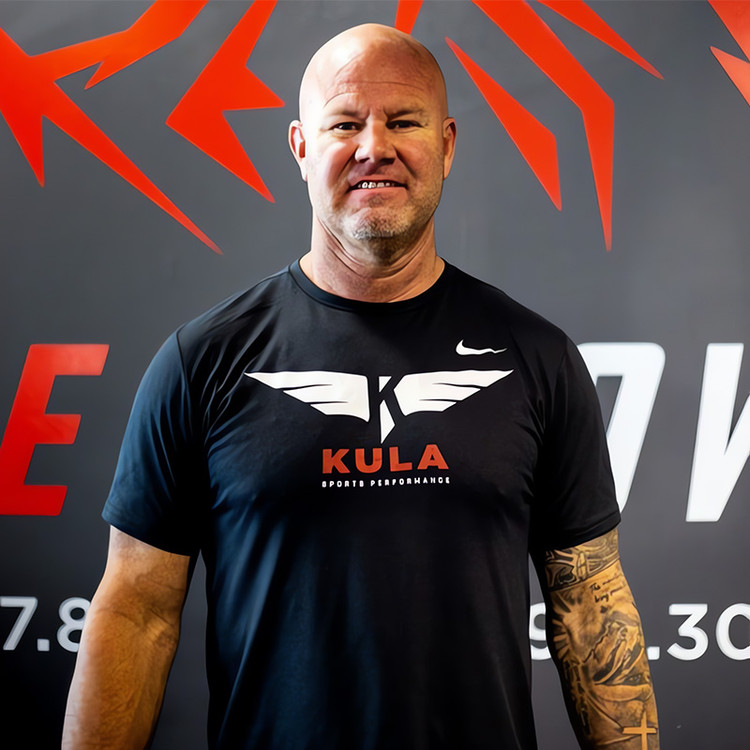
Brian Kula
6
APPEARANCES
6
PODCASTS
Sep 8, 2026


Jon HeckHOST
But just for my non-performance audience, do you mind defining acceleration versus max velocity? And maybe what are some of the physical traits that distinguish a good accelerator versus somebody who's got great top end speed? Sure,

Brian KulaGUEST
I mean, in a nutshell, I guess, just to kind of bring everybody to the same page, right? You know, you're talking about different vectors, right? So in acceleration, you're talking about a horizontal vector, you know, where you're trying to move, you know, down the field.
Brian KulaGUEST
In max velocity, you're still moving, but the forces actually turn more to a vertical, you know, displacement.
Brian KulaGUEST
And so how you train those two things are distinctly different from how the ground is interacted with, what the shin angles look like, things like that.
Brian KulaGUEST
So without being overly technical, You know, when we're focused on acceleration, it's more of a strength based.
Brian KulaGUEST
We have some longer ground contacts and we're really focused on that horizontal hip projection, you know, where we're not, you know, we're trying to overcome inertia basically in the acceleration phase.
10 MINS LATER
Jon HeckHOST
All right, so just getting back to some of the acceleration versus max V training, could you talk about just kind of a base, hey, what does a basic day of acceleration training look like and how might you progress that over the course of an offseason? I know there's a lot that goes into it, but just kind of your basic overview once you're on the field, what does that excel day look like and how do you progress it?

Tony HollerHOST
when you teams that prioritize speed seem to be healthy, what are your ideas on that?
Brian KulaGUEST
Yeah, I mean, I think, well, A, you're giving in the sprint-based football the best that I know of it.
Brian KulaGUEST
And those things are accumulation, right? I mean, if you're going a little bit extra every week or you're on the field two hours versus 90 minutes, those hours add up over the course of the year.
Brian KulaGUEST
And so it doesn't surprise me that, you know, by going by doing less early makes them fresher later in the season when everybody else is trying to get a little more work in a little a few more reps in.
31 MINS LATER


Chase JacksonHOST
Your thoughts on cold plunge and how that can potentially impact performance, not about recovery, not about dopamine, but like potentially performance where the nervous system plays into that.
9 MINS LATER

Tim RileyHOST
And, um, you know, even now with, with Apex, like I see, and which I'm thrilled about, um, more people that were either former athletes or just, like-
Brian KulaGUEST
like-... are tired of training, like- Yeah ... you know, uh, traditionally, I guess- Yeah ... you would say- Yeah ... for like gen pop.
Brian KulaGUEST
They're like wanting to- Yeah ... like explore other avenues of- Yeah ... of training and being active, and sprinting is- Yeah ... like at the top of that list.
Brian KulaGUEST
Um, however, going from someone who is either a former athlete who hasn't sprinted in five or six years- [laughs] ... to sprinting again, or someone who's like never really sprinted- Yeah ... like there, there is a, there is a way to go about doing that that is practical- Yeah ... and pragmatic.
7 MINS LATER


JT AyresHOST
What are those kind of key factors that coaches just should be like trying to achieve and get better? And what have you even seen through your years of being a mentor coach?
Brian KulaGUEST
I, you know, I think, you know, I think the deal, especially nowadays with such access to information is the art of coaching has been a little bit lost on the young coach.
Brian KulaGUEST
And when I say that, what I mean is, you know, there's an art to immersing yourself in the craft, you know, and having a passion for what you're doing.
Brian KulaGUEST
And, you know, you opened the podcast with saying it's the best sport in the world.
Brian KulaGUEST
And if you don't love what you're doing, just love it to the to the point where you do it for free, then you're probably in the wrong space.
9 MINS LATER
JT AyresHOST
You know, what advice do you have to the coach, especially to the athlete? What can you say about things like peptides, supplements, like things that are those quick – I'm using air quotes here – quick fixes?

Brian KulaGUEST
No, I think first and foremost is sleep and nutrition, right? Like, I mean, I think you can't get too far away from that.
Brian KulaGUEST
Um, you know, there's, there's different products out there of, you know, compression boots and saunas and things like that that I think would be beneficial.
Brian KulaGUEST
Um, I'm working with a company right now called AiR Therapeutics, um, and they have a, a CO2, uh, delivery system of paste and a suit, um, where you can actually, uh...
Brian KulaGUEST
Um, it basically helps deliver oxygen from the, the, off the hemoglobin into tissue and muscle.
Brian KulaGUEST
And so, you know, everything that you're always after with, you know, the sleep, with the, you know, all the different modalities is to try to utilize oxygen better to repair and heal, you know, tissue.
24 MINS LATER