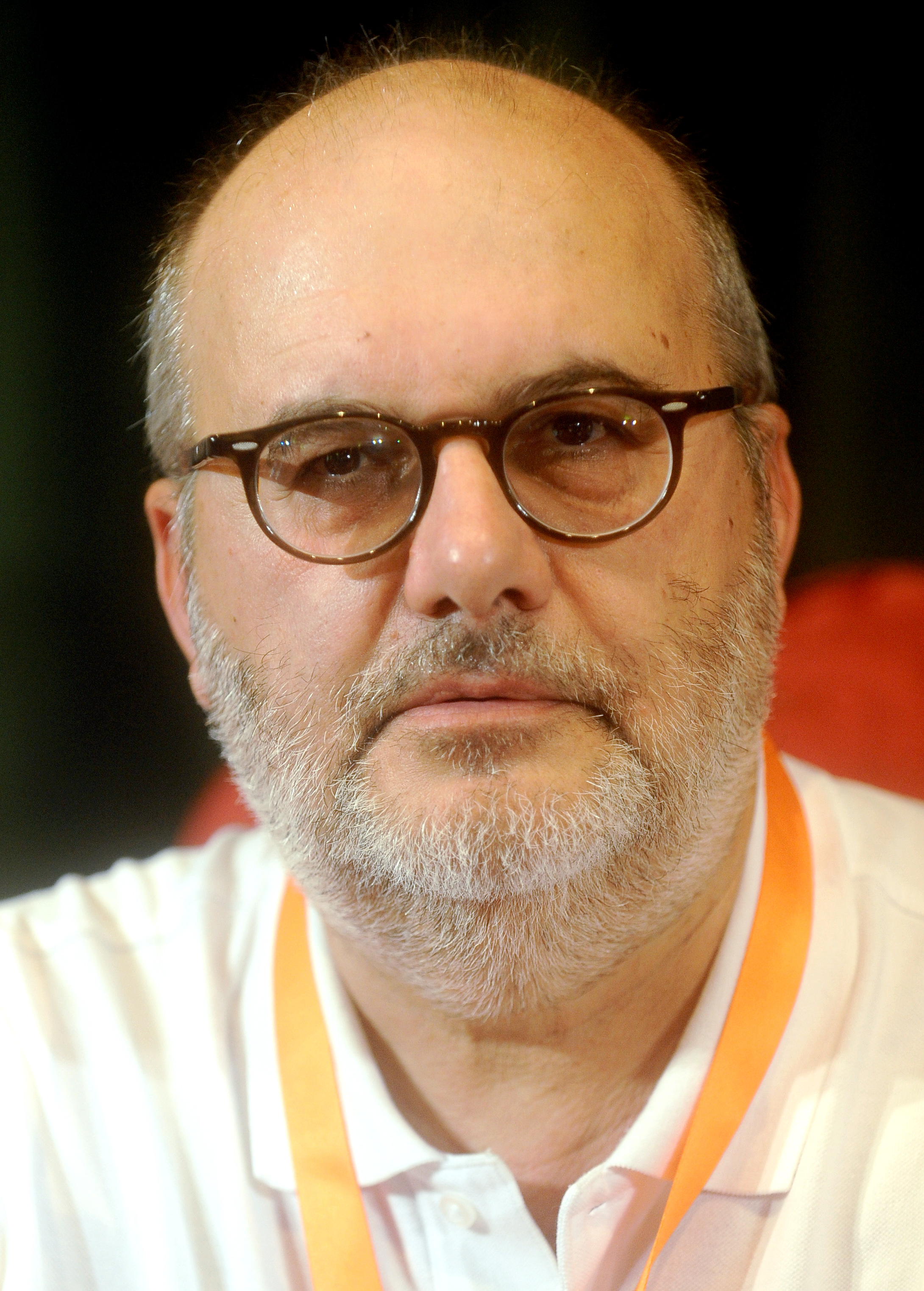
Branko Milanović
American economist
8
APPEARANCES
8
PODCASTS
Oct 18, 2026

SimonHOST
If China's on the rise and we have America and China as the leaders of the world, is it the first time that we've had two equal leaders and what will that look like?

Branko MilanovićGUEST
Well, of course, this is a little bit like a question about artificial intelligence.
Branko MilanovićGUEST
You know, I'm not sure it is the first time, because even if you look at relatively recent history, yes, there was a British Empire, but the British Empire was challenged by Germany, and they took that challenge quite significantly and seriously.
Branko MilanovićGUEST
then the U.S. was the hegemon over one part of the world, but the Soviet Union was the hegemon over the other part of the world and actually had quite a lot of self-power in the rest of the world.
Branko MilanovićGUEST
I think it became in 1990, again, relatively recently, that the U.S. became ideological hegemon and, of course, military and economically the most powerful country without anybody sort of challenging that supremacy.
SoniaHOST
For those who don't know about this, can you explain it to them?


Peter SlezkineHOST
How does the emergence of homo plutia in various societies and the redistribution of wealth globally affect domestic politics in the various big countries in the world?
Branko MilanovicGUEST
As I was saying before, when you asked me in the very beginning, when I said actually what we see now, and I was very reluctant to talk much about Trump, Putin, and Xi Jinping.
Branko MilanovicGUEST
And what I argued there is that all three represent a certain form of the rejection of some essential features of the previous period of neoliberal globalization.
Branko MilanovicGUEST
Trump has been brought to power, and I'm not going to talk about that because millions of people have been writing about this, for the malcontents of people who were not happy with the way that globalization went, for many reasons, whether it was because of a lack of jobs or lower wages or expectations or because they were called various names by Hillary Clinton, but in any case, dissatisfaction, which was internalized here.
Branko MilanovicGUEST
And of course, in many other countries, including Germany, as we see now, France, the United Kingdom with the Reform Party, it's all well-known.
Branko MilanovicGUEST
But my argument is also that the same logic applies to the other two cases, Russia and China.
16 MINS LATER
Peter SlezkineHOST
So what is national market liberalism and how will that impact international relations?


Nafkote DabiHOST
Do you see any echoes of that today? Are there parallels between their analysis and, you know, the geopolitical tensions we're living through now?
Branko MilanovićGUEST
As you know, in Chapter 2 of the Great Global Transformation, I do exactly that.
Branko MilanovićGUEST
I say, okay, let us go over the theories which link openness and globalization and trade to either peace or war.
Branko MilanovićGUEST
And I will not now recount the entire But I started with Montesquieu, of course, because he is really very important.
Branko MilanovićGUEST
And Montesquieu's view was that trade actually leads to peace because everybody has an interest to cooperate, for me to sell goods to you.

Max LawsonHOST
Can you say a little bit about that and how that those two things might be a bit related maybe?

Branko MilanovicGUEST
U.S., actually, it is easy for me to unwrap and I'll come to China in a second.
Branko MilanovicGUEST
For the U.S., actually, what they argue is that and for basically lots of countries in the world, the European Union in particular also, Neoliberalism has been replaced in its international component.
Branko MilanovicGUEST
You know, it's essentially we are now having mercantilist policies and trade is seen psychologically, intellectually as a zero-sum game.
Branko MilanovicGUEST
So we actually are back to what I think actually Hobson, Rosa Luxemburg, and Lenin were speaking in 1914 and before 1914.
12 MINS LATER

Bilal HafeezHOST
But what does that mean? And how is it different from, you know, the traditional capitalist class that we kind of, you know, imagine in our heads?


Branko MilanovicGUEST
And, you know, one of the weird things, I had a paper with three quarters on that, which we had a really hard time publishing.
Branko MilanovicGUEST
You had a permanent story, which actually was defended practically by everybody.
11 MINS LATER


Branko MilanovicGUEST
The growth, we actually did the same thing, I did this with the cadres actually, Chinese cadres.
Branko MilanovicGUEST
And what you see in that elite, 1988 were the first data begin, is that two-thirds, broadly, two-thirds of the income of the elite comes from state-owned enterprises, government jobs, and jobs in the Communist Party.
Branko MilanovicGUEST
Two-thirds of total income from the elite, in the elite, for the elite, comes from private sector jobs, professional jobs in private companies, and one-third from state-owned enterprises, Communist Party, and government.
5 MINS LATER


Martin SandbuHOST
So I just wanted to start our conversation with asking which is more important, the similarities or the differences between countries at the point we've now come to over the last 30, 40 years? Mm-hmm.
Branko MilanovićGUEST
Well, I think that at the point that we are now, I think that the differences between the countries are more important, although there are some fundamental similarities like, you know, being capitalist.
Branko MilanovićGUEST
You actually very correctly and skillfully actually introduced the period up to 1989 or 1990, which is actually a period up to the fall of communism.
Branko MilanovićGUEST
Then we have the second period, which went from 1990, which was characterized first by the unipolar world, where actually the United States was uncontested leader economically, politically, and what is actually very important to highlight, ideologically.
Branko MilanovićGUEST
So that was the period which went up to probably either you can say 2016, whether you want Trump's election or Brexit or whatever you want to call it.
Branko MilanovićGUEST
But that period, I think, was also associated with a generally benign view of globalization.
10 MINS LATER
Martin SandbuHOST
What is it you see coming into being in the US as symptomatic of a sort of Western turn?


Branko MilanovicGUEST
thinking on the... how should I say, the interpretation of the facts has not changed very much.
Branko MilanovicGUEST
What has happened is that even the evolution of global inequality, the decrease of global inequality has continued because China has continued outperforming the Western countries, or actually not only China, India as well, with the exception of one year in COVID.
Branko MilanovicGUEST
If I were to rewrite the book, I think there would be just an extension on what I did.
Branko MilanovicGUEST
What has changed is that my interest has now become, and that's actually I think quite obvious even in capitalism alone, has become broader.
Branko MilanovicGUEST
In other words, I believe now we should try to situate inequality in general and global inequality and individual country inequalities, within a more political framework.
8 MINS LATER