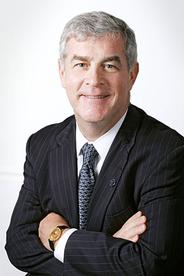
Bill Sweeney
CEO of the Rugby Football Union
7
APPEARANCES
7
PODCASTS
Oct 27, 2026


Matt McClureHOST
But just just clarify here that seniors could see a drastic reduction in their checks from month to month if that were to happen.
Bill SweeneyGUEST
I think it's important to note that that is six years away and that we have an election coming up in November.
Bill SweeneyGUEST
The people elected to the United States Senate who serve six-year terms, they will be in office at the end of their term.
Bill SweeneyGUEST
So this is becoming very real now from an electoral point of view and from a voter point of view.
Bill SweeneyGUEST
This is the time to really be focused on it if you weren't focused on it before.
Matt McClureHOST
But what what? Can people do what kind of information is available for folks who are maybe pre-retirees who are trying to get a better idea of what their benefit amount is going to look like when they do retire?

Matt McClureHOST
But just just clarify here that seniors could see a drastic reduction in their checks from month to month if that were to happen.
Bill SweeneyGUEST
I think it's important to note that that is six years away and that we have an election coming up in November.
Bill SweeneyGUEST
The people elected to the United States Senate who serve six-year terms, they will be in office at the end of their term.
Bill SweeneyGUEST
So this is becoming very real now from an electoral point of view and from a voter point of view.
Bill SweeneyGUEST
This is the time to really be focused on it if you weren't focused on it before.
Matt McClureHOST
But what what? Can people do what kind of information is available for folks who are maybe pre-retirees who are trying to get a better idea of what their benefit amount is going to look like when they do retire?

Bill SweeneyGUEST
The full retirement age for anyone who's not currently retired is 67 right now.
Bill SweeneyGUEST
And you can get a maximum amount of Social Security every month if you wait until you're 70.
Bill SweeneyGUEST
The issue is that this is a really personal decision that everyone needs to make thinking about the specifics of their family and their needs and their circumstances.
Heather ValeHOST
So for those of us who haven't retired yet, can we still sign up for MySSA accounts?

Lisa PriceHOST
Well, tell us about the COLA adjustment because so many people, y- you know, that was announced on October 15th, so many people right now rely on that for 90% of their income, which kind of surprised me.
Bill SweeneyGUEST
[clears throat] For people who are on Social Security, especially older people, right, as, as you get older, you can't really go back to work and get a new job if, if things start to run out.
Bill SweeneyGUEST
So the cost of l- living adjustment in Social Security is absolutely critical to making sure that the money that you need [clears throat] to pay your bills, and Social Security, uh, is able to keep up with it as inflation goes up.
Bill SweeneyGUEST
That's, um, for the average person, that's about $75 a month or $900 a year, and that is a really important, uh, amount of money for them to, uh, be able to afford higher grocery prices, higher gas prices, higher rents, higher electric prices, all those things that are going up every day.
Bill SweeneyGUEST
Um, and, and it's really an important part of making sure that you can continue to have that same earning power from year to year on Social Security.

Bill SweeneyGUEST
Yeah. (laughs) Uh, and, um, there weren't many of the topics that were raised that weren't known to me. But of course, then that would beg the question, well, if you knew about them, why haven't you done more about them, uh, up until now? But the same topics kind of come up. One- one perhaps a little bit more so than I was expecting, uh, wh- when we covered that many members. There was a clear demand for governance change in the RFU, a sense that the RFU has had the same structures for a very, very long time, you know, the game went professional 30 years ago, the RFU is over 150 years old, and the structure hasn't really changed much over that period. So is it fit for purpose in the- in the contemporary world? That came across very clearly. But in the context of we need to engage with the game more, the game needs to have more of a say, clubs wanna have more of a say in some of the bigger decisions, they wanna be represented in a different way, and the structure perhaps inhibits us in our ability to communicate with the game. So that came through across very clearly. Most of the other topics raised were around the real challenges, and it's tough out there, the real challenges of running a community club, uh, in- in- in today's society. So it was mainly around the number of, uh, participants in the game, particularly in the adult male game. So how do we address numbers which are not growing, uh, and what can we do to do that? And part of that is societal, but part of it are things that we- we can do. Another one that came through very strongly was engagement with schools. If we're gonna get more players playing, we've gotta have a better engagement with the schools. And frankly, you're not gonna get more rugby played in the state school system, o- on the curriculum. You've gotta find other ways to do that. And we've got some initiatives that have already kicked off whi- which- which are good in that area. Uh, communication generally was a big one. They don't feel loved, they don't feel as if we're engaging with them in the way they want to hear us o- on a regular basis, and they feel that we've got a- a- more of a bias towards the professional game, whether it's the England national teams or whether it's the Premiership clubs and so on. And I get that, because that tends to hog most of the publicity. So, I don't believe that's a reality. You'd expect me to say that. I really don't. I spend as much time on community game issues as I do on professional game issues. But if that's the perception, then that is reality, isn't it? So- so we've gotta address that. And so a lot of topics to cover, most of them pretty well known, but you know, we've gotta act on those now and come back with solutions.

Gabby LoganHOST
Do you know, I'm sorry to interrupt you, Bill, because I've heard you explain this before. I think the hard thing for people is thinking, "Gosh, that wasn't my concern in COVID. I was worried about my business, my job." You know, "I wasn't, I wasn't worried that, you know, that somebody needed an extra few hundred thousand pounds to stay in an amazing job running one of the biggest sports organizations in the country." And I think that's where the disconnect is for people, that I know this explanation is about exec salaries and all that. It just feels... I don't know, it just feels like it's, it's very cut off from the majority of people who are trying to understand how that could even have been instigated in the very beginning.
Bill SweeneyGUEST
Yeah, and as I say, you know, it wasn't an executive-initiated issue. I mean, we, we were absolutely focused on how do you stay alive, and how do you keep the game going, and when's it gonna come back. Um, I think the board did feel at the time though that they knew that post-COVID there was gonna be a need to retain this team. At that time also, I don't know if you recall, it was, it was called the Great Move, and there was a real concern about the number of people who were gonna be leaving corporate life or looking for different things to do, and they wanted to retain that team through to the end of, of the year. And then you said, "What, what could we have done wrong?" I think because that final year in the cycle of a, of a Rugby World Cup is always a loss-making year for us, you know, could it have matured in the following year? Could it have matured at the end of '25? That would have been a, a better solution. Uh, I did try to defer it either to the end of '25 or '27. But as you said, I think, at the start there, once it's in your annual report, once it's declared to be a scheme that, that vests on, in, in year '23, '24, you have to state it and declare it in your accounts regardless of when you choose to pay it.