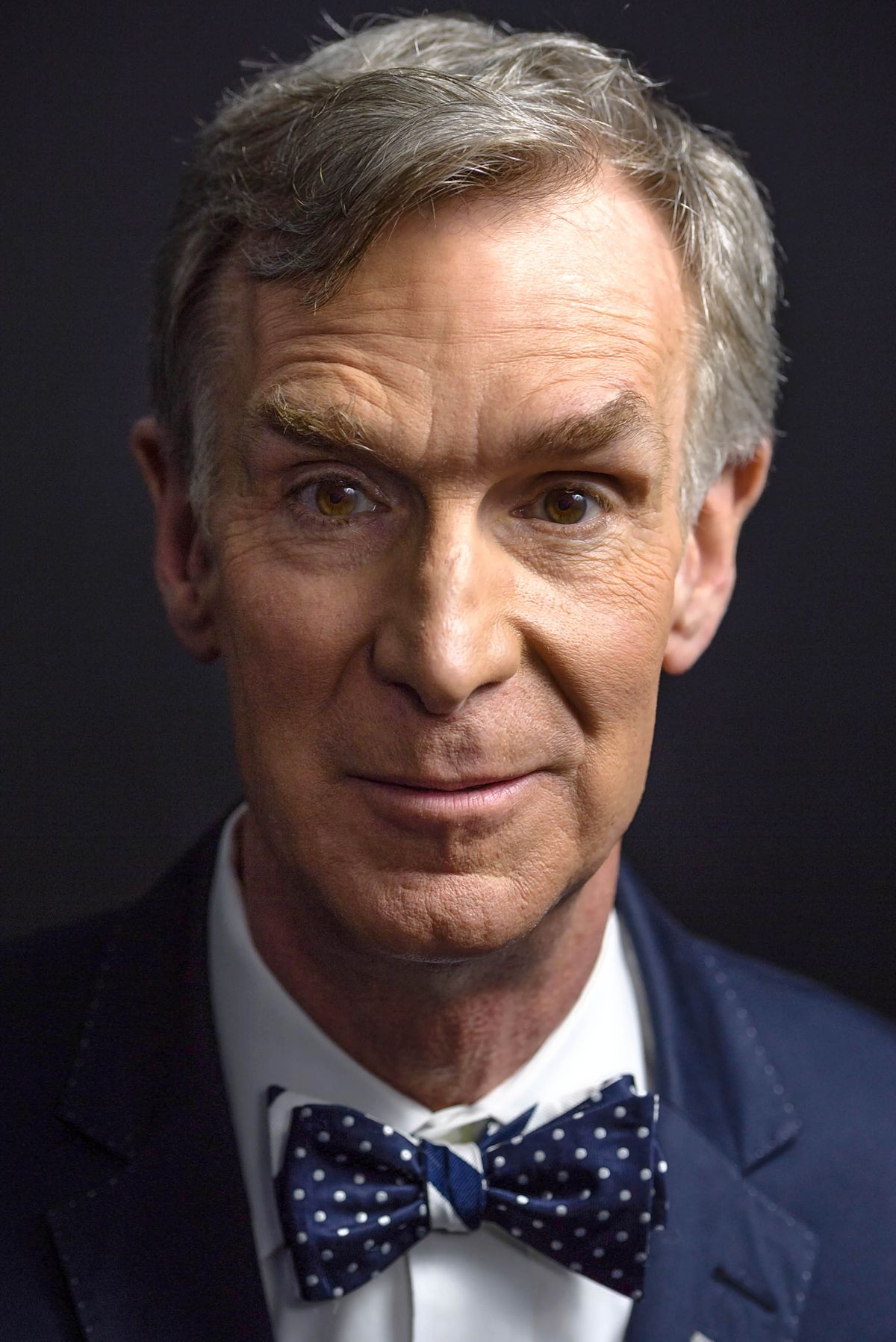
Bill Nye
American television presenter
16
APPEARANCES
14
PODCASTS
Aug 13, 2026


Tony TalatoHOST
As far as disasters, u- unfortunately, there's a lot to choose from these days, but how did you sit down with Seth and Brannon and decide which ones to do?

Bill NyeGUEST
We not only s- uh, uh, we had a list, but we had ones that were possible that we could produce.
Bill NyeGUEST
You know, in the 21st century, you're gonna do a disaster show, you're gonna have digital effects.
Bill NyeGUEST
So how much, you know, if you're gonna flood an entire city, how much, how much trouble can you go to? Then, so then how many shows are we gonna do? 11? That was thrown around for a while.
Bill NyeGUEST
10, 15? I mean, the, the studio or the f- people with the money decided six was what we could afford, so we picked our top six.
6 MINS LATER


Katie PetersHOST
Now, can you tell us a little bit about when you started your partnership with the National Ataxia Foundation?
Bill NyeGUEST
I'll tell you, my brother especially was, you know, "Bill, you should use your celebrity to do something for ataxia.
Bill NyeGUEST
You should do something." You know, "Why aren't you out?" And I go, "Well, it's..." We all grew up with it.
Bill NyeGUEST
We all in, uh, my family, we all live with it, and there ain't much, known much you can do with it until two and a half years ago, two separate groups of researchers discovered the gene repeat that causes spinocerebellar ataxia 27B.
Bill NyeGUEST
It was first called SCA, spinocerebellar ataxia 50, 5-0, but then they, it, you all realized that it was really part of 27.
Katie PetersHOST
Can you just educate our listeners about what Friedrich's ataxia is and how it differs from other ataxias?
Katie PetersHOST
What was sort of the time span of sort of you learning about that diagnosis and sort of how did it impact your childhood even into adulthood?

speaker_1ADVERTISER
Watch now.
Bill NyeGUEST
I'm talking about fundamental astronomy that lets us know where we are in the cosmos.
6 MINS LATER
speaker_6ADVERTISER
Hey, ho, let's go

speaker_1HOST
Could you tell us about how you've addressed that uncertainty in terms of seeking answers and also how you've managed any kind of medical anxiety? This might be helpful for our listeners.
Bill NyeGUEST
So first of all, when you grow up in a family with ataxia, every time you lose your balance, Every time you lose your grip on a wet glass or whatever the heck it is, you figure that's it.
speaker_1HOST
There's still a lot of things that could be gleaned, but what is your perspective on those gaps?


Bill NyeGUEST
... that that weekend after the second one came out, every big city in North America had one or two comedy clubs, and along with that, uh, Warner Brothers Records sponsored the Steve Martin lookalike contest.
Bill NyeGUEST
The guy who had been my freshman roommate, Dave Lax, was still a friend of mine, and he comes hurrying over to, "You gotta see this guy.
Bill NyeGUEST
He talks like..." I went and I saw this, the video of Steve Martin at the Boarding House.
15 MINS LATER


Bill NyeGUEST
Uh, NASA has funding streams in virtually, oh, in every congressional district in the United States, certainly every state of the United States.
Bill NyeGUEST
The thing that's happening again is something like the Office of Management and Budget is trying to, uh, cut NASA funding by twenty percent, cut science by forty-six percent, and this is very much not in the national interest.
Bill NyeGUEST
Everyone in the US, everyone around the world, was inspired by the Artemis 2 mission, where, uh, four extraordinary people went beyond the Moon and came back.

Antonia HyltonHOST
So tell me, if the US does end up pulling back on all of this investment in science, who or what fills the vacuum, you think? Is it, you know, the private companies like Blue Origin and SpaceX? Is it one of the countries that we compete with, like China?Where does this go?

Dan LambeHOST
So do you mind for our listeners just backing us up a little bit? And how did you start down this path?
Bill NyeGUEST
And that through that combined with some sort of mistake, In the admissions department at Cornell University, I went there in major mechanical engineering because I like bicycles and I really like airplanes.
Bill NyeGUEST
So then the guy who had been my freshman roommate, senior year, he went into material science.
15 MINS LATER
Dan LambeHOST
Do you mind telling us a little bit about the Planetary Society for our listeners so they know a little bit more about the organization and how they might be interested in engaging?


Kaitlan CollinsHOST
But what, what would you say to someone who's, like, looking at all that private investment and, and looking at it differently than they did decades ago?


Bill NyeGUEST
So s- there's something that nobody talks about because everyone is, "Oh, my gosh, there's a ball of fire coming through, and it's gotta, you know, and the heat energy has to dissipate, and it's dangerous." Yes, all that's true.
Bill NyeGUEST
Uh, but we talk about it as though it's a necessary evil, when in fact it's a high- highly desired fact that you don't need fuel to slow down out of orbit.
50 MINS LATER

Bill NyeGUEST
Do you know that the International Space Station is the only after the waging of war, is the International Space Station the greatest investment of human capital that the world has ever seen, of international capital?

Bill NyeGUEST
No, it doesn't happen for free, but it happens for a tiny fraction of the federal budget.
Bill NyeGUEST
You ask, you walk down the street and you ask somebody, They'll say NASA budget is 10%.
Bill NyeGUEST
And the return the United States gets for goodwill, NASA is the best brand the United States has.


Bill NyeGUEST
When I was in school, the, nobody had a reasonable explanation what happened to the ancient dinosaurs.
Bill NyeGUEST
Now, uh, the Alvarezes proved pretty much to everybody's satisfaction that it was an asteroid impact, and you can see what happened here on Earth, uh, in that same era, or maybe epoch, where this, uh, solar system was bombarding the Moon and the Earth.
33 MINS LATER

Sarah El-AhmedHOST
Why is now the moment that you feel like it's time to step out of this role? Is it just a nice, round 15 years, or is there some moment in your life that you've kind of decided is the catalyst for this?
Bill NyeGUEST
My anniversary was in September of 2025, for you listeners who may not be listening in 2026 [laughs].
Bill NyeGUEST
So I'm, I think this is a good ti- And by the way, everybody, they're not letting me leave.
6 MINS LATER


Bill NyeGUEST
... with these, these voting districts that are a tortured shape on a map, geome- geographically misshapen voting districts, and this has polarized the country.
Bill NyeGUEST
Both sides gerrymander, to be sure, but the way it's gone right now, it's really favored, uh, people who, who are not open to change.
Bill NyeGUEST
S- in science or s- uh, the practice of science or the body of knowledge of science, there is change.
Bill NyeGUEST
People didn't know there was Pluto-... then Pluto was found, and it was v- it's very shiny.
7 MINS LATER


Katie GreifeldHOST
Tell us about what the reception has been like from the Trump administration, from Congress, in trying to push back against some of these proposed cuts.
Bill NyeGUEST
So both the Senate and House have pushed back, rejecting virtually all of the proposed cuts.
Romaine BostickHOST
And I'll seriously, I mean, talk a little bit about why that's important for the average person, because I think the average person looks at this and just thinks, OK, we're just shooting stuff up into space just for, you know, you know, just for giggles.


Bill NyeGUEST
Well, so, uh, the pre- the premise of the bit back in 2009 was carbon dioxide, i- if you think of it as, um, the greenhouse gas that keeps the earth warm enough for all of us to be here, to have liquid water, solid water, and gaseous water all at the same time, that's great.
Bill NyeGUEST
If you, uh, think of it as the, uh, chemical, the, uh, compound that nourishes plants, that enables them to metabolize and for you and me to have food, that's really good.
Bill NyeGUEST
But if you have too much carbon dioxide, then the world's getting warmer at an, right now, uncontrollable weight- rate, and that's bad.
Bill NyeGUEST
So carbon oxide is a gas that is both good and bad, and Mr. Zeldin and his colleagues have embraced the idea that it's only good, and so therefore it's not a pollutant or it doesn't endanger anyone as was discovered, as you said, back sort of 1950s, but especially in the 1980s.
Bill NyeGUEST
People pointed out (clears throat) that if you have too much of it, that we're gonna have serious pro- problems here on Earth, and so I'll just say categorically, I'm not...