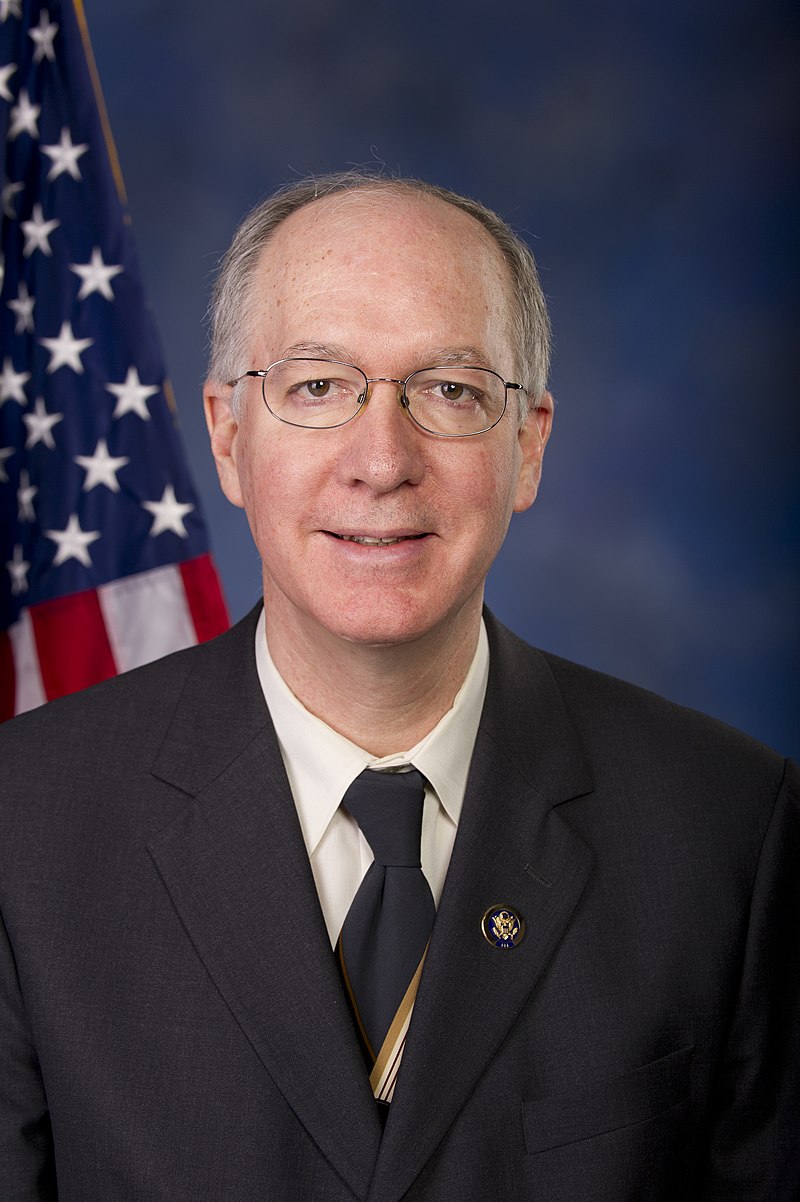
Bill Foster
United States Representative
5
APPEARANCES
5
PODCASTS
Sep 17, 2026


Brittany LewisHOST
that he believed that the companies he worked for both anthropic and open ai are racing straight to self-improving super intelligence and gambling with our lives one of his former colleagues chimed in there on that post and he said that he believed there's a more than 10 chance that within the next decade ai can kill us all since then industry leaders have said whoa we need to pump the brakes here a little bit on ai we need to slow down when it comes to ai and we need some regulation As a member of Congress, what do you make of all of this talk around AI?

Bill FosterGUEST
My first program, Neural Networks, the technology behind all of this, back in the 1990s when I was working in a particle physics accelerator lab smashing protons and antiprotons together to make particles that haven't been around since the Big Bang.
Bill FosterGUEST
During my time there, I designed 10 integrated circuits, and I'm very proud they all worked the first time.
Bill FosterGUEST
I was really first startled by the progress back in around 2012 when neural networks started outperforming people for image recognition, for telling the difference between pictures of flowers and cats and dogs.
Bill FosterGUEST
I remember it was about 10 years ago that I first went up to the microphone at the Democratic retreat where we get together and stare at our belly buttons and try to understand the future of the Democratic Party.
7 MINS LATER
Brittany LewisHOST
What do you make of that? Are you critical of that? Because any other industry in this country, if someone said, hey, I just made a product and I made a ton of money on it, but it also could kill all of humanity, wouldn't we be putting some of the onus on them?

Garett PyleHOST
And just like you, I am so excited to learn about it, because here at Sustainable Week, you're hearing about all the new innovations that's happening.
Bill FosterGUEST
I'm the Army Functional Lead for the Department of War's Joint Transportation Management System.
Bill FosterGUEST
It's a Department of War initiative program but it's being program managed by U.S. Transcom at Scott Air Force Base, Illinois.
Bill FosterGUEST
And I'm really excited about the opportunity to be here during sustainment week to get the message out.


Bill FosterGUEST
And important, as I said in the book, you know, we don't drink, smoke, take drugs or anything like that.
Bill FosterGUEST
We left the party early because he had his own business and he gets up at 5.30 in the morning.
1 HR 9 MINS LATER


Sanjay PuriHOST
When an AI agent acts on my behalf, how does the other side know that it is really authorized by me? I mean, will the agents also need some kind of an ID? You kind of touched on this, but now we are moving into agentic AI and who's on the hook when somebody gets it wrong legally.
Bill FosterGUEST
Now, what should the rules be? And the problem is it starts by having the human who is authorizing the agent to do something.
Bill FosterGUEST
And then you have to give clear instructions to the agents that say, okay, you can buy a used car, but for me, but don't spend more than $15,000.
10 MINS LATER
Sanjay PuriHOST
How worried should our audience be or should we be that our adversaries are already storing encrypted data to later crack?


Dan PonemanHOST
There is that question of the 60% highly enriched uranium that is beyond what is now findable down there, and where are we now in terms of we've got this memorandum of understanding and so forth, and how does a responsible U.S. policy take the current situation and turn it to whatever the optimal result for our citizens would be?
Bill FosterGUEST
Well, I think, first off, I was really impressed by the team that was assembled to negotiate the JCPOA, the Iran nuclear deal.
Bill FosterGUEST
I mean, you had Ernie Moniz, MIT nuclear physicist, and a very, very extensive support from the national labs on this.
Bill FosterGUEST
I spent many hours in the SCIF getting classified briefings on the details of the fundamental representation there was that if Iran stuck to the terms of the deal and then at some point decided, OK, we're going to kick out the inspectors and just run for a nuclear weapon, that we still had a one year so-called breakout time.
Bill FosterGUEST
And so I spent a lot of time getting briefed on all of the different paths to a nuclear weapon because, unfortunately, there are a surprisingly large number of paths and the Iranians are capable of following any one of them.
Dan PonemanHOST
But just from a technical matter, with all of the tons of rubble that have been created on top of Natanz and Fordo, etc., Is it technically feasible, do you think, to find and account for the 60% that we still think is there?