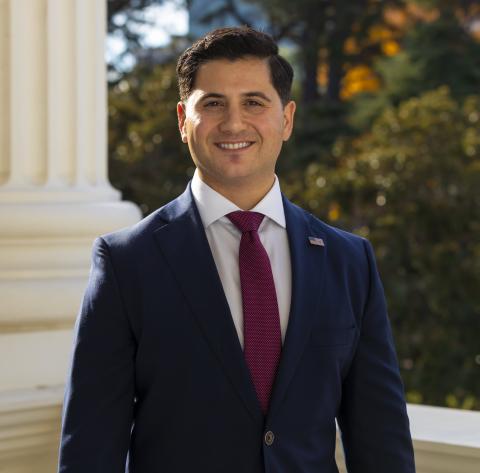
Bill Essayli
United States Attorney for the Central District of California
25
APPEARANCES
9
PODCASTS
Sep 22, 2026


James O'KeefeHOST
One of the frequently asked questions from the people, the millions of American people, but what about the people that are paying her? What about the people above her? Anything you could say about any of that?
27 MINS LATER


Bill EssayliGUEST
You may recall James O'Keefe actually went and did a hidden camera report down in Skid Row, and he saw, hey, wait a minute, there's all these shady characters down here, and they're paying homeless people to sign petitions.

John KobyltHOST
If James O'Keefe doesn't make this video, would Brass and his friends have gotten away with it? Was the video the key for your prosecution?
Bill EssayliGUEST
So Congress has passed laws saying that only U.S. citizens are allowed to participate in federal elections.
Bill EssayliGUEST
And so they've relied on states to do their jobs and to ensure that only citizens are on the voter rolls.
Bill EssayliGUEST
It's kind of a recent phenomenon where you have states sort of just Looking the other way and just registering people through the DMV and all this mass registration stuff, and they don't really care if you're a citizen or not.
Bill EssayliGUEST
They just want to get people registered to vote so they can harvest those ballots and win their elections.
Bill EssayliGUEST
So we're in this position where I think the law hasn't fully caught up to where we are in time, which is you have states that have basically abandoned their responsibilities as responsible states.
Bill EssayliGUEST
But between that juror speaking out and the defense attorney and your last guest, I think it's important that we push back.
John KobyltHOST
What do you do in the next trial with trying to get your message that you just articulated across to a new set of jurors? Because clearly this first set didn't get it.
Bill EssayliGUEST
But between that juror speaking out and the defense attorney and your last guest, I think it's important that we push back.
John KobyltHOST
What do you do in the next trial with trying to get your message that you just articulated across to a new set of jurors? Because clearly this first set didn't get it.


Michael MonksHOST
So this is just something that you're not going to consider or you can't consider?
Bill EssayliGUEST
It's extremely difficult to move, to change the venue of a case out of jurisdiction.
Michael MonksHOST
What can you tell us about what went down this morning in that area well known for prostitution and trafficking?
Bill EssayliGUEST
But between that juror speaking out and the defense attorney and your last guest, I think it's important that we push back.
John KobyltHOST
What do you do in the next trial with trying to get your message that you just articulated across to a new set of jurors? Because clearly this first set didn't get it.
John KobyltHOST
Newsom said he already closed down the offending hospices years ago and that there is no fraud going on.
Bill EssayliGUEST
He put in a moratorium, so he says, oh, we're not going to give out any new hospice licenses.
Bill EssayliGUEST
So there's already plenty of fraudulent hospices out there that are operating.
33:23

with the election? I mean, with the governor's election and the mayor's election?
Bill EssayliGUEST
And we've already brought one case just about a month ago where an individual caught undercover by James O'Keefe was registering homeless people to vote using fake information and paying them to do so.
Richard WeinbergPANELIST
How do you have an integrity system when you're mailing out absentee ballots when they're unrequested?

Richard WeinbergPANELIST
So what's gonna happen with the election with the go- I mean, y- with the, with, with the governor's election and the mayor's election?
Bill EssayliGUEST
Our job is to investigate violations of federal law, and, uh, we've already brought one case just, uh, about a month ago where an individual caught undercover by James O'Keefe was, uh, registering homeless people to vote using fake information and paying them to do so.
Bill EssayliGUEST
We have other investigations ongoing on election fraud, but what I'm talking to you about is the system.
Bill EssayliGUEST
They've basically, in the state of California, they've decriminalized election fraud with the way they register voters, and then you have to understand what else goes with that.
Richard WeinbergPANELIST
How do you have a integrity system if when you're mailing out absentee ballots when they're unrequested?

speaker_3HOST
with the election? I mean, with the governor's election and the mayor's election?
Bill EssayliGUEST
And we've already brought one case just about a month ago where an individual caught undercover by James O'Keefe was registering homeless people to vote using fake information and paying them to do so.
Richard WeinbergPANELIST
How do you have an integrity system when you're mailing out absentee ballots when they're unrequested?


Bill EssayliGUEST
That's a great question, and you really have to understand what California's done over the last about decade in this election space.
Bill EssayliGUEST
I was in the legislature before I was appointed by the, by the president to be in my current position.


Bill EssayliGUEST
And you really have to understand what California has done over the last about decade in this election space.
Bill EssayliGUEST
I was in the legislature before I was appointed by the president to be in my current position.
6 MINS LATER
Bill EssayliGUEST
Uh, every DEA agent is, uh, teamed up with a LAPD officer, and, uh, we're here to support them.
Bill EssayliGUEST
Obviously, if there's somebody selling drugs or committing a federal crime, uh, we will, we will take that.
Bill EssayliGUEST
That's why this is a task force, and I'm gonna give huge, huge credit today to LAPD.
John KobyltHOST
You've been working well with them on these, uh, on these raids that you've been doing.
Bill EssayliGUEST
I mean, every time I'm down there and I see these, these Jeeps handing out crack pipes and, and needles and all, everything you need to use drugs, the word on the street is that they also deal drugs because it's very convenient that you would be in a position to do hand-to-hand exchanges with the people who are addicted to drugs.
Bill EssayliGUEST
As you're handing them the paraphernalia, you'd want to supply them the drugs as well.
Bill EssayliGUEST
But we didn't, we didn't have any concrete evidence of it until this case, which is frankly a little seren- uh, serendipitous to how it happened.
Bill EssayliGUEST
It was while we were getting ready to do the MacArthur Park takedown that we did about two weeks ago, LAPD happened to pull him over and find the drugs in his car, and it was the same day or, or just the day before we did that takedown.
Bill EssayliGUEST
So we weren't able to charge him in time to include him in that takedown, but we have since worked it up, uh, since then.
John KobyltHOST
Just explain to people that it, w- when the state or local authorities don't want to take on cases like this for their, you know, for political reasons, right? Um, what gives you the right to come in to a local jurisdiction and slap federal charges? H- how, how does it transform into a federal crime and gives you the power to, to bust up, uh, these drug gangs?
Bill EssayliGUEST
So actually, if you want to call it phase one, phase one started in March when we indicted and arrested a bunch of the MS. I'm sorry, not MS, but the 18th Street gang members, the leadership, the people actually running the gang organization that was done by FBI.
Bill EssayliGUEST
Remember that claims this territory, this the north part of MacArthur Park is claimed by the 18th Street gang.
Bill EssayliGUEST
This morning, we conducted multiple arrests and raids throughout Southern California this morning, and we did that in conjunction with the Vice President's new Task Force on Fraud.
John KobyltHOST
It's a tremendous amount of crime they were involved in and how you guys busted the whole operation because I know it isn't easy.
Bill EssayliGUEST
This involves what's called the 18th Street Gang, which actually originated right here in Los Angeles.
Bill EssayliGUEST
They've got over 100,000 members nationwide, and they also have members in Central and South America.
Bill EssayliGUEST
They control, you know, each gang sort of claims control of a particular area or neighborhoods.
Bill EssayliGUEST
Of interest, this gang claimed the north side of MacArthur Park, and I'm sure you're very familiar with MacArthur Park and all the lovely things that happen there.
John KobyltHOST
So is there going to be a noticeable, visible change in the atmosphere around MacArthur Park after these arrests and indictments? Or do you still have a lot of work to go?
Bill EssayliGUEST
He had contracts to house 600 homeless people and to feed them three nutritious meals a day.
Bill EssayliGUEST
What did he do with the money? He used it as a down payment for that mansion in Westwood.
Bill EssayliGUEST
Did she win – did she get elected sheriff that I'm not aware of? Because that's not really her call.
Bill EssayliGUEST
They want to set up a confrontation between federal and local law enforcement.
Bill EssayliGUEST
That's what all these laws they're trying to do with the mask ban, making that a crime.
Bill EssayliGUEST
What they're trying to do in other contexts is they want – local law enforcement to resist and stand up to federal law enforcement.
John KobyltHOST
Explain the violation that is being charged here and explain the Equal Protection Clause.
Bill EssayliGUEST
Under the Constitution, it is illegal and unlawful for the government to make decisions based on race.
Bill EssayliGUEST
And that is what we're alleging California did when it designed or drew the Prop 50 maps, when the legislature drew that.
John KobyltHOST
How long does a case like this have to go through the system here? I mean, is this a quick decision or a quick analysis of the maps by the federal judge, or is this going to be a lengthy, twisted thing?

Charlie KirkHOST
What is, what are some of the fights that you guys are engaged in in California to bring down crime? Please walk us through it.
Bill EssayliGUEST
And, uh, since I've gotten here in April, we have, uh, taken on a huge initiative here.
Bill EssayliGUEST
I would say the first thing I've made a priority is going after this homelessness fraud that happens here in the state of California.
Bill EssayliGUEST
We've had $24 billion spent over five years, and it's only gotten worse and, uh, there's a lot of people who've seen, been enriched off that.
Bill EssayliGUEST
So, we have open investigations into that and I think you'll be seeing some of the fruits of that here very soon.
Charlie KirkHOST
Uh, so, so, uh, w- walk us through what are the other issues that we are fighting h- that you are fighting first hand in California and how present is the cartel activity?

Bill EssayliGUEST
It's designed to inflame the public's emotions and to delegitimize our federal agents.
Bill EssayliGUEST
And so what we saw there was an immigrant attorney group hold the press conference, coordinated with this lady's family, and they even had a GoFundMe and a financial structure set up to raise money off of it as well.

Glenn BeckHOST
Uh, let's start with what happened in San Diego with the arrest that you've just made, uh, with the, uh, prosecution of the US Chinese citizen.
Bill EssayliGUEST
He got employed at some really sensitive, uh, technology companies where he stole trade secrets and other confidential proprietary information.
Bill EssayliGUEST
Um, and we're not just talking about any proprietary confidential information.
Bill EssayliGUEST
We're talking about systems that are used to detect missile launches and ballistic and hypersonic missiles.