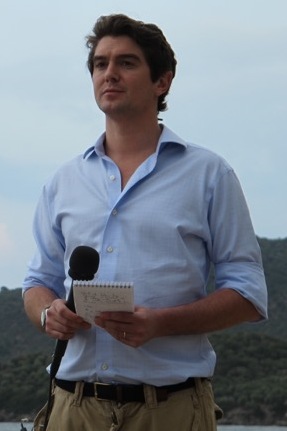
Benjamin Hall
British-American journalist
22
APPEARANCES
9
PODCASTS
Sep 17, 2026

Claire HarveyHOST
How was your reaction when you heard that news, and, and what does it make you think about the way that conflict's going in Ukraine?

Benjamin HallGUEST
I mean, I think Putin has been doing everything he can to stop people going to Ukraine, going to speak to Zelensky.
Benjamin HallGUEST
It's a big question about whether or not Boris Johnson was targeted, or whether it was a warning sign for people not to continue going in.
Benjamin HallGUEST
But, um, I think Russia has reached a point where it's on the back foot in the conflict, and it's gonna start escalating.
Benjamin HallGUEST
And not only is it gonna start escalating by launching gray zone attacks across Europe, um, sabotage, arson, cyber attacks, and we're seeing more and more and more of these.
Claire HarveyHOST
Do you ever wish that this had not happened to you, or do you feel as though, um, the gift that it has given you, this experience, was worth all the suffering?

speaker_3ADVERTISER
Look, Zawahiri went
Benjamin HallGUEST
from Egypt's sort of underground jihadist movement through prison and then into the Afghan jihad.
Benjamin HallGUEST
And I think Peshawar in Pakistan was the place where both his sort of Egyptian revolutionary ideology connected with bin Laden's money and his international network.
Benjamin HallGUEST
If you want to go back to talk about Zawahiri's past, He was radicalized in Egypt long before al-Qaeda existed.
Benjamin HallGUEST
And in Egypt, he joined these Islamic underground movements and he became involved with Egyptian Islamic jihad.
Benjamin HallGUEST
But it was only after President Anwar Sadat, who was the leader of Egypt at the time and who was considered a real reformer.

speaker_0ADVERTISER
Gambling problem? Call 1-800-GAMBLER.
Benjamin HallGUEST
Look, Zawahiri went from Egypt's sort of underground jihadist movement through prison and then into the Afghan jihad.
speaker_3NARRATOR
Benjamin Hall
Benjamin HallGUEST
And I think Peshawar in Pakistan was the place where both his sort of Egyptian revolutionary ideology connected with bin Laden's money and his international network.
Benjamin HallGUEST
If you want to go back to talk about Zawahiri's past, he was radicalized in Egypt long before al-Qaeda existed.
Benjamin HallGUEST
And in Egypt, he joined these Islamic underground movements and he became involved with Egyptian Islamic jihad.
Benjamin HallGUEST
But it was only after President Anwar Sadat, who was the leader of Egypt at the time and who was considered a real reformer.
speaker_10UNKNOWN
hero status on the streets of Afghanistan have only added to the problems of authorities trying to bring him to justice.
Benjamin HallGUEST
We flew into Pakistan, and believe it or not, about 24 hours after the Taliban-hosted al-Qaeda terror group had killed thousands of Americans and crashed buildings and planes and All parts of America, we were sitting down having tea with the Taliban ambassador to Pakistan.
Benjamin HallGUEST
And talking to him about what this was all about and why this happened and how they came to host this entity.
Benjamin HallGUEST
There was a lot of denials, as you can imagine, a lot of hand-wringing, as you can imagine.
Benjamin HallGUEST
But we found it myself, my cameraman, Mal James, and my producer, Kevin Monahan.
Benjamin HallGUEST
We found it quite eerie to be sitting there talking to somebody 24 hours after the country that that person represented had helped this terror group do so much damage to the United States.
33 MINS LATER
Barack ObamaSOUNDBITE_SPEAKER
That is not common sense.
Benjamin HallGUEST
I think the switch from the Bush administration to the Obama administration was a greater emphasis on the war in Afghanistan.
speaker_18UNKNOWN
ISIS came about really...
Benjamin HallGUEST
as a result of a perfect storm benjamin hall you had the syrian civil war on one hand a country that was in complete turmoil the assad regime was bombing indiscriminately around the country and there were pockets of resistance that were doing everything they could to fight back in that context some of these jihadi movements were able to rise up and get a lot of public and popular support against them at the same time you had what was happening across the border in Iraq.
Benjamin HallGUEST
One is that had the U.S. never gone in originally, then Saddam would have stayed in place, and perhaps you would not have ended up with the chaos that ensued.
Benjamin HallGUEST
But the other way of thinking, and the one to which I personally tend to lead, is that the U.S. had al-Qaeda on the back foot in 2007.
Benjamin HallGUEST
You had al-Qaeda in Iraq, who was the last little pocket of resistance down in the southwest, And after the Bush surge of 2007, they were on the run.
20 MINS LATER
speaker_40UNKNOWN
I am so happy now.

Benjamin HallGUEST
Now, Jeremy Corbyn is someone who was Labor leader, um, around five years ago or so, and he was-- wanted to leave NATO.
Benjamin HallGUEST
He's, he, he-- Andy Burnham has said in the last few days, he's not out there, nor is he trying to compete with the Reform Party, which is run by Nigel Farage, that has taken quite a lot of traditional Labor voters up north.
Benjamin HallGUEST
He's saying he wants to be more of a traditional labor socialist, and so he's definitely moving to the left, and it's going to be mainly focused on the economy where he wants to move to the left, and of course, that means largely funded by tax rises.
7 MINS LATER

Dave AnthonyHOST
Where does Andy Burnham fit into this? Where does the UK policy go when it comes to Ukraine?


Benjamin HallGUEST
Um, and I would, I would feature at least three artists a night, um, usually one rootsy, one, uh, in the middle, and, and, and one newer.
Benjamin HallGUEST
And I would try to tell as much, you know, historical facts about them and that sort of thing.
Benjamin HallGUEST
And, um, I think that, I can't remember, some- I think an album came out on Delmark, and I contacted Kevin to try to get that album, um, to have him send it to the studio.
Benjamin HallGUEST
And, um, I ended up talking with him, and I told him that my son was named after Junior Wells.
Benjamin HallGUEST
... years later, I contacted Kevin again because I was coordinating a, a, a jazz festival, and we were looking for specifically kind of a, a free jazz or kind of a, you know, psychedelic jazz act to play, um, as part of a series that we had.
Benjamin HallGUEST
And, um, I call, you know, contacted Kevin and, and he gave me the name of Jason Adasiewicz and, and he was, he was fantastic.
Benjamin HallGUEST
You know, you look at how Keir Starmer, the prime minister, has sort of fallen out with President Trump, particularly when it has come to how he did not support President Trump in his, um, attacks against Iran.
6 MINS LATER
Unknown podcast
Secret Service Under Scrutiny Again
Apr 28 · 32m
Karoline LeavittSOUNDBITE_SPEAKER
First Lady Melania Trump has led all of the preparation for the state visit, which will honor the longstanding and special relationship between the United States and the United Kingdom.
Benjamin HallGUEST
The president and the king will also hold formal talks at the White House today before King Charles later goes to Capitol Hill to deliver a speech to Congress.
Benjamin HallGUEST
You know, you look at how Keir Starmer, the prime minister, has sort of fallen out with President Trump, particularly when it has come to how he did not support President Trump in his, um, attacks against Iran.
Benjamin HallGUEST
He didn't allow the US to use air bases, Diego Garcia being one of them, and President Trump has spoken out very clearly about Keir Starmer.
6 MINS LATER

Benjamin HallGUEST
Um, and, uh, I just think get, allow kids to be imaginative and to think of other worlds.
Benjamin HallGUEST
And look, one of the things in this book is that the little hedgehog, he saves the forest, and he stands up against the big bear.
Benjamin HallGUEST
But he does so by writing, by drawing up these posters and spreading them around the forest, and I hope that children will read the book and then go, "Let me go write a poster.
7 MINS LATER

Eben BrownHOST
He's also about to debut a new Fox Nation series taking us all on a journey to visit America's churches.
Benjamin HallGUEST
It's only been in the last couple of weeks we've started to realize it's also because they don't really have the capability to send naval ships there.
Benjamin HallGUEST
Now, what we're looking at at the moment is, uh, you, you remember when the U- UK base in Cyprus was hit by Iranian drones, and immediately the UK said, "We've got to send a ship to, to defend it"? It turned out they didn't have a ship available to send.
Benjamin HallGUEST
They have one available ship at the moment, one destroyer frigate, one of them, and that was planned to go and lead a NATO, uh, naval drill in the, uh, Baltic Sea.
Benjamin HallGUEST
Do they send it to defend Cyprus, or do they send it up to the naval, um, the, the NATO naval, uh, drills? Now finally, after a week of deciding what to do, they got it into the water, and they sent it to Cyprus.
Unknown podcast
Escalating Standoff Between NATO And The U.S. Over Iran Conflict
Mar 30 · 17m
Eben BrownHOST
He's also about to debut a new Fox Nation series taking us all on a journey to visit America's churches.
Benjamin HallGUEST
It's only been in the last couple of weeks we started to realize it's also because they don't really have the capability to send naval ships there.
Benjamin HallGUEST
Now, what we're looking at at the moment is, uh, y- you remember when the U- UK base in Cyprus was hit by Iranian drones, and immediately the UK said, "We've got to send a ship to, to defend it"? It turned out they didn't have a ship available to send.
Benjamin HallGUEST
They have one available ship at the moment, one destroyer or frigate, one of them, and that was planned to go and lead a NATO, uh, naval drill in the, uh, Baltic Sea.
Benjamin HallGUEST
Do they send it to defend Cyprus, or do they send it up to the naval, um, the, the NATO naval, uh, drills? Now, finally, after a week of deciding what to do, they got it into the water, and they sent it to Cyprus.

Benjamin HallGUEST
We also had a big NATO navy drill in the Baltic Sea, which is starting, I think, in the next week or so, and our one ship, the HMS Dragon, I believe, was gonna go and lead this NATO drill.
8 MINS LATER
Benjamin HallGUEST
Yeah, it's a big question what comes next, and I know the regime has sent out text messages to every phone in Iran saying, "If you come onto the streets, you will be..." I can't remember the term exactly, but you will basically be killed.
Benjamin HallGUEST
Um, the question is, when can they rise up? What happens? To what degree does the regime have to be bombed before, a-and weakened until they can rise up? You mentioned the Basij militia there, and I think it's important to point out that these are the guys you often see on motorbikes going around really at the forefront of killing the protesters, the thirty-plus thousand who were killed.
Benjamin HallGUEST
It's the Basi-Basij militia, and we haven't seen many of them hit yet, and I wonder if that's the next phase for the US and for the Israelis.
7 MINS LATER
Benjamin HallGUEST
And I know the regime has sent out text messages to every phone in Iran saying, "If you come onto the streets, you will be..." I can't remember the term exactly, but you will basically be killed.
Benjamin HallGUEST
We will attack this as a s- as if you are the, the worst threat to the country.
Benjamin HallGUEST
Um, the question is, when can they rise up? What happens? To what degree does the regime have to be bombed before, a-and weakened until they can rise up? You mentioned the besieged militia there, and I think it's important to point out that these are the guys you often see on motorbikes going around, really at the forefront of killing the protesters, the thirty-plus thousand who were killed.
8 MINS LATER

Benjamin HallGUEST
My children were always worried where I was going, and it was this little hedgehog would send videos home, and it would say, you know...
Benjamin HallGUEST
We're in a new part of the world," and I'd tell them I was okay, and that they didn't, didn't need to worry.
Benjamin HallGUEST
This little hedgehog was in my body armor when we were attacked in Ukraine, and it survived, and I was barely alive for a few days.
Dave AnthonyHOST
And the, and, and this president, leading Syria, is going to help in the coalition that still exists against what's left of the Islamic State.
Benjamin HallGUEST
He's, um, Syria is now gonna become, the government of Syria is gonna become the 90th country to be part of the anti-ISIS coalition.
Benjamin HallGUEST
And it is so interesting to see this because, um, if we look back quickly about, uh, about where al-Sharaa came from, you know, he used to be called, uh, Mohammed al-Jolani.
13 MINS LATER
Dave AnthonyHOST
You reported when ISIS fell.... did you ever think that we'd have the president of Syria at the White House?
Benjamin HallGUEST
Well, I suppose we have to look, first of all, about how Russia has r- been responding to the ceasefire the last few days, uh, after Ukraine agreed to it and, uh, it was passed onto the Russians.
Benjamin HallGUEST
It seems as if the Russians and President Putin are not talking about a ceasefire.
Benjamin HallGUEST
They're talking about a ceasefire with conditions, which is effectively the peace deal.
Benjamin HallGUEST
Let's just stop the guns, the rockets for 30 days, and then we can talk about the next step.
20 MINS LATER
Benjamin HallGUEST
You know, what was really interesting is that when I wrote the first, I was actually still in hospital when I started to write it, and I thought that the toughest part was going to be that recovery, learning to walk, being in hospital, recovering from the serious injuries, and I actually found it was much tougher when I got home.
Benjamin HallGUEST
You know, when you're in hospital, you're surrounded by doctors and physios and therapists, and they build you together, and you have this team, and you've got one goal.
Benjamin HallGUEST
But when you take these injuries home, and you put added pressure on your family, getting back to your old life, you realize the things you can't do, you realize the way different people interact with you.


Benjamin HallGUEST
And I was, uh, just, eh, returned home from hospital and, you know, it was the middle of the night at 2:00 AM, and two people broke in downstairs and they were robbing the house. Now, our dog started to bark, and it was my pregnant wife, Alesha. She jumped up and said, "I've gotta go downstairs." And I said, "You, you've gotta wait for me. You can't go." She said, "I'm not letting them get near the children." And she was the one who ran downstairs, screaming, shouting, flailing at them, and she chased the robbers away. But what a reversal that was. I was the man of the house. I was the person who was supposed to protect our household, protect my family. And I was unable to do that. I couldn't get my prosthetics on in time. I was still upstairs. And that was a bit of a hit that time, because I realized that what a reversal. My wife had to step in when I couldn't do something. And that one moment actually had, you know, a bit of a hit on me. And, but, you know, my wife is an inc- incredible person who knows when roles reverse in some cases. There are things I can't do at home because of my injuries that she has stepped up and said, "I'll do that." And I, I say, "Well, I will do something else that you used to do." And so we have balanced out what we can do and what we can't do. And that, I think, is a great relationship. And I, I got through this because of her and her strength.
Benjamin HallGUEST
Yeah, you know, it was always interesting 'cause I've covered conflict for over 15 years and I've seen people injured the way I was injured and I'd seen people lose their lives, and I always asked myself, "What would it be like if it happened to me? How would I respond? Would I have the resilience?" And, you know, you never, you would never find out until it does happen to you, and then it did happen to me, and I have been immensely proud of how I handled it and how I managed to get through it. And what I have learned is that I think everyone does have the level of resilience inside them, but ma- many people don't realize it. But when your back is up to the wall, when you have no other choice, you do find it and it is inside everyone. And I... It was a learning curve, but I learnt quite quickly, even on my evacuation from Ukraine, it was this 10-hour brutal train ride with no pain meds and I was barely alive, I learnt even that early on that when the pain got too bad, that I was able to stop, focus, really concentrate, and try to bring that pain down. And it reminded me just how much the mind can control how you are feeling. And once I started to learn these lessons, I was able to use them time and time again. Um, I knew I could recover. I knew I was gonna be fine at some point. But again, it was the impact it would have on my family, my young children, and that, I think, is something I will always be working at. You know, my eldest daughter is almost 10 years old at the moment, and I thought that, you know, this was n- not going to be such a big issue for them, but just as they... 'cause they were young when they found out, but already I'm starting to see as she gets older and moves into her, you know, uh, uh, 10, 11, she's starting to talk more and more about it. So I'm aware that this is something that will be with us forever and we will constantly be finding ways to change it. But I write in the book that adapting is one of the most important things you can do. When walls come up, you adapt. You find a way around them. You address them. You don't just be so hot-headed that you do it one way. You learn to get round and find new ways of doing things, and that was a great lesson that I learned.

Brian KilmeadeHOST
So your first book was the number one bestseller in the country. It's, uh... And now this one, Resolute, comes out today. What do you want people to take away from this as opposed to your first?
Benjamin HallGUEST
You know, what was really interesting is that when I wrote the first, I was actually still in hospital when I started to write it, and I thought that the toughest part was going to be that recovery, learning to walk, being in hospital, recovering from the serious injuries, and I actually found it was much tougher when I got home. You know, when you're in hospital, you're surrounded by doctors and physios and therapists, and they build you together, and you have this team, and you got one goal. But when you take these injuries home and you put added pressure on your family, getting back to your old life, you realize the things you can't do. You realize the way different people interact with you. I found that to be really quite hard. I was struggling with a traumatic brain injury. I talk about some of the flashbacks. I talk about the pain as I kept trying to come off painkillers, and that was done just me and my family. And that is what the, the, uh, sort of what happens to so many people, I think, who ha- go through injuries, is that it is difficult when they're home. How do you get through that when you don't have that support anymore? And I've written very clearly about the, the hard times, the difficult times, and I suppose I've written it because I hope might be other people can read this book and it can give them influence, because when it came down to it, all these times were difficult, but at the end of every single one of them, I got through it, I found a way, and not for a second did I ever say... I will find a way through. I always did, and, and I've just tried to write about my thought process and, and how I did it.
Benjamin HallGUEST
Totally. I mean, I don't speak all that much about Ukraine, as I talk about going back to Ukraine, but, uh, what I have found is that, look, you may not be injured in the way I've been injured, but at the same time, everyone goes through some sort of traumatic event. Everyone has difficulties, whether that is just financial difficulties, whether that is anxiety or family, all those sort of things. You still gotta find a way to get through them. You still have to find a way to stand up and say, "You know, I'm not gonna let this hold me down. I'm gonna find a solution," and, um, that's what I've tried to talk about in the book. All these moments, and not just my moments. I've tal- brought other people into the book. I've brought in an inc- a lady, 21 years old, who was taken by Hamas and in the tunnels of Gaza and her story about how she rebuilt. I've spoken to American veterans about how they've gone through their injuries, and, look, there is a similarity in all their stories. When you are knocked down, all these people found ways of building it back up, and everyone's recovery is individual. You have to find what works for you, but you can use various ways that I write about in which you can try and harness resilience.
Benjamin HallGUEST
Look, n- neither side wants to give any land up, and I think that's gonna be, is gonna be one of the most difficult scenarios right there.
Benjamin HallGUEST
I don't think that either side will formally pass over, Russia or Ukraine, will formally pass over any land and, and draw new borders.
Benjamin HallGUEST
I think we will end up, wherever the line is, it will end up being in the same way we have in Korea, where it is just frozen.
Benjamin HallGUEST
You know, President Zelensky has been very, very clear that he will never formally give up Ukrainian land and make it part of Russia.
Benjamin HallGUEST
And on the other hand, Putin has said that those three parts, Donetsk, Donbas, uh, the, the three areas in the east, that they are now Russian and he will never give any of those up.
Benjamin HallGUEST
Now, you have any negotiation, both sides start off, you know, very far apart.
Dave AnthonyHOST
This book details Hall's recovery, which included surgeries and months of rehab.