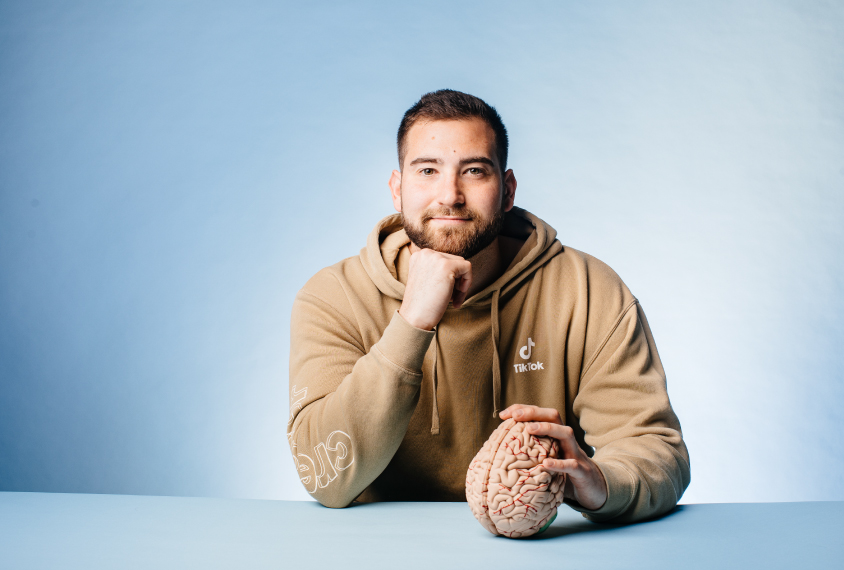
Ben Rein
Neuroscientist
18
APPEARANCES
17
PODCASTS
Oct 28, 2026


Ben ReinGUEST
Yeah, well, we're getting better and better at sort of measuring what's going on inside the brain.
Ben ReinGUEST
I think that in the next few decades, if we develop some new, you know, neuroimaging techniques, and it'll allow us to ask new questions that will provide interesting new answers.
Ben ReinGUEST
My career as a neuroscientist has really always centered around social interaction.
22 MINS LATER
Ronald HoffmanHOST
You have to put a, like an emoticon on it because you don't under, could it be a sarcastic comment? Could it be a hostile comment or could it be a friendly comment? And so you put maybe a little smiley con on there just to make sure that people are reassured that what you said can't be misinterpreted, but it is a shallow form of communication.
Ronald HoffmanHOST
And actually, you've done some studies on why is it that people online are so vituperative and are in attack mode so often? What is it about social media that's conducive to that type of discourse?
Ben ReinGUEST
Well, vituperative has to be the word of the day here on Intelligent Medicine Podcast.
Ben ReinGUEST
So remember I talked about how we are missing those social cues when we're interacting online, right? It flattens the texture.
Ben ReinGUEST
The research that exists on empathy suggests that our empathy systems are also engaged by social cues.
Ben ReinGUEST
So empathy is the process of sharing someone else's emotions, right? You see someone break their leg and you're like, oh my gosh, I feel horrible.
7 MINS LATER
Ronald HoffmanHOST
bummer, you know, anticipating rejection, you know, is it really worth it? You know, uh, it's all, you know, that kind of stuff.

Ben ReinGUEST
Yeah, you know, I think this gradual decline in connectivity that you're talking about can be traced back to what I was just talking about before, that we've automated so many services, that it's just, we've taken so many of these little you know, momentary interactions out of our lives.
Ben ReinGUEST
Obviously, we all went through the, you know, isolation associated with COVID in those early months when the lockdowns, nobody really left their house.

Maiken ScottHOST
Ben says we're not always good at noticing when we're lonely, when we're lacking social interaction and connection.

Ben ReinGUEST
And I like the way you're setting up these questions, too, because I generally think about the value and the importance of interaction as a two-sided coin on one side of the coin is isolation is bad for us on the other side of the coin interaction is is genuinely good for us in very different ways and so when you're connecting it's not that you're just avoiding the harm of isolation you're also experiencing other different benefits and so i'll tell you what those are um for one I mentioned that our brains have kind of evolved to reward us for being around others for the sake of survival.
Ben ReinGUEST
All social species have this, where when we connect with others, we have this oxytocin release, which oxytocin many people have heard of as this love hormone and neurotransmitter.
Ben ReinGUEST
What oxytocin does in the brain is it drives the release of two other neurotransmitters that you will have heard of, dopamine and serotonin.
Ben ReinGUEST
And those are both kind of thumbs up neurotransmitters and that, you know, more is generally pleasant.
32 MINS LATER
Christy WiepeHOST
How do you approach creating scientifically responsible videos to put on social media when the real answer to some of these questions is probably pretty nuanced and something going viral for example doesn't really lend itself well to nuance so how do you do this what's your approach

Ben ReinGUEST
yes so it's a it's a competition held at graduate schools um across the world i think it's not just the united states i'm pretty sure it's global or at least multiple nations and the challenge is you're a phd student you've been studying your research for however many years and you must now take all of that and compress it into three minutes and explain everything you can in three minutes to a to a live audience with no scientific background so it's the three minute thesis And I bring it up because, to answer your question, so I do some coaching for the University of Minnesota.
Ben ReinGUEST
I coach their contestants where I have them pitch their presentation and then I walk through it.
Ben ReinGUEST
And what I often experience is that they really struggle with the sort of ethical component of making their research, which is so complicated and so thoughtful.
Ben ReinGUEST
And there's hours and like thousands of hours going to thinking up the experiments and designing them and taking all of that and distilling it into something overly simplified.
Ben ReinGUEST
And I remember experiencing that for myself too, where I was like, no, no, I can't leave out this.
Amanda SturgillHOST
So can you talk about what it takes for you to make one of the videos that you make?

Ben ReinGUEST
Yeah, thank you so much for having me, and I am just, as, Jess, as you were going through that monologue about yesterday's whatever it was, um, I have a lot of thoughts, and I wanna just kinda throw them out there quickly.
Ben ReinGUEST
Sarah, you mentioned that my, my research has focused on the neuroscience of social interaction.
Ben ReinGUEST
My PhD was focused on the neurobiology of autism and the genetics of autism and how various genetic alterations influence brain development and therefore may be associated with autism.
Ben ReinGUEST
So first off, um, autism is, it's called autism spectrum disorder because it is a spectrum.
21 MINS LATER
speaker_8HOST
[laughs]


Dan HarrisHOST
So like w- walk us through exactly how, you know, what are the-- what's happening in our brain and what are the downstream effects?
Ben ReinGUEST
When you connect with someone and you're having a positive interaction, there are three neurotransmitters happening and being released in the brain that together are responsible for something called social reward.
Ben ReinGUEST
This is this, you know, this feeling of just like sugar is pleasant, you wanna have more of it.
Ben ReinGUEST
Those three neurotransmitters are oxytocin, which is, you know, the love hormone, social bonding kind of molecule, serotonin and dopamine.
19 MINS LATER


Michelle YatesHOST
So can you talk about why is it healthy to interact with people, to have this social interaction?
Ben ReinGUEST
Um, it turns out interaction influences so many different bodily and brain systems.
Ben ReinGUEST
The, the big one that kind of underlies everything is that isolation is really, really bad for us.
Ben ReinGUEST
I mentioned that, you know, social interaction evolutionarily is sustenance in a way.
8 MINS LATER
Michelle YatesHOST
Can you describe how those differ from dopamine? I know they're usually seen in the same context, right? But they have different functions, I assume.


Dean SherzaiHOST
It was not just psychologically devastating, but physiologically devastating, wasn't it?
Ben ReinGUEST
Yeah, I, I believe now looking at modern science that examines solitary confinement, because actually I think in the United States, I believe 8% of prisoners are held in solitary confinement still to this day.
Ben ReinGUEST
What they find is that if you serve a 20-year jail sentence and you are held in solitary confinement for any amount of time, the year after their release, they were 24% more likely to die by any cause.
Ben ReinGUEST
Being isolated is obviously psychologically destructive, right? It just eats away at your wellbeing, but also in terms of a, like, a physiological standpoint, just what happens in the brain when we're isolated is equally devastating or maybe even more devastating because there's been evidence to suggest that when we are isolated, when...
Ben ReinGUEST
There's literally studies where you put someone into a little solitary confinement, basically, and you just measure their biology.
14 MINS LATER
Dean SherzaiHOST
So tell us about the quality of those relationships that, that are profoundly important.

Liz MoodyHOST
As a neuroscientist, do you think that we should try to be friends with people of different political beliefs or values than us?
Ben ReinGUEST
I think that the world would be a better place, and people would be healthier and happier if people who had different opinions could get along better.
Ben ReinGUEST
I get a little bit of hate for saying this, that like, you know, people on opposing sides of the political aisle should hang out and be friends.
Ben ReinGUEST
But if you think about it, in the United States right now, we are tensely politically divided.
Ben ReinGUEST
What does it do to your brain when you feel that when you go out in public, roughly 50% of the population cannot be trusted and is the enemy? It's really, really bad for you.
17 MINS LATER

2:35

So what happens to us when we don't interact with other people for long periods?
Ben ReinGUEST
Well, you know, as, uh, the introduction you gave there, um, with the reference to that episode, you know, you can kind of imagine being there, walking around a deserted world, feeling the emptiness and the loneliness of that.
Ben ReinGUEST
And I think for most people, that scenario causes a tightening of the chest, you know, a little bit of a elevated heart rate.
Ben ReinGUEST
And that's actually exactly what the science basically suggests, is that being isolated triggers a stress response in the body.
19 MINS LATER


Ben ReinGUEST
There are certain settings and scenarios where having an AI companion can be really useful.
Ben ReinGUEST
For instance, there's a bit of research looking at, um, how AI interactions can be used for sort of, uh, recovery after sexual abuse, that for those who have been sexually assaulted, having these kind of simulated AI date interactions can help establish comfort, you know, in those types of scenarios.
Ben ReinGUEST
On the other hand, going on an actual date with an AI chatbot, which is a realistic scenario nowadays, there are services that offer this, where you can pay for an AI companion.

26:53

Do you feel like historically we're less socially connected than we've been? Or do you think this is a manifestation of a lot of other factors?
Ben ReinGUEST
I think right now, today, and in the near future, we are in a special sweet spot of isolation.
Ben ReinGUEST
Because, number one, I mean, people are already becoming more isolated, as you're describing, just naturally, societally, culturally.
Ben ReinGUEST
Obviously, that was an intensely isolating experience for the length of that it lasted.
9 MINS LATER
36:39
So moving on to like the next last part, which is sort of the prescriptions, right? Like what's our solution to this problem? So I guess first question would be how much socializing do you need? Yeah.

speaker_6UNKNOWN
Yeah.
Ben ReinGUEST
So (laughs) there was a, a researcher, Luis McCullough, at, at University of Houston, and they were doing stroke research.
Ben ReinGUEST
Very scientifically, right? This isn't like, "Oh, the mouse had a stroke." It's like, "We occluded the artery for 30 seconds exactly," right? And it produces a very reliable area of damage in the brain because the oxygen and glucose aren't flowing, the cells die.
9 MINS LATER
speaker_12UNKNOWN
So what I'm saying is, if that person who's an introvert, but has their extroverted kind of supercharge, and they get that all the time, will that make them the same as an extrovert being happy over a period of time? Like...


Ben ReinGUEST
This also may have evolutionary roots, because like I just said, if you're cast out from your tribe, the brain would be wise to have a built-in system that basically makes you uncomfortable until you find community again for the sake of your survival.
Ben ReinGUEST
And studies have shown that when people are exposed to isolation, like if, you know, controlled environments, person goes into a NASA space station by themselves, they know what they're doing 30 days.
Ben ReinGUEST
But during the 30 days, their cortisol levels will progressively rise and they will remain elevated.
36 MINS LATER

Ben ReinGUEST
So most people have probably heard this, right? This is like a well-used and worn factoid.
Ben ReinGUEST
And the truth is that, yes, being isolated is associated with a significantly higher chance of dying than by any cause.
Ben ReinGUEST
And, you know, that doesn't mean that like you're more likely to get in a car accident, you know, not that, but that if you just track mortality, the likelihood of death period, isolated people are more likely to die.
Doug BopstHOST
Like how do you, from a science perspective, like how do you begin to unpack what it actually means to be lonely or to not be lonely?


Ben ReinGUEST
So thinking from an evolutionary perspective, humans are social animals, meaning we, we survive best in groups.
11 MINS LATER
18:17
So what I want to know from Ben Rein is what does the neuroscience say about young people, not those who are 80 and still have their wits about them? What about young folks and the suffering that they are experiencing today?


Ben ReinGUEST
Yeah, and that courage that you're describing is so key, right? Because one of the things in the book that I talk about, I have a whole chapter devoted to this idea of our brains are very bad at making social predictions.
Ben ReinGUEST
And we have all these internal barriers that hold us back from connecting with others.
Ben ReinGUEST
And, you know, there's a lot of examples of this, but... what it basically boils down to is that we often like underestimate how much a social interaction is going to benefit us.
Ben ReinGUEST
And we, we have doubts and we have fears and anxieties and, you know, it takes courage to do honestly what you did to go and show up.
Ben ReinGUEST
I mean, especially, I mean, God, for me, I'm thinking like, not only do you have to meet people, but you have to perform athletically in front of them, right? Like what if you suck? And there's just, there's so many reasons you could think of that you could convince yourself not to do it.
Ben ReinGUEST
But I'm sure, I mean, as you described, when you did it, it felt great and it was rewarding.
13 MINS LATER