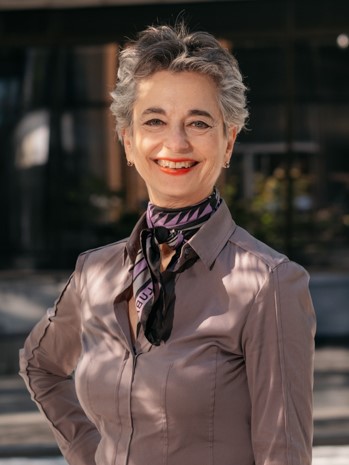
Barbara Slavin
American journalist
12
APPEARANCES
8
PODCASTS
Jul 29, 2026

Sam HawleyHOST
[laughs]

Barbara SlavinGUEST
[laughs]No, it's absolutely crucial, and both of them are, you know, facing a lot of criticism.
Barbara SlavinGUEST
Now, Netanyahu is, uh, an extremely accomplished politician, and Israel has very complicated politics, uh, that involve threading together all of these complex coalitions.
Barbara SlavinGUEST
Trump, on the other hand, is facing almost certain defeat in the midterm elections.
Barbara SlavinGUEST
He's trying to muck with the system to make it harder for people to vote, and there's a lot of paranoia about efforts that he may make, uh, to interfere with elections.
Barbara SlavinGUEST
But I think people are prepared, and the Democratic base is energized and extremely angry over everything that has happened over the last, uh, couple of years since Trump came in, uh, uh, for a second time.
Sam HawleyHOST
Mm-hmm.


Barbara SlavinGUEST
Well, the text of the agreement has not been released, so all we have are the media leaks, which suggest there will be a two-year period, uh, during which the United States and Saudi Arabia will study whether it i- it makes sense economically and in other ways for, for Saudi Arabia to enrich domestically.
Barbara SlavinGUEST
But I should just add that even if the Saudis do eventually have a facility to enrich uranium, they still can't manufacture fuel for a nuclear reactor.
Barbara SlavinGUEST
They would have to send the enriched uranium out of the country to produce the fuel assemblies for a reactor.
8 MINS LATER


Ahmed MoorHOST
But what's to prevent the unraveling of the of the policy taking shape in the next administration.
Barbara SlavinGUEST
I mean, the question for me is whether we can get through the rest of the Trump administration without a new war and a worse war, whether this kind of no war, no peace situation can be extended, whether the MOU can be extended if there is not.
Barbara SlavinGUEST
a real agreement between the United States and Iran which is going to be very, very difficult to accomplish.
Barbara SlavinGUEST
So, you know, I think we're going to see changes in the region that are going to have an impact.
Barbara SlavinGUEST
We're already seeing countries, Arab countries in the GCC, for example, diversifying relationships, distancing themselves in various ways from the United States, trying to find ways to co-opt Iran, bribe Iran into not attacking them again.
14 MINS LATER
Ahmed MoorHOST
What is it? Is Iran fundamentally emotionally committed, historically committed, strategically committed? What is it about Lebanon that requires the Iranian leadership to say that, in fact, our destiny, our future is linked to this small, unfortunate country on the Mediterranean?


François PicardHOST
Listing there to Richard Verli, do you see Trump basically crossing out the words JCPOA, putting his name on it and going with the same deal?
Barbara SlavinGUEST
It won't be the same deal because the United States, first of all, has lost the leverage that the military option supposedly gave it.
22 MINS LATER
François PicardHOST
clip of J.D. Vance that we just played, and you have the sense that we may see a normalization of exchange of ambassadors almost when you listen to


Barbara SlavinGUEST
Well, I tend to believe the Iranians when it comes to this more than Donald Trump.
Barbara SlavinGUEST
And the fact that Abbas Arachi, the foreign minister, has said that they're close suggests to me that, yeah, this is real.
Barbara SlavinGUEST
There's so many reasons why really both sides want to end this fighting or at least end this phase of war.
Barbara SlavinGUEST
U.S.-Iran animosity, not the least of which Donald Trump celebrates his 80th birthday on Sunday.
5 MINS LATER

Barbara SlavinGUEST
Well, I tend to believe the Iranians when it comes to this more than Donald Trump.
Barbara SlavinGUEST
And the fact that Abbas Arachi, the foreign minister, has said that they're close suggests to me that, yeah, this is real.
Barbara SlavinGUEST
There's so many reasons why really both sides want to end this fighting or at least end this phase of war.
Barbara SlavinGUEST
U.S.-Iran animosity, not the least of which Donald Trump celebrates his 80th birthday on Sunday.
5 MINS LATER

Sami ZeidanHOST
Barbara, has there been any movement or indications of movement in the US position on some of those issues that were dragging this out?
Barbara SlavinGUEST
There have been a lot of leaks, uh, and it's hard to know how, you know, authoritative they are.
Barbara SlavinGUEST
It's going to resolve the issue of the Strait of Hormuz, and perhaps result, uh, in, um, if not some unfreezing of assets now, then a pledge of unfreezing of, uh, some of Iranian assets in, in Qatar.
Sami ZeidanHOST
Barbara, how, how is that likely to go down with some aspects, some parts of the MAGA movement, um, which has been very vocal, uh, calling for a resumption of the war, saying, "Forget these talks"? And if there has been movement on the US position on some of those points, like the, the dilution of highly enriched uranium, like a timetable for the release of Iranian assets, how is that gonna be s- perceived domestically?

Sydney PeadHOST
Barbara, who do you believe is in command in Iran right now and what are they trying to achieve? Because despite all the assassinations, the Islamic regime remains in place and there's been no uprising that Trump called for at the start of the war.
Barbara SlavinGUEST
And there, you know, there was hope among some that US and Israeli attacks would actually bring about the demise of the regime.
Barbara SlavinGUEST
So I wouldn't say that the regime has been strengthened by this, but people have now seen the consequences of war.
Barbara SlavinGUEST
It probably will be a while before people will be willing to come out in the streets.
Sydney PeadHOST
So what do you think, Barbara? At this stage, who do you feel is winning the war, or at least has the upper hand?
James BaysHOST
So who gets the most, Barbara, out of this relationship? Does China get more from Iran, or is it the other way around?
Barbara SlavinGUEST
I think, uh, even though it's perhaps, what, ten, fifteen percent of, uh, oil that China gets from Iran, it's ninety percent of Iran's oil exports that go to China.
12 MINS LATER
Barbara SlavinGUEST
Well, we know that he has been obviously very influential for quite a long time.
Barbara SlavinGUEST
In fact, I wrote a short profile of him in 2019 when he was considered at that time already a possible successor to his father.
Barbara SlavinGUEST
Moshe is rumored to have played a major role in orchestrating the fraudulent reelection of Iran's President Mahmoud Ahmadinejad in 2009 during the Green Movement.


Hamish MacdonaldHOST
Do you think the idea is to keep this going until such time as that happens in some fashions?
Barbara SlavinGUEST
I don't think the quote-unquote Iranian people are in a position to overthrow this regime.
Barbara SlavinGUEST
It has very, very large security forces who have the preponderance of military might.
Barbara SlavinGUEST
So until or unless we see major defections within the Islamic Revolutionary Guard Corps, I don't think we're going to see that sort of situation.


Barbara SlavinGUEST
I, I think 80% or more of the Iranian people would love to get rid of the system of government they've had for the last 47 years.
Barbara SlavinGUEST
But, of course, this is all easier said than done, as we saw in January when protests were put down absolutely brutally.
Barbara SlavinGUEST
Uh, and I have no doubt that the regime would do the same to, to these protests, uh, although I think they're letting people let off a little bit of steam.
Barbara SlavinGUEST
As you mentioned, 40 days is a mourning period in Iran, and so it was expected that people would protest again 40 days after the last protests.
Barbara SlavinGUEST
Also, college campuses have reopened, and college students historically have protested in Iran.
Mary ReichardHOST
Is there a path to regime change that doesn't involve outside help? And, uh, how much do you think the military buildup has emboldened the protesters to come out again?