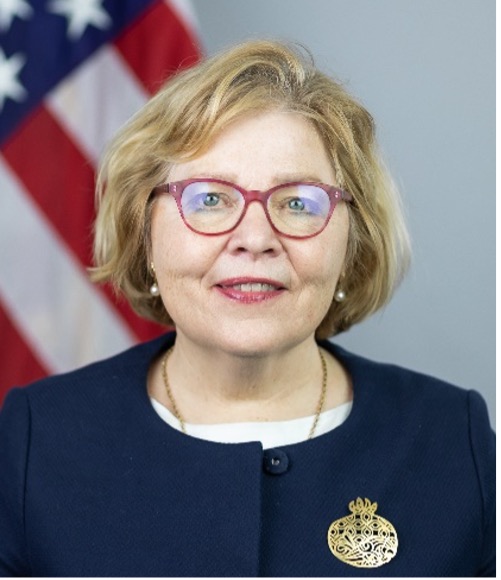
Barbara A. Leaf
Former United States Assistant Secretary of State for Near Eastern Affairs
7
APPEARANCES
4
PODCASTS
Jul 14, 2026


Barbara LeafGUEST
I mean, uh, diplomacy is always something that is available and that, that one should think to resort to, especially when the military tools are of diminishing utility as they are now.
Barbara LeafGUEST
As I say, the Iranians have, as an asymmetrically imbalanced power, then, in other words, the US and US Israel certainly can overmatch the Iranians in conventional military power.
Barbara LeafGUEST
But we've seen the stark limitations of achieving, uh, strategic goals from the air, from standoff strikes.

Sally SaraHOST
Barbara, just briefly, the bigger picture, what sort of conversations are happening in places like Washington DC about the reality of asymmetrical conflict? What's been seen between Ukraine and Russia, for example, and now the US facing its own example with the way that Iran has managed to stay in this conflict?
Barbara LeafGUEST
I mean, uh, diplomacy is always something that is available and that, that one should think to resort to, especially when the military tools are of diminishing utility as they are now.
Barbara LeafGUEST
As I say, the Iranians have, as an asymmetrically imbalanced power, then in other words, the US and US-Israel certainly can overmatch the Iranians in conventional military power.
Barbara LeafGUEST
But we've seen the stark limitations of achieving, uh, strategic goals from the air, from standoff strikes.
Sally SaraHOST
Barbara, just briefly, the bigger picture, what sort of conversations are happening in places like Washington DC about the reality of asymmetrical conflict, what's been seen between Ukraine and Russia, for example, and now the US facing its own example with the way that Iran has managed to stay in this conflict?


David MakovskyHOST
We're gonna see the US in a little different way"? Or do you say, "Look, all these states are so joined at the hip with the United States that it's not gonna fundamentally change US-Gulf relations"? Barbara, what do you think?
Barbara LeafGUEST
think?First of all, none of them want to be in the position of having their strategic choices compelled by the attacks of a, of an adversary who is looking to create just such a rift, and arguably was trying to, even as it was targeting, was doing its best to exploit certain preexisting strains within the Gulf family.
Barbara LeafGUEST
So sparing Saudi Arabia seemingly, but really just, just sending withering waves of drones and ballistic missiles towards Abu Dhabi.
Barbara LeafGUEST
I think you may not get the sort of verbiage that from all of them that you hear from the Emiratis doubling down and so forth.
Barbara LeafGUEST
Although the Saudis have as much as said so, doubling down on the relationship with the United States, because they do look at it as larger than the defense relationship.
Barbara LeafGUEST
I think the really tricky part for both the US administration and for these governments is how to do a careful assessment of what post-conflict security in a very technologically different battle space looks like, what the defense structures and presence should look like to reflect that.
Barbara LeafGUEST
These countries over time had a thickening of physical presence of troops, base-like facilities, um, uh, all sorts of defense kit, and offered themselves as such to be the platforms from which the US could range far and wide across different theaters and for different fights.
12 MINS LATER
Unknown podcast
'Far more that we don't know' about Iran deal than we do know - Fmr. Amb.
Jun 15 · 5m
AntoniaSOUNDBITE_SPEAKER
Some might say concept of a deal here and how it compares to the deal that we had at one point under President Obama.
Barbara LeafGUEST
Well, Antonia, you know, the truth is we there is far more that we don't know about the details of this agreement than what we do know.
Barbara LeafGUEST
So you can expect lots of chaff, lots of disinformation, misinformation all the way through to Friday, when presumably we will get a look at the details of this ostensible 14 point plan.
Barbara LeafGUEST
It is not a JCPOA-like deal on the full set of nuclear issues that fall within Iran's nuclear program.
speaker_4ADVERTISER
Come to Fredericton, stay at Delta Fredericton, and visit Marriott.com to secure your room.
SallyHOST
How do you see the pressures, uh, from, uh, the neighboring, uh, countries at the moment, particularly the UAE?
Barbara LeafGUEST
Well, of course, we saw some terrible Iranian attacks on UAE, on their export terminal at Fujairah, and then a, a, you know, a handful of drones, cruise missiles, uh, and ballistic missiles deployed against the UAE, most of which they successfully inter, in, uh, intercepted.
Barbara LeafGUEST
But the, the, the way I look at that, um, the Iranians were sort of laying out for the US to consider that this is what they will do if the US escalates militarily.
Barbara LeafGUEST
And I will say that given the kind of standoff, that is not a, a stable standoff, um, in the, the strait, there's every possibility of an actual military clash and escalation.
Barbara LeafGUEST
But the, the Iranians are expecting, uh, President Trump to take another spin at military pressure.
Barbara LeafGUEST
And so Monday's, um, attacks were a display of what they intend to do in response.
SallyHOST
How much has this war affected relations between the Gulf States, in your view?
Barbara LeafGUEST
Well, among the Gulf States, there have been strains evident simply because, um, for the most part, five of the six, uh, Gulf States, um, were subjected to a constant barrage of attacks and, and in the case of the UAE, they received over 60% of those attacks, far more than were directed against Israel, for example.

Barbara LeafGUEST
Well, look, uh, it's true that President Joseph Aoun and Prime Minister, uh, uh, Nawaf Salam have been asking since early March, since the onset of the war and the, the devastating campaign, Israeli campaign in Lebanon, they have been asking for direct negotiations or discussions with Israel hosted by the US or, or s- supported by the US.
Barbara LeafGUEST
But given this friction point that Lebani- that the, uh, campaign in Lebanon was providing to the main game, the effort to bring an end to the war, uh, negotiate an end to the war, uh, with Iran, the US did essentially lean on the Israelis for this off-ramp.
Barbara LeafGUEST
And w- you see in the statement that was issued sort of the variance of, of goals, if you will.
Barbara LeafGUEST
She simply was there to show up to show the goodwill of the Lebanese government, but she has absolutely no, um, leeway to negotiate over the terms of disarmament.

Amna NawazHOST
What is that tension on the ground? Why has it been so difficult for them to contain or control or disarm Hezbollah?

Barbara LeafGUEST
Well, I think the, the, the sad truth is that there has not been regime change as such.
Barbara LeafGUEST
There has been a transition in the regime, but it has meant that the IRGC has captured the heights of power, of every element of power.
Barbara LeafGUEST
Um, but in any case, uh, doubtful that he will be, uh, less hard line than his father.
Barbara LeafGUEST
Um, and so, uh, as Mike said, it's, it's a very, it's an opaque system and it's very difficult to measure, uh, where it's gonna come out.