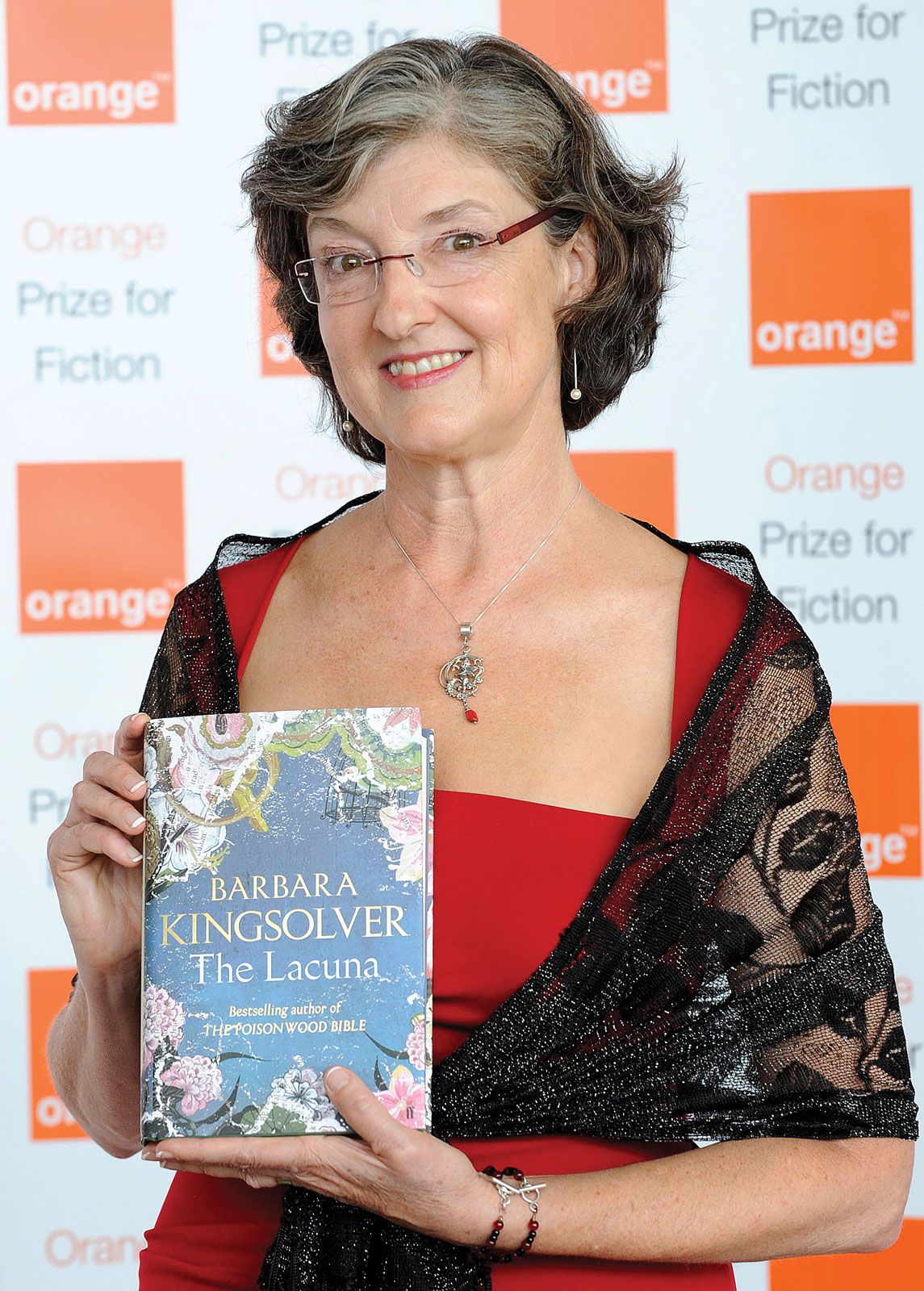
Barbara Kingsolver
American novelist and essayist
10
APPEARANCES
10
PODCASTS
Oct 15, 2026


Barbara KingsolverGUEST
It's so important just not to worry about what anybody wants from me, but what I have to say from my particular position in the world, in experience, in my womanhood, in my motherhood.
Barbara KingsolverGUEST
And it's not that I'm writing about myself, but I'm writing about what matters to me.
Barbara KingsolverGUEST
And then Demon Copperhead, it just kind of blew the roof off of previous expectations.
Barbara KingsolverGUEST
And I know that a lot of readers came to me for the first time through Demon.
22 MINS LATER


Barbara KingsolverGUEST
Um, well- To begin with, I was thinking about, you know, the, kind of the size of it.
Barbara KingsolverGUEST
I just thought, "I wanna write something that's not m- not, like, trying to look at a big picture." So sprawling.
Barbara KingsolverGUEST
But, but yeah, not an epic saga, but just maybe like a little love story.
Barbara KingsolverGUEST
And I just, um, I have always wanted to write about music, mu- um, classical music.
11 MINS LATER

Barbara KingsolverGUEST
Okay, this is a passage where Livia is, she's remembering when she was 17 years old, and she entered a competition in which the winner would play a piano concerto with the Knoxville Symphony.
Barbara KingsolverGUEST
and she wins and she has had a big fight with her mama she needed a dress for this and her mama was not going to spend that kind of money and she just thought that Olivia was getting above herself thinking she could win this competition but she in fact does so this is what happens My triumph in the preliminaries and then on stage with all those exquisitely black-clad adults, heads cocked, bows tilted at the ready as I threw my whole upper body into the falling minor second, falling minor third of the opening motif was the peak of my 17 years.
Barbara KingsolverGUEST
My quailing heart and steady hands cast a net over a giant hall and transfixed the audience until they stood on their feet applauding at the end.
Barbara KingsolverGUEST
When the conductor's little daughter came onto the stage with a big bouquet of roses, I laughed and burst into tears at the same time, which made the applause louder.
Barbara KingsolverGUEST
Outside in the parking lot afterward, I had to sit in the car for half an hour, just me and my roses and pounding heart, before I trusted myself to drive home.
Barbara KingsolverGUEST
I came back to a dark sleeping house that night and to school the next day, invisible as ever.
5 MINS LATER
Mason AdamsHOST
the main character is so richly drawn and we see her at snapshots all throughout her life at pivotal moments two two pivotal moments that just tell us so much about everything before can you share some of your inspiration for livia and where some of her details came from


Barbara KingsolverGUEST
Well, I want to thank the good people at Barnes & Noble who brought a piano up on the freight elevator for this occasion.
Barbara KingsolverGUEST
And let's also thank the good people of Barnes & Noble for selling books.
13 MINS LATER


Alison StewartHOST
In all your years of writing about class, what's changed about class in America, and what's stayed the same?
Barbara KingsolverGUEST
Almost nothing has changed, and that's fascinating because we've watched a- a lot of, we have lo- we've wa- we've watched improve- improved consciousness of many other things.
Barbara KingsolverGUEST
But we're still pretending in this country that America is a classless society.
Barbara KingsolverGUEST
We are still pretending that any kid from anywhere can grow up to be anything, and that is simply not the case.
Barbara KingsolverGUEST
Um, and- and- and I think the- the- the rural, the barriers to rural kids are- are underestimated in our culture.
Barbara KingsolverGUEST
And so Demon Copperhead was a big Appalachian novel about kind of the historic inherited, um, uh, sort of class- class barriers in terms of industry and the c- you know, coal mining and what that has done to the country, uh, to- to Appalachia.
12 MINS LATER


Barbara KingsolverGUEST
It's, I think a- all of us have probably, most of us have lost somebody that way in our lives, if not a close friend, at least some, you know, a friend of a friend or a family friend or something.
Barbara KingsolverGUEST
And [sighs] it's something, it's, it's a scary thing to write about, but I decided a worthy thing to write about because it is such a particular kind of grief.
17 MINS LATER

speaker_4HOST
Hmm.
Barbara KingsolverGUEST
Um, we feel invisible here, you know? We do not see ourselves represented on, on, in, in any, any popular culture, um, u- unless it's as a joke, you know, unless it's as some kind of a condescending hillbilly joke or, or a poverty documentary.
Barbara KingsolverGUEST
I mean, just the fact that people don't even know how to say Appalachia, this huge region of the country, tells you that people are not used to hearing us represent ourselves.
Barbara KingsolverGUEST
People are used to hearing other people talk about us, if they hear any such thing at all.
Barbara KingsolverGUEST
W- So after, a- at least from, from the day I left Kentucky and went to college in Indiana, I have learned that I come from a place that people think is m- m- backward or hilarious or, or just, you know, m- m- [laughs] not, not worth investigating.
speaker_4HOST
Um, and I, and I'm just curious, after all this time, what do you think it is that people still misunderstand about this place?


Barbara KingsolverGUEST
I thought it was amazing what books did for me, but I didn't imagine they were written by ordinary people like me.
28 MINS LATER


Barbara KingsolverGUEST
happen?I, uh, I don't even know why, but Chelsea Green sent me a galley of This Organic Life.
Barbara KingsolverGUEST
I was a novelist, and [chuckles] was a novelist who grew up on a farm and, um, was farm- was, uh, uh, live on a farm now and have, uh, sort of been engaged with gardening and agriculture my whole life.
33 MINS LATER
speaker_3HOST
My question is: Do you think in that 18-year period, has the food system gotten better or has it gotten worse?

Barbara KingsolverGUEST
Well, this place where I live just over the mountains from Kentucky in Southwestern Virginia is a perfect home.
Barbara KingsolverGUEST
We live on a farm, and it's just exactly where I wanna be among people I wanna be, to be with, and to claim as, as my own and as my neighbors.
Barbara KingsolverGUEST
So here I am as an Appalachian writer, and it was finally with Demon Copperhead that I could tell the most Appalachian story I've ever told.
Barbara KingsolverGUEST
I really, (laughs) I know this one probably sounds ridiculous, but I wanted to write the great Appalachian novel.
Barbara KingsolverGUEST
I wanted this novel to hold the entire story, the whole background of why, why it is we are who we are, all of the things that people look down on, um, sort of how they are not our fault, how they were perpetrated against us as sort of an economic program exploiting us, and also all of the good stuff, that we are people made of community, that we are the most resourceful Americans you're probably gonna find anywhere.
Barbara KingsolverGUEST
So what is that shame that I had internalized? Well, look, it wasn't just in college.
28 MINS LATER

Ezra KleinHOST
I'd like to just hear you talk a bit more about that, about how you thought about the respect we do or don't give to people who end up addicted to or dying from medications that they were given and told by people with medical degrees or people, you know, who were there, the nurse in the doctor's clinic that, that this was safe and somebody had checked this out for them.