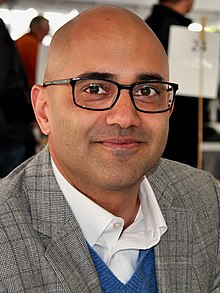
Ayad Akhtar
American playwright and novelist
6
APPEARANCES
6
PODCASTS
Sep 29, 2026


Ayad AkhtarGUEST
It's the place to ask the big questions, the biggest questions about God, about sex, about love, about meaning, about life.
Ayad AkhtarGUEST
You know, questions that may not have answers, but the asking, the active pursuit in asking is enough of a meaning.
Ayad AkhtarGUEST
And I think that maybe, maybe higher education has become a place where it's a little bit less, uh, friendly to larger questions like that, just as it is less friendly in the culture at large to be asking larger questions like that.
Ayad AkhtarGUEST
I think increasingly we are confronted by an informational environment where we don't know what is concocted by AI or what is propaganda, what is point of view, what is advertising, what is discourse.


Ayad AkhtarGUEST
So with Homeland Elegies, I kind of had a sense that something had changed in the reader, the ability to focus and concentrate.
Ayad AkhtarGUEST
But what was the ordering principle? And so Instagram struck me as a great way of thinking about it because Instagram is a kind of unifying platform that allows you to look at pictures of sunsets and recipes and selfies and...
Ayad AkhtarGUEST
quotes from Nietzsche and book reviews and it all makes sense because it's all ordered.
Ayad AkhtarGUEST
So in Homeland Elegies, there was this continuity of the staging of the self that is a kind of Instagram feed in which you get this repository of things, wines and landscapes and sex and all kinds of stuff, Trump, whatever.
12 MINS LATER

Ayad AkhtarGUEST
Tess, I mean, the question is so beautifully articulated, I'm not sure there's an answer.
Ayad AkhtarGUEST
I wanted to represent the rich braid of experience, personal, collective, and the way in which our, as you said, what our forebears have lived lives on in us.
Ayad AkhtarGUEST
unknown unknown to us in many ways shaping us in many ways i wanted to depict all of that without there being a without reducing any aspect of the experience to any one thing Because I think our lives are made of these multitudes, these pluralities that move us.

Tess CallahanHOST
And I wanted to ask what your, what you think constitutes greatness in a person.

Tess CallahanHOST
And so I wanted to ask you about this idea of epigenetics, ancestral trauma, the way energies, individual and collective, live in us subterraneally, and what happens when they surface.
Ayad AkhtarGUEST
Tess, I mean, the question is so beautifully articulated, I'm not sure there's an answer.
Ayad AkhtarGUEST
I wanted to represent the rich braid of experience, personal, collective, and the way in which our, as you said, what our forebears have lived lives on in us.
Ayad AkhtarGUEST
I wanted to depict all of that without reducing any aspect of the experience to any one thing.
Ayad AkhtarGUEST
Because I think our lives are made of these multitudes, these pluralities that move us.
Tess CallahanHOST
And I wanted to ask what you're, what you think constitutes greatness in a person.


Vivek MurthyHOST
But how did you come out of that experience of being an outsider, of being the other, with this sense of very positive, like optimism and curiosity? Yeah.
Ayad AkhtarGUEST
I mean, one thing I would say is that I think my father... was a very unusual sort of person, very, very larger than life.
Ayad AkhtarGUEST
He was one of the world's foremost electrophysiologists for two generations and built a medical practice after being in academic cardiology that was the largest cardiology practice in the state of Wisconsin.
23 MINS LATER
Vivek MurthyHOST
And I was curious in your own life, if you had a soul box, what's something that would be in it that would help provide you some inspiration when you feel low?


David BrooksHOST
It just doesn't feel authentic to me," or, or h- have there been ad- advantages and disadvantages to, uh, this spiritual sense that's not tied to an institutionalized religion?
Ayad AkhtarGUEST
I, I, I think I'm trying to live by an empirical ethic, an ethos of being attentive to my experience, being attentive to those who've written about their experiences, trying to accumulate whatever wisdom over time that I can, recognizing that they are making connections both which I value and others which I don't understand.
Ayad AkhtarGUEST
I don't wanna take anything on faith, because to me, faith is not about an object.
12 MINS LATER