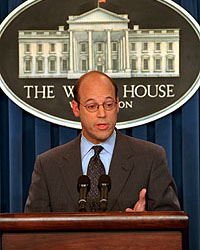
Ari Fleischer
Consultant and former White House Press Secretary
75
APPEARANCES
15
PODCASTS
Oct 15, 2026


Blake NeffPANELIST
What's that prep process like? What are things we might not think about that you need to be thinking about as a press secretary?

Ari FleischerGUEST
Um, typically at a briefing, they last 30 to 45 minutes, at least when, when I was press secretary.
Ari FleischerGUEST
You know, if there was a crisis, it was my easiest briefing 'cause I knew all the questions were gonna be on one topic.
Ari FleischerGUEST
If it's a slow news day, I could get questions on Medicare, Social Security, the situation in the Balkans, involved relations with China, tariffs with Canada, the president's health.
Blake NeffPANELIST
How many hours of work and memorization and prep would you say, uh, there was for every half-hour press briefing that you'd be doing?

Blake NeffHOST
What's that pr- process like? What are things we might not think about that you need to be thinking about as a press secretary?
Ari FleischerGUEST
Um, typically at a briefing, they last 30 to 45 minutes, at least when, when I was press secretary.
Ari FleischerGUEST
You know, if there was a crisis, it was my easiest briefing, 'cause I knew all the questions were gonna be on one topic.
Ari FleischerGUEST
If it's a slow news day, I could get questions on Medicare, Social Security, the situation in the Balkans, involve relations with China, tariffs with Canada, the president's health.
Blake NeffHOST
How many hours of work and memorization and prep would you say uh, there was for every half-hour press briefing that you'd be doing?

Rita CosbyHOST
Uh, this is such a tough time to be a White House Press Secretary, right? [laughs]
Ari FleischerGUEST
But it's especially tough when you're an outsider coming into an administration in midterm.
Ari FleischerGUEST
I had the advantage of working for George W. Bush for one year on the presidential campaign from 1999 through 2000.

Ari FleischerGUEST
The only people it works for are the New York State's most powerful people and the most liberal people, but if you're the average working-class person in New York, what has she done for you? How has she put more money in your pocket? How has she lowered your costs? How has she done any of the things you need to make your life less of a struggle? And then there's crime, and then there's her policies and the Democrat national policies on letting people take your job from you, people who came over the border illegally.
Ari FleischerGUEST
Thank goodness that's down, but under what they believe in, it'll come roaring right back.
Ari FleischerGUEST
These are the types of things, you've gotta drive the wedge between her and the blue-collar, working-class people of New York, who are the ones who really make the difference in elections.
Rita CosbyHOST
Uh, this is such a tough time to be a White House press secretary, right? [laughs]

Ari FleischerGUEST
She'll be one of maybe 30 Democrats who starts to look at running for president.
7 MINS LATER
Ari FleischerGUEST
We have a growing internal problem, just like Europe does, where communities come here and they don't assimilate.
Ari FleischerGUEST
The beauty of America and the reason we're a religiously tolerant country is because people come to America and become like Americans.
Richard WeinbergPANELIST
When are the American people going to wake up and understand that these people are a clear and present danger to the survival of Western civilization?
Ari FleischerGUEST
And, you know, it's difficult for us Americans because we are a nation born in tolerance.
Ari FleischerGUEST
Our founding principle is welcoming to religion, and we need to and must be welcoming to religion.
Ari FleischerGUEST
We have a growing internal problem, just like Europe does, where communities come here and they don't assimilate.
Ari FleischerGUEST
The beauty of America and the reason we're a religiously tolerant country is because people come to America and become like Americans.
Ari FleischerGUEST
We have a growing internal problem, just like Europe does, where communities come here and they don't assimilate.
Ari FleischerGUEST
The beauty of America and the reason we're a religiously tolerant country is because people come to America and become like Americans.
speaker_2ADVERTISER
Grainger, for the ones who get it done.


Ari FleischerGUEST
It is because the entire passion and energy of the Democratic Party comes from the far, far left as espoused by people like Hassan Piker.
Ari FleischerGUEST
And so therefore, if you're a Democrat in a primary or a Democrat trying to avoid a primary, you will not alienate the energy in the left-wing base.
Rita CosbyHOST
But he's been very effective at saying, do you want communism? Do you want people like an El Sayed? Do you want Chevalier who washed her hands with the American flag in New York? Is that a compelling argument? And if they can turn the tide with some of these things, like you said, if Iran can fall apart, some of these other things, do you think that that's effective enough because the other side is crazy?
Ari FleischerGUEST
Good campaigns can use the Democrat craziness on their issues, the socialism on their issues, woke 2.0 on their issues.
Ari FleischerGUEST
Good Republican candidates can use that to win individual races and fight the national tide.
Ari FleischerGUEST
So there are those good options out there, and Lord knows the Democrats are nominating the craziest candidates you can imagine everywhere, from a defender of Al-Qaeda in New Jersey, additional socialists throughout the United States, a fake physician in Michigan with Abdul Al-Said, all kinds of opportunities for Republicans.

Craig EatonPANELIST
And if we don't get that messaging out, we're not going to be successful in the midterms.
Rita CosbyHOST
But he's been very effective at saying, do you want communism? Do you want people like an El Sayed? Do you want Chevalier who washed her hands with the American flag in New York? Is that a compelling argument? And if they can turn the tide with some of these things, like you said, if Iran can fall apart, some of these other things, do you think that that's effective enough because the other side is crazy?
Ari FleischerGUEST
Good campaigns can use the Democrat craziness on their issues, the socialism on their issues, woke 2.0 on their issues.
Ari FleischerGUEST
Good Republican candidates can use that to win individual races and fight the national tide.
Ari FleischerGUEST
So there are those good options out there, and Lord knows the Democrats are nominating the craziest candidates you can imagine everywhere, from a defender of Al-Qaeda in New Jersey, additional socialists throughout the United States, a fake physician in Michigan with Abdul Al-Said, all kinds of opportunities for Republicans.
Craig EatonPANELIST
And if we don't get that messaging out, we're not going to be successful in the midterms.
Rita CosbyHOST
But he's been very effective at saying, do you want communism? Do you want people like an El Sayed? Do you want Chevalier who washed her hands with the American flag in New York? Is that a compelling argument? And if they can turn the tide with some of these things, like you said, if Iran can fall apart, some of these other things, do you think that that's effective enough because the other side is crazy?
Ari FleischerGUEST
Good campaigns can use the Democrat craziness on their issues, the socialism on their issues, woke 2.0 on their issues.
Ari FleischerGUEST
Good Republican candidates can use that to win individual races and fight the national tide.
Ari FleischerGUEST
So there are those good options out there, and Lord knows the Democrats are nominating the craziest candidates you can imagine everywhere, from a defender of al-Qaeda in New Jersey, additional socialists throughout the United States, a fake physician in Michigan with Abdul Al-Said, all kinds of opportunities for Republicans.
Craig EatonPANELIST
And if we don't get that messaging out, we're not going to be successful in the midterms.
Ari FleischerGUEST
It's been a parade of terrorist leaders coming to the United Nations and speaking.
Ari FleischerGUEST
It's been a parade of terrorist leaders coming to the United Nations and speaking.
Ari FleischerGUEST
It's been a parade of terrorist leaders coming to the United Nations and speaking.


Scott JenningsHOST
When that happened and after 9-11 was underway and after the president was notified and you started moving, talk to us about how information was getting in and getting out of the bubble around the president at that moment.
Ari FleischerGUEST
You got your news by watching television and by getting reports on the telephone.

1:33
I mean, but the real facts of it, and President Trump said it right over the weekend in some of the speeches I've heard, is that we are trying to get rid of the evil empire, and the evil empire keeps, you know, poking their head up.
Ari FleischerGUEST
The American people are very much focused on domestic economic matters, and it's always tricky for a president to get involved in international affairs, particularly in this modern era that we're in.
Ari FleischerGUEST
As a strong supporter of Israel, it is necessary to protect America's best ally around the world.
Ari FleischerGUEST
People who think he just does things for political reasons should look at this.
Ari FleischerGUEST
But the bigger question is, is this rise of big government socialism, which threatens each and every one of us, which is going to drive our prices higher, which will drive the price of oil even higher.
1:21
I mean, but the real facts of it— And President Trump said it right over the weekend in some of the speeches I've heard, is that we are trying to get rid of the evil empire, and the evil empire keeps, you know, poking their head up.
Ari FleischerGUEST
The American people are very much focused on domestic economic matters, and it's always tricky for a president to get involved in international affairs, particularly in this modern era that we're in.
Ari FleischerGUEST
As a strong supporter of Israel, it is necessary to protect America's best ally around the world.
Ari FleischerGUEST
People who think he just does things for political reasons should look at this.
Ari FleischerGUEST
But the bigger question is, is this rise of big government socialism, which threatens each and every one of us, which is going to drive our prices higher, which will drive the price of oil even higher.
21:31
I mean, but the real facts of it, and President Trump said it right over the weekend on some of the speeches I've heard, is that we are trying to get rid of the evil empire, and the evil empire keeps, you know, poking their head up.
Ari FleischerGUEST
The American people are very much focused on domestic economic matters, and it's always tricky for a president to get involved in international affairs, particularly in this modern era that we're in.
Ari FleischerGUEST
As a strong supporter of Israel, it is necessary to protect America's best ally around the world.
Ari FleischerGUEST
People who think he just does things for political reasons should look at this.
Ari FleischerGUEST
But the bigger question is, is this rise of big government socialism, which threatens each and every one of us, which is going to drive our prices higher, which will drive the price of oil even higher.
26:02
I mean, but the real facts of it, and President Trump said it right over the weekend in some of the speeches I've heard, is that we are trying to get rid of the evil empire, and the evil empire keeps, you know, poking their head up.
Ari FleischerGUEST
The American people are very much focused on domestic economic matters, and it's always tricky for a president to get involved in international affairs, particularly in this modern era that we're in.
Ari FleischerGUEST
As a strong supporter of Israel, it is necessary to protect America's best ally around the world.
Ari FleischerGUEST
People who think he just does things for political reasons should look at this.
Ari FleischerGUEST
But the bigger question is, is this rise of big government socialism, which threatens each and every one of us, which is going to drive our prices higher, which will drive the price of oil even higher.

speaker_0HOST
And so that takes us to that's a nice transition into how did how did you then get to the White House? So I
Ari FleischerGUEST
And after about five months from Election Day, two months after I got to Washington, I got my first job on Capitol Hill as a press secretary to another New York congressman.
Ari FleischerGUEST
I was at the House Ways and Means Committee communications director, and I was kind of getting bored with Capitol Hill.
Ari FleischerGUEST
And a friend of mine was the chief consultant for Elizabeth Dole when she was running for president in 1999.
8 MINS LATER
speaker_0HOST
That's

speaker_12NARRATOR
Ari Fleischer.
Ari FleischerGUEST
That then went through the Situation Room, got transferred then, the information transferred to the PEOC, the bunker underneath the White House, where the Vice President, Condi Rice, and other top White House officials were.
Ari FleischerGUEST
And then the Vice President called the president on Air Force One and said to him, we just got a phone call saying Angel is next.
Ari FleischerGUEST
The fact that someone had the name Angel sent shockwaves through the Secret Service and through Colonel Tillman, Colonel Mark Tillman, the Air Force One pilot.
Ari FleischerGUEST
How did anybody have the code word for Air Force One? and call the White House and say, Angel is next.


speaker_22NARRATOR
Ari Fleischer
Ari FleischerGUEST
... that then went through the Situation Room, got transferred then, the information transferred to the PEOC, the bunker underneath the White House where the vice president, Condi Rice, and other top White House officials were.
Ari FleischerGUEST
And then the vice president called the president on Air Force One and said to him, "We just got a phone call saying Angel is next." [tense music] Now, Angel is the Secret Service code word for Air Force One.
Ari FleischerGUEST
The fact that someone had the name Angel sent shock waves through the Secret Service and through Colonel Tillman, Colonel Mark Tillman, the Air Force One pilot.
Ari FleischerGUEST
How could anybody have the code word for Air Force One and call the White House and say, "Angel is next"?
Ari FleischerGUEST
The president simply said, "I'm going back to Washington." The Secret Service would have preferred him to stay overnight in Offutt, but at that point, there were no more aircraft in the sky.
Scroll for more appearances