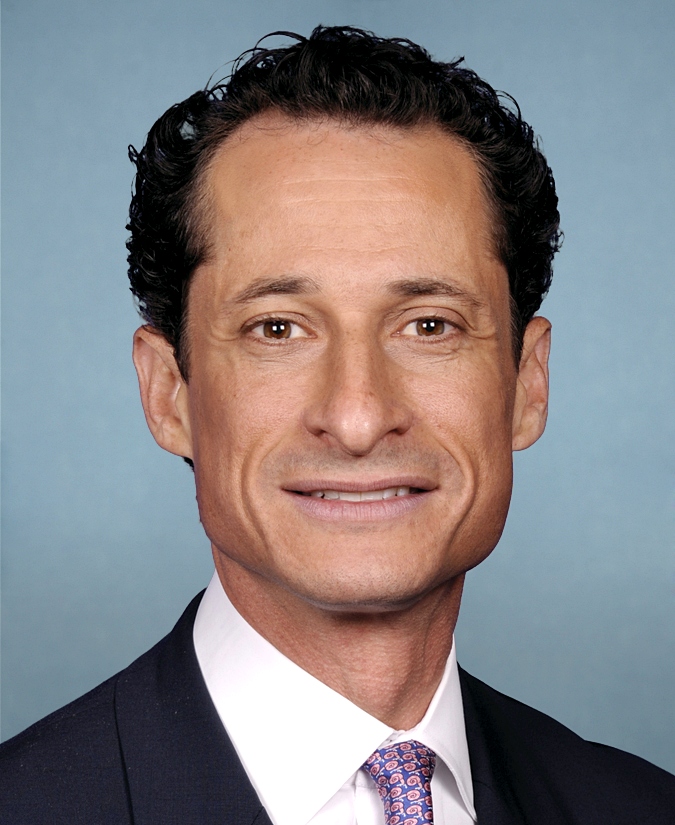
Anthony Weiner
Former United States Representative
4
APPEARANCES
2
PODCASTS
Jun 19, 2026


Mike PescaHOST
But then again, when the people you get to run against them don't have a track record, you might be playing with fire.

Anthony WeinerGUEST
But I mean, look, here's what I learned acutely last summer when I ran for city council after being out of the game for over a decade.
Anthony WeinerGUEST
We used to – we had this thing that when we – we used to believe that these shifts, these realignment shifts, the throw out the bum shifts happened every so often but didn't happen always.
16 MINS LATER
speaker_1SOUNDBITE_SPEAKER
acutely last summer when I ran for city council after being out of the game for over a decade.
Anthony WeinerGUEST
We used to – we had this thing that when we – we used to believe that these shifts, these realignment shifts, the throw out the bum shifts happened every so often but didn't happen always.
16 MINS LATER

Anthony WeinerGUEST
The founding fathers thought of lots of reasons why we should slow down Congress and make it less impulsive, and I don't think they contemplated a time when people would literally run for Congress saying, "I'm gonna do everything I can to stop Congress from acting." And the main place I disagree with her, look, we've always had this tension.
Anthony WeinerGUEST
I mean, I disagree with her that during Pelosi's reign we did the most progressive things imaginable.
Anthony WeinerGUEST
In fact, if you look at things like the Affordable Care Act and bailing out Wall Street and things like that, we actually were fairly moderate in, in the things that we approached.
Anthony WeinerGUEST
But the difference is with the Republicans, is unlike the Democratic caucus, they have this group, and it doesn't need to be that big to make a difference, of 20 or so people that are gonna be no on everything.
26 MINS LATER

Nick GillespieGUEST
I think is what I want it to mean, and telling ravens from a writing desk. But go ahead.
Anthony WeinerGUEST
To talk about this, like, I'm pissed that there was a continuing resolution, which was in Donald Trump and the Republicans' interests, uh, because Trump understands from his own previous experience that, like, he's going to get tagged with any kind of government shutdown. But I don't care. I'm not a Republican, I'm not a Democrat, and the only, uh, two people I think who, uh, acquitted themselves with honor this time around were Rand Paul and Thomas Massie. They were the lone Republicans who voted against, in the Senate and the House, the continuing resolution. If there were actual adults in the room, we would not be debating the budget for this fiscal year with, what, like six months to go in it. Um, the, the Senate or the, or the federal government has not passed a budget according to the processes that they put into law in the '70s. They have not managed to pass a year before the fiscal year it governed since the 1990s. That is a sign that the, uh, you know, the classroom doesn't have a teacher in it. There's no adults here. Um, regardless of, you know, then you get to the question, okay, well, what should Chuck Schumer have done or not? You know, from a v- uh, a viewpoint whether or not you want to spend a lot of money or a little money, m- you know, what- whatever your scope of government is, like, there needs to be a ser- I, there needs to be a serious discussion of, okay, what is the framework for how we're going to spend gov- how we're going to spend money, what we're going to spend it on, and how do we talk about that so that we're not just constantly doing more of the same? Um, and the w- the only alternative to this is, you know, looking up, uh, in 2019, right? The last year before COVID, the federal government spent $4.4 trillion. Uh, in 2025, it's estimated that we're going to spend $7.2 trillion, okay? There was a massive jack up during COVID. It has gotten even higher than we were spending at peak COVID. This is a real problem. And what I fault Chuck Schumer for many, many things, uh, I'm not a fan of him as a, as a politician, whatnot, but he is the opposition in the Senate. He could have at least extracted some agreement to have an actual discussion of what, you know, what do we spend money on and why?
55 MINS LATER
Mike PescaHOST
... is that because there are too many people with access to the breaks, progress can't happen. And when you look at the Democrat-run places like New York City, it is a bad... Or California. It is a bad advertisement to Democrats. How good an agenda item and a critique is that, would you say?
Anthony WeinerGUEST
I think it's, I think it's all very fair. By the way, it's Democratic cities. I don't know why we stopped dropping those last letters of this thing. It's not the Republic Party, it's the Democratic Party. Listen, here's my case, and I agree with you, and I think maybe Nick and I are gonna conclude by agreeing on this stuff. Here's what has happened within Democratic politics and within Republican politics, but for the purpose of New York City, let's focus on Democrats. That right now, if there's a problem to be solved, take one. Um, there are too many people who live on our streets who have, who are mentally unwell, okay? They can't take care of themselves. Within Democratic politics, they, we are trained nowadays to just go to a place and figure out where the interest groups are. And if our interest groups are over there, let's say the ACLU says, "That homeless person has a right to be on the street," our primaries encourage everyone to be in that spot. Instead, the way New Yorkers, the way Americans, the way human beings think is, "How do we solve that problem? How do we get that person off the street? How do we provide them with care? How do we get our public spaces back?" And I think that what's wound up happening is because we are in this environment where there is no friction between the parties, we've figured out, "Let's not have any friction even within our own party." And that's why we're not producing ideas anymore. We've become, we- there's too much in New York City people getting elected on, "I'm gonna be the values person." I'm running a race that's very different. I've got these very specific things that I'm arguing that we should do to try to solve problems, and if people get pissed off about it, I say, "All right, what are your ideas?" Now, is that a function of being a one-party town? I kind of think that it is, but I also think it's a function of a larger problem. We have become a country of two one-party party, one-element parties, that there is zero friction in the Republican Party. It's Trump or nothing. And in the Democratic Party, we're quickly becoming the anti-Trump or we're nothing. And I am trying to argue in this race that I'm having here in very progressive, very liberal East Village that, you know what? Hiring police officers, it leads us to a progressive value, which is we're safe. Stopping people from jumping the turnstile leads us to a progressive value of fairness. Taking that homeless person off the street because they're not well enough to take care of themselves is a progressive value of getting back our public spaces. That's where people like Dunkelman and I are trying to make an argument that yes, to some degree, if we don't solve these problems, we don't deserve to win.