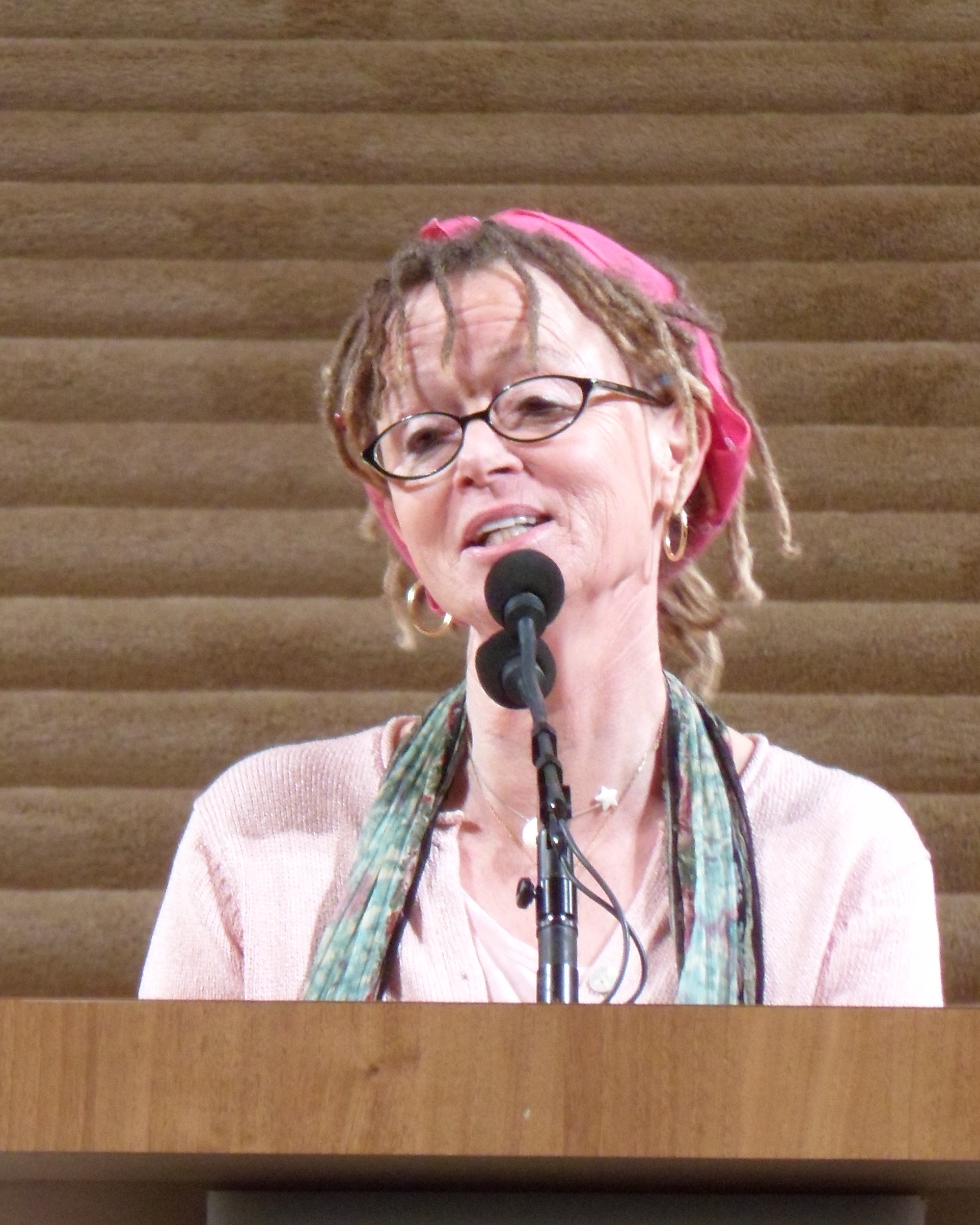
Anne Lamott
American novelist
20
APPEARANCES
19
PODCASTS
Nov 13, 2026


Anne LamottGUEST
Yeah, well, I hear that there are people who don't relate to that and who had a pretty easy time of it, but I'm not close to any of them.
Anne LamottGUEST
And I wouldn't be able to have a meal with them because it would just be so pointless.
Anne LamottGUEST
Like, what would we talk about? And the people that I trust and I'm really safe with and I'm growing with and I'm evolving with and...
Anne LamottGUEST
and doing the work with are all people, the Me Too people, who I share something like this with and they don't go, well, that's horrible.

Anne LamottGUEST
Well, besides pets dying when I was little, we always had pets and pets always died and it would just feel like the end of the world.
Anne LamottGUEST
But when I was six years old, my grandfather passed, my father's father, and I had really loved him.
19 MINS LATER
Sarah CavanaughHOST
I'm 60, so I have a decade to go, but I just wondered, has your relationship with death changed?


Anne LamottGUEST
My, my mother was from England, and my father was just very, very hip, slick, and cool, and jazz-oriented.
Anne LamottGUEST
So it was believed that you could give children sips of things so they could test beer or wine and, and therefore be more, um, superior to other children in WASPier families.
Anne LamottGUEST
But I remember chugging a beer, a 16-ounce Coors, when I was 12 years old, so it would've been '66, with my best friend, Lisa Kampmeier, and I felt hope bloom [laughs] in my chest.
Anne LamottGUEST
But I remember that first beer, and I remember thinking, "I'm good." [laughs] And then I believe I also had a predisposition.
15 MINS LATER


Manoush ZomorodiHOST
For people who maybe haven't read along in that journey, tell us about when and how that started, your addiction, and when it started to heal.
Anne LamottGUEST
I can remember being on rope swings with my girlfriends when I was really young, swinging, you know, spinning around, spinning around.
Anne LamottGUEST
And the girls would stop before they got dizzy, and I would want to keep going.
29 MINS LATER
Manoush ZomorodiHOST
Uh, it's a dream about your father's girlfriend, and it's, it's intense, but I wonder, could you read us that story?


Anne LamottGUEST
find God? I was living across this, I was on a houseboat, literally twice the size of this table with a sleeping loft in Sausalito.
Anne LamottGUEST
And I would be so hungover and I'd walk across the street to this flea market that was in this... economically totally deprived place where the crack epidemic had taken place, mostly people of color, six churches in a place of 2,000 people.
Anne LamottGUEST
So, and there was this, because when you're hungover, you want kind of greasy food and a lot of coffee.
Anne LamottGUEST
And Um, and I would hear music from the civil rights movement coming out of this one ramshackle church with this horrible, uh, Charlie Brown Christmas tree out in front of pine tree that, you know, it looked like Bertrand Russell at the end.
Anne LamottGUEST
And, um, but I could hear this music coming and I had been raised on civil rights music and on Joan Baez and the Weavers and, um, Pete Seeger.
10 MINS LATER

Anne LamottGUEST
Turning 68 means you've seen what you've seen, Ukraine, Sandy Hook, the permafrost, Marjorie Taylor Greene.
Anne LamottGUEST
By 68 you have seen dear friends literally ravaged by cancer, lost children, unspeakable losses.
12 MINS LATER

Eric ZimmerHOST
You know, how do you work with yourself to stay on the more intrinsic motivations versus getting sort of really focused on the extrinsic pieces of it?
Anne LamottGUEST
As I wrote a lot in Bird by Bird, when you're a writer, you get fixated on the outside validation, and you believe before you're published that it will completely affirm you and validate your parking ticket, and it will last, and it won't.
24 MINS LATER


Anne LamottGUEST
We were marching against Vietnam early on and marching for, you know, just all the great good causes.
8 MINS LATER


Diana ChapmanGUEST
It is not for the faint of heart, and if we can make it a little simpler, amen.
Anne LamottGUEST
The last one was called Good Writing, which I wrote with my husband, Neil Allen.
Anne LamottGUEST
At the age of 60, 12 years ago, I woke up feeling a heaviness on my chest, a cellular understanding of how much I had been carrying all these decades that were things my parents had told me about myself that were simply not true.
Anne LamottGUEST
My parents were very progressive, but they started seeing me for my achievements at five or six instead of for the goofy, loving being that we are all underneath the surface.
Anne LamottGUEST
When I decided on the right to be who I truly was instead of the person I had always agreed and striven to be, i.e., highly successful, endlessly charming, life got a lot more simple.


Anne LamottGUEST
Usually it's because I've been reading good reviews about it, although there are almost no reviews anywhere anymore.
Anne LamottGUEST
But if you look around, um, or somebody's told me that they loved it, and I'll pick it up, and I'll read the first few pages, and I will be looking for somebody that is using, that is writing really nice sentences.
Anne LamottGUEST
You know, M.F.K. Fisher, the, probably the world's greatest food writer, said, "What you're doing as, as a, as a writer is writing one clean, fresh sentence and putting a period at the end of it." And so I'll start to read, and I'll see if the, the, if these sentences are pleasing to me, and I'll read a little bit more, and I'll see.
30 MINS LATER


Anne LamottGUEST
And, um, and but then finally, at some point, ugh, you just think, "I don't have the time.
Anne LamottGUEST
I don't have the time to keep trying to get myself to sound like I'm somebody different than I am.
Anne LamottGUEST
I'm just gonna see what it might be like if I just write what, what is inside me that wants to get written." But also, another thing in good writing that I think is important...
Anne LamottGUEST
But, um, I don't think writers, uh, not grant writers or writers, people writing to their edi- their, um, boss, you don't know how much help is available, and how much you can ask for people to read your stuff for you.


Anne LamottGUEST
And metaphors are really beautiful attempts at expressing the inexpressible, you know, and they're so right.
Anne LamottGUEST
It's a long and winding road and it's a thunder road and the moon really is blue.
43 MINS LATER


Anne LamottGUEST
Well, it's a real moment we're in, and it sometimes feels like these are end times, children.
Anne LamottGUEST
So I have to answer that question by telling you that I typed in the address of the studio, but I accidentally typed in Oakland instead of San Francisco.
Anne LamottGUEST
So I was immediately in like feeble old lady mood, just trying to get to where you would be.
Anne LamottGUEST
And then, but you know what I did? I thought the secret is always just radical self-care and I'm going to be really nice to myself and God will get me there.
24 MINS LATER

Jen HatmakerHOST
These statements have not been evaluated by the Food and Drug Administration, and this product is not intended to diagnose, treat, cure, or prevent any disease.


Anne LamottGUEST
Well, Neil and I show each other everything we write before we submit it to an agent or an editor.
Anne LamottGUEST
And I will ask him to go through because, you know, by the time you've written the draft, your eye starts glancing off stuff, you know, that you really would.
12 MINS LATER


Anne LamottGUEST
So Duncan, let me answer your question, um, th- that was really profound, um, in a, a specific thing that happened on, uh, Saturday morning.
Anne LamottGUEST
Saturday morning I was in New Orleans to speak to this wonderful do-gooder group called Keep America Beautiful, who plant trees and flowers in the neighborhood, and they pick up litter.
Anne LamottGUEST
So I wake up at 7:00, which is 5:00 California time, and I, I start to get little flickers that Iran is back in the news, and I think it's just the saber-rattling.
9 MINS LATER


Anne LamottGUEST
In the fifties and sixties, all girls had an other mother, right? You had your mother-mother, who had a lot of thoughts and worries about you and a lot of issues concerning you, uh, some of which had to do with disappointment [laughs] or...
Anne LamottGUEST
And the other mother, your best friend's mother, just thought you were fabulous.
Anne LamottGUEST
So I wanna talk about, uh, Lee Adams, who was the mother of my best friend, Shelly Adams, from six years old.
Anne LamottGUEST
I still walk with Shelly Adams two or three times a week, so this is sixty, uh, six years later, we're still walking.
Anne LamottGUEST
But Lee-- See, my parents were atheists, and they were very devout atheists, and they just thought Christians were a mortification upon the land, but they had a list of who were the worst of those.


Anne LamottGUEST
I'm going to tell a short story about another storyteller who I adore named Mark Iaconelli, who wrote a book called Between the Listening and the Hearing.
Anne LamottGUEST
But he told this one story where he goes into communities like you have where there's been a tragedy, where there's been a shooting or a fire or a factory closure and people are really frightened and he just gets them gathered together in a warm room and he has them tell their stories and he asks them prompts and they tell their stories.
6 MINS LATER

Anne LamottGUEST
My, my first best friend was Catholic, and she used to, I mean no offense to your people, but she used to whisper to me in the dark when I was, we were s- I was sleeping over, that because I wasn't Catholic, I was gonna rot in hell, and that hell was gonna be like, like spinning through outer space forever.
Anne LamottGUEST
So I was a little tense about that, and I actually learned the Hail Mary in response to that, and in case she was right.
Anne LamottGUEST
And, um, and then my other best friend, and, and still some, I mean, this is from 66, 67 years ago, Shelly Adams, her mother was a Christian Science healer, and I've written a lot about her in my books.
11 MINS LATER

James MartinHOST
Um, yeah, I'm curious, what do you say to someone who's kind of listening and feeling a little jealous, and saying, "Oh my gosh, I've never had an experience like that." Do you ever get people that ask you that question and maybe feel a little jealous or?


Anne LamottGUEST
... somehow the, Thoughts on Love, a lot about the really pretzelizing, um, disease of perfectionism that a lot of us were raised by, and that you really need to do things right, or you're flooded with shame, you know? And we call shame, um, the acronym is should, have, already, mastered everything.
Anne LamottGUEST
Well, how could you have, you know? You're young, you're much younger than I am, and I'm a very young old woman, and, um, how am I gonna have...
Anne LamottGUEST
You know, I'm human and, and what I'm here to do is to step into that shape of being fully human that was always waiting for me.
Anne LamottGUEST
But the perfectionism kept me from that, and kept me th- thinking I needed to do things better, i.e. to forgive more perfectly.
Anne LamottGUEST
Like, the radical self-love and, and acceptance, comma, and the breaking through the perfectionism and allowing ourselves to do things the best we can on any given day, which was not how it was in my family.
15 MINS LATER
Manoush ZomorodiHOST
I'd like to play actually some of the advice that you put into that book that you also shared in your TED Talk about the act of writing.
Anne LamottGUEST
If you don't know where to start, remember that every single thing that happened to you is yours, and you get to tell it.
Anne LamottGUEST
If people wanted you to write more warmly about them, they should have behaved better.
Anne LamottGUEST
[laughs] You're going to feel like hell if you wake up some day and you never wrote the stuff that is tugging on the sleeves of your heart, your stories, memories, visions, and songs, your truth, your version of things in your own voice.
Anne LamottGUEST
Publication and temporary creative successes are something you have to recover from.
34 MINS LATER
Manoush ZomorodiHOST
Uh, it's a dream about your father's girlfriend, and it's, it's intense, but I wonder, could you read us that story?