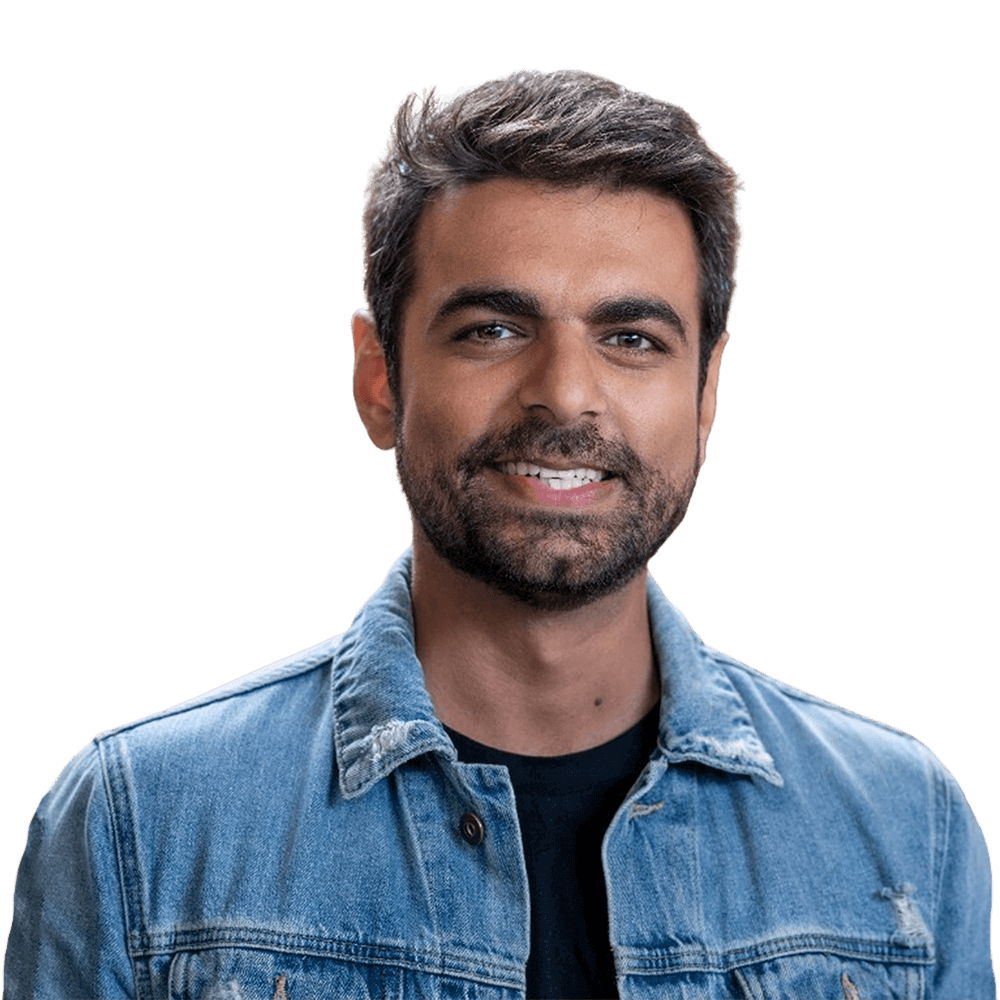
Anjney Midha
7
APPEARANCES
5
PODCASTS
Sep 25, 2026

SwyxHOST
[laughs]

Anjney MidhaGUEST
And it was so obvious to me that an ecosystem of different kinds of models were being created, um, and that this whole dom-- na-narrative of like only one company will dominate like Google was, um, well, like maybe true, but one, I don't believe that, but two, there was so much extraordinary innovation happening across several different research teams.
Anjney MidhaGUEST
But the shared problem I was noticing across all of them was o-often, you know, the research teams were fantastic at figuring out how to reason about new capabilities.
Anjney MidhaGUEST
They think in terms of capabilities, but never on, like, are not developer mindset oriented.
Anjney MidhaGUEST
Like what happens after the training is done and the checkpoint comes out? Like you'd be shocked how, how like similar the early pre-training teams at OpenAI, uh, sorry, Anthropic, BFL, Mistral, uh, were in, in, in their like default approach to Taking their imp-- research out of the la, you know, lab and kind of scaling their impact, which is often, "Oh, the checkpoint is done.
56 MINS LATER
SwyxHOST
Even for a specialized model like Midjourney.

6:17

So how do you grapple with you know, um, working with different countries, but at the same time keeping AI regional for, you know, security purposes.
Anjney MidhaGUEST
Um, so I think, you know, a few months ago, a lot of nation state leaders started realizing probably around the time deep sea came out that AI is not just a, it is not just compute infrastructure.
Anjney MidhaGUEST
And you end up using it in ways like defense, national security, healthcare that affect the future of your country.
Anjney MidhaGUEST
And what's also unique about AI is that it's cultural infrastructure because it's trained on data that often represents the values of the people that that data is about.
Anjney MidhaGUEST
And so I think that what's changed in the last six, seven, eight months is that the conversation has gone from AI adoption being this primarily a conversation about the technology to being a conversation about culture and national capabilities.
21 MINS LATER
28:14
So what advice would you have to people who want to structure their teams who might have otherwise modeled themselves after the Spotify org


Anjney MidhaGUEST
So, so I'm gonna try to workshop a, a theory that I'd, I'd like you guys to red team because my, my sense is that there, there's a, there's a somewhat pe-pessimistic view that you described, Rick, that, you know, there's this homogenization of culture partly imposed on us by experts going, "Hey, here's what's good for you.
Anjney MidhaGUEST
Let me tell you what, what's good for you." But w-what is quite novel about AI is not only that it, it's, it's a sort of democratizer, like you said, but we...
Anjney MidhaGUEST
But as I watch you use it, as I watch Mark, you know, start writing scripts that he puts online, as I watch Ben use AI to, to do a bunch of stuff inside the firm, and as I watch Eric, who's a prolific podcast creator- You know, use AI in creating podcasts.
Anjney MidhaGUEST
What, what, what, what I'm-- what seems to emerge for me is that when you-- it's also a ceiling raiser, right? In that when you put AI in the hands of a master craftsman from one domain and let them expand to a new domain, it raises the bar in what they can create because you're no longer trapped by the expert of that prior domain to give you more and more of the same stuff, right? So you've created-- you-- I mean, you, you're, you're-- the world thinks of you as a prolific musician, but you've just created a piece of software, right? And, and you've, you've transcended one domain to the other.
Anjney MidhaGUEST
And, and I, I find there are these moments when-- especially when I watch folks who are at the top of o-one creative discipline use AI.

SwyxHOST
Super horizontal.
Anjney MidhaGUEST
Where, where it's much more horizontal and it's, you know, it's multi-cloud, it's multi-silicon.
Anjney MidhaGUEST
Um, the goal is to try to make f-mega, you know, f-flops flow like megawatts, and that is very hard to do today for many reasons.
Anjney MidhaGUEST
Like, there's stranded pools of compute all over the place and, and there's no fungibility.
Anjney MidhaGUEST
And so f- right now we do it at, uh, at the level of scheduling, and we often do it at the economic layer.
Anjney MidhaGUEST
But as we start to announce what we're working on, it's extraordinary, like, how many folks are coming out of the woodworks and saying, "Hey, I'm actually working on a way to make compute fungible at this part of the stack and that part of the stack." And as a grid, we'd like all of these folks to participate on the grid.
Anjney MidhaGUEST
There's, you know, people often ask me, "Andra, you're a new cloud," and I go, "No, actually, new clouds are suppliers." Or sometimes they'll ask, "Are you a venture capital firm?" I go, "No, actually, they are, they are demand like sort of off-takers of the grid." We see ourselves as what's called an independent system operator.
43 MINS LATER
SwyxHOST
Yeah.


Ellis HamburgerHOST
'Cause that was, that was startups forever, right? It's like every year Apple would relieve or release a new SDK of some kind for a new sensor on the phone or a new API, and then 100 startups would spin up around it, and yeah, I mean, I'm curious, like, how, how do you advise these students or your guests advise these students to navigate that? I like the mission approach, but it's like tactically, I mean, I feel like half the startups I work with are pivoting during our conversations in some way just 'cause the, the foundation is changing so quickly.
Anjney MidhaGUEST
You know, typically what I've learned is whether it's Anthropic from the early days or... uh, periodic.
Anjney MidhaGUEST
Like it, depending on what you mean by pivoting, and there's no canonical definition of pivoting, like if you're not iterating with massive updates based on new information coming in, and so hill climbing, so to speak, you know, towards your mission, you're just not making progress.
Anjney MidhaGUEST
And so, um, my biggest regret, of course, in life as a founder when I started Ubiquity6, which was the last company I- I failed at it miserably, was I wasn't updating fast enough because I felt like I'd committed something, uh, to my investors and, and my team that I had to hold constant and consistent artificially.
Anjney MidhaGUEST
And now in hindsight I'm like, "That was so stupid." Like I wasted so much of my life, um, trying to hold constraints that were not, not really there.
Anjney MidhaGUEST
Um, and so I th- I, I, I think the thing you should hold pretty constant was your mission, right? And I, uh...
8 MINS LATER

speaker_1HOST
Mm
Anjney MidhaGUEST
We do a stand-up every morning from eight AM to eight thirty AM, and then we make our priorities and then go execute.
speaker_3HOST
Yeah


Anjney MidhaGUEST
We do a standup every morning from 8:00 AM to 8:30 AM, and then we make our priorities and then go execute.
Anjney MidhaGUEST
We then have an X-ray diffraction machine that tests whether the material has the properties that robots sa- uh, the AI said, and then we pipe that ver- verification loop back into the training ground, like, as many times as we need for the agents to continue predicting new superconductors.
5 MINS LATER
speaker_12UNKNOWN
Mm.