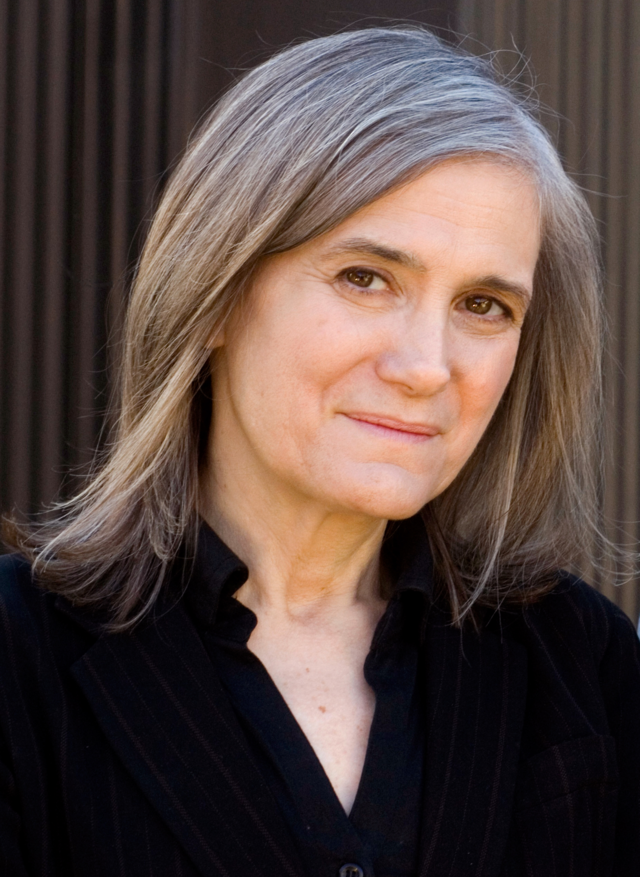
Amy Goodman
American broadcaster and journalist
18
APPEARANCES
18
PODCASTS
Oct 15, 2026


Amy GoodmanGUEST
And interestingly, um, the directors Carl Deal and Tia Lessin, Tia is the daughter of a Holocaust survivor, so we had that in common.
Amy GoodmanGUEST
And I, as I was raised in Hebrew school and in regular school, I would always look at who helped us, who helped the Jews, right? And especially the non-Jews.
Amy GoodmanGUEST
Why would someone risk their family, their own life to hide a kid in a basement or a family in a barn or an attic? They were called the righteous.
6 MINS LATER

Amy GoodmanGUEST
And interestingly, um, the directors Carl Deal and Tia Lessin, Tia is the daughter of a Holocaust survivor, so we had that in common.
Amy GoodmanGUEST
And I, as I was raised in Hebrew school and in regular school, I would always look at who helped us, who helped the Jews, right? And especially the non-Jews.
Amy GoodmanGUEST
Why would someone risk their family, their own life to hide a kid in a basement or a family in a barn or an attic? They were called the righteous.
6 MINS LATER

Alex CearnsHOST
And you, you look very calm under pressure, but are there moments where you're terrified, or just, do you just push through to get the job done when you're in those, you know, frontline situations?
Amy GoodmanGUEST
I have to say I don't even understand the word fearless, because sure, I mean, as you know, Australia next door to East Timor, the genocide that took place there in the late 20th century, Indonesia killed off a third of the population of East Timor.
Amy GoodmanGUEST
From 1975 when Indonesia invaded, 90% of the weapons were from the United States.
Amy GoodmanGUEST
And I went there with my colleague, another journalist, Alan Nairn, who was writing for The New Yorker in '90 and '91.
Amy GoodmanGUEST
And November 12th, 1991, we survived and witnessed the Santa Cruz massacre, where Indonesian soldiers armed with US M16s opened fire on defenseless Timorese, many of them not even born at the time of the invasion.
11 MINS LATER


Amy GoodmanGUEST
Guam is a territory of the United States, and legislator on Guam, uh, had introduced an abortion ban.
Amy GoodmanGUEST
Her daughter was a lawyer who challenged that ban, sued her mother, uh, which was very interesting, and it sounds like a family affair.
Amy GoodmanGUEST
But it was much bigger than that because that ban could go to the US Supreme Court, and Guam could overturn abortion in the United States.
Amy GoodmanGUEST
And so I went there, and I had heard about what was happening in East Timor, mainly from the writings of, um, Noam Chomsky, the MIT, uh, linguist who was also, to say the least, a political analyst and activist.
Amy GoodmanGUEST
And it was very close to East Timor from Guam, and so I decided to move on to there with another journalist, my colleague, Alan Nairn.
9 MINS LATER


Amy GoodmanGUEST
And I went with my colleague, Alan Nairn, an investigative reporter who had done so much on Latin America, particularly places like El Salvador and Guatemala, and the US role there in supporting, and, um, coups and military regimes.
Amy GoodmanGUEST
At the beginning of our trip, we were going there then because we'd learned the UN was going to send a delegation for the first time to investigate the human rights situation, so we wanted to be there, and it was horrifying still.


Amy GoodmanGUEST
Um, when we cover the standoff at Standing Rock, that's the, uh, Standing Rock Sioux taking on the Dakota Access Pipeline, this epic struggle back in 2016 at the time of the presidential race between Donald Trump and Hillary Clinton at the time, when rarely in the media were they even talking about the, uh, climate change.
Amy GoodmanGUEST
Uh, but thousands of indigenous people went to North Dakota here in the United States, uh, supporting the Standing Rock Sioux, and they, uh, stood off against this large energy corporation.
Amy GoodmanGUEST
Um, we were among the only media there, and we captured, um, on film the dogs that were, um, being held by the security guards, uh, biting the protesters, their, uh, mouth and nose dripping with blood.
Amy GoodmanGUEST
President Obama was in Laos at the time, and one of the people who participated in the democracy forum he held said, "What about this, um, what's happening there?" And he came back to the White House, saw the footage.
10:09
And he said, "We were devastated," maybe I'm paraphrasing, "that we couldn't stop the Iraq War." And I'm sitting there thinking to myself, really? You really think you could stop this stuff? So this is my way of asking you, do you think your job is to try to stop this, whether it's climate, whether it's war? And what about people who say that you're more activist than journalist?

Amy GoodmanGUEST
My grandfather, my mother's father, as you said, was an Orthodox rabbi, principal of the Crown Heights Yeshiva.
Amy GoodmanGUEST
My mother and her sister went to school there, and my great-grandfather on my father's side was a Henry Street rabbi, a Hasidic rabbi here in New York, very revered author as well.
Amy GoodmanGUEST
And that lineage, my great-grandfather goes back to on the great-great-great-great-granddaughter of Baal Shem Tov, who is the founder of Hasidism.
Amy GoodmanGUEST
And I will just say that it is because of that education, not in spite of it, that I learned to deeply care about the world and about suffering.
14 MINS LATER

Margo PattersonHOST
What do you think have been the most baneful developments in Have there been any positive changes? And what do you see as the future of journalism now?

Tia LessinGUEST
And it is kind of an unprecedented attempt of, you know, of creators to control the narrative and to say, we oppose this and there's something we need to do about it.
Amy GoodmanGUEST
And for people to understand the stakes, I mean, Paramount merging with Warner Brothers Discovery, it means, you know, Paramount, which owns, among other media outlets, CBS, would then own CNN and HBO.
Amy GoodmanGUEST
Tia just won recently three Emmys for her documentary called The Janes about the Underground Abortion Network in Chicago in the 1960s.
11 MINS LATER

Sammy YounanHOST
But is there does that longevity feel like a victory for independent media or is it a sobering indictment? Many of the systemic issues that you kind of covered even in the late 90s, 95, 96, 97, like are still headlining 30 years later.


Amy GoodmanGUEST
I just lost a dear friend in Brattleboro, Charlie Hutchison, who was a science educator.
Amy GoodmanGUEST
To come here to highlight Brattleboro Community TV means so much, as well as LP Radio.
8 MINS LATER

Carl DealGUEST
And so we also hope that this film and folks having access to this film and seeing it will turn them on to new kinds of media in their own communities.


Amy GoodmanGUEST
We want it to reverberate out, because who are we covering? I mean, in the film you have our coverage of the standoff at Standing Rock, right? Where indigenous people, Standing Rock Sioux in North Dakota, were joined by indigenous people from Latin America, First Nations from Canada, and then many non-Native allies.
Amy GoodmanGUEST
You know, they thought maybe a couple dozen people would come to help them fight the Dakota Access Pipeline, but thousands came.

Amy GoodmanGUEST
... and Kissinger went to Indonesia, met with the long-reigning dictator, Suharto.
Amy GoodmanGUEST
They flew out to meet with Marcos, and Indonesia invaded by land, by air, and by sea, uh, East Timor.
Amy GoodmanGUEST
And over the next 17 years, there was not a mention of East Timor on NBC, ABC, CBS.
Amy GoodmanGUEST
Now there's more media, um, in the world, but those were the big TV gatekeepers at the time, so this really mattered, until November 12th, 1991.
10 MINS LATER

Sam SederHOST
What, what's your assessment of all that? Or is it something that you are like, don't f- spend too much time focusing on? 'Cause you have a lot of work to do on a daily basis.

MaryHOST
I wonder if you think the journalists in a room like that would laugh at a question like that now.
Amy GoodmanGUEST
And I had survived and witnessed a massacre in 1991, November 12, 1991, with my colleague Alan Nairn, who was writing for The New Yorker.
MaryHOST
It's really an amazing story of bearing witness and bringing a story back to the United States that wasn't being told here.

Mary HarrisHOST
I wonder if you think the journalists in a room like that would laugh at a question like that now?
Amy GoodmanGUEST
And I had survived and witnessed a massacre in 1991, November 12, 1991, with my colleague, Alan Nairn, who was writing for The New Yorker.
Mary HarrisHOST
It's really an amazing story of bearing witness and bringing a story back to the United States that wasn't being told here.


Amy GoodmanGUEST
It isn't that hard to do this, and these networks have much more resources than we do.
Amy GoodmanGUEST
You say, "What's happening on the ground?" And in the same way, Israeli peace activists, they are not monolithic, and we don't hear their voices either.


Amy GoodmanGUEST
Uh, Native Americans, Standing Rock Sioux, were opposing the Dakota Access Pipeline.
Amy GoodmanGUEST
It was in the middle of the presidential race between Hillary Clinton and Donald Trump.
Amy GoodmanGUEST
And the unofficial historian of the Standing Rock Sioux, LaDonna Brave Bull Allard, who has since died, said,I'm gonna open my property to anyone who will come and help us oppose this.
Amy GoodmanGUEST
The, you know, the Dakota Access Pipeline would go beneath the Missouri River, the longest river in North America, and they were afraid it would imperil the water supply of millions of people, native and non-native.
12 MINS LATER


Akela LacyHOST
What was that experience like, being surrounded by that press corps? Did you ever question your approach? I mean, h- how was that for you?
Amy GoodmanGUEST
I mean, this was about the 1991 massacre, which Indonesian soldiers, armed by the United States with M16s...
Amy GoodmanGUEST
I mean, Indonesia invaded East Timor December of 1975, and they would go on to occupy East Timor for two decades.
Amy GoodmanGUEST
And my colleague, journalist Allan Nairn, and I survived a massacre November 12, 1991, which the Indonesian soldiers opened fire on innocent Timorese civilians, and they killed over 270 of them.
7 MINS LATER


Amy GoodmanGUEST
I don't like stalkers, you know? And, um, because that's what I perceive this as.
Amy GoodmanGUEST
But having said that, I felt it was absolutely critical to get the word out about independent media.
Amy GoodmanGUEST
And if I had to pay a price personally, okay, maybe, like, if they followed me for a week.
6 MINS LATER


Amy GoodmanGUEST
Well, first, Andy, I just want to, uh, say thank you to the DGA, to the Directors Guild of America, and to these two directors, uh, to Carl Deal and to Tia Lessin because, uh, their work on this, um, has been, um, really eye-opening, inspiring.
Amy GoodmanGUEST
I mean-So many of you are directors, and whatever it is you're dealing with, it's their craft, it's their genius, their compassion that really brought together something that we-- well, next week, um, we're gonna have a big event in New York celebrating thirty years of Democracy Now! [clapping] And, uh, you know, as you saw, started in nineteen ninety-six.
Amy GoodmanGUEST
And, um, Patti Smith, who you hear at the end, that was from our twentieth anniversary.
22 MINS LATER