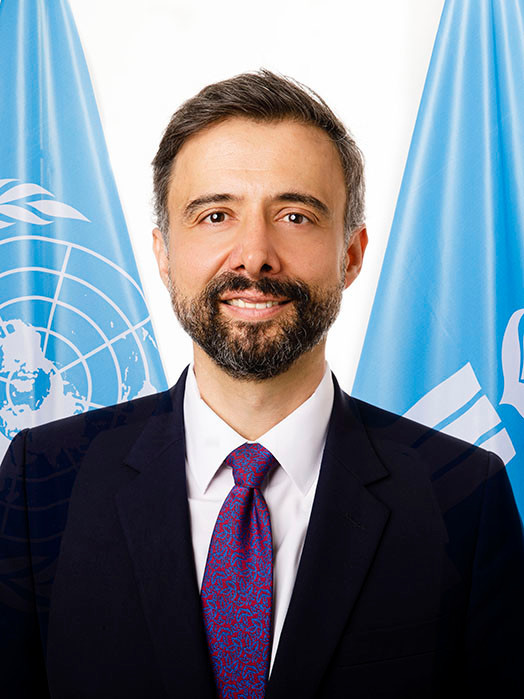
Alvaro Lario
President of the International Fund for Agricultural Development
3
APPEARANCES
3
PODCASTS
Sep 8, 2026


Melissa FlemingHOST
coastal erosion, but certainly, I mean, when you think about climate change and your job, both hats, water and food, what are you most worried about when you think of what's happening with climate change that is here so dramatically already?

Alvaro LarioGUEST
Well, we are having, as I think it's well known, but we are having like countries, especially in sub-Saharan Africa, which are going through five, six years of drought.
Alvaro LarioGUEST
I mean, if you think about what's the impact of El Niño, if we think about Zambia, for example, a couple of years ago, I think it was 2023, actually one million hectares of maize was lost there.
Alvaro LarioGUEST
We had six million of people which needed humanitarian assistance, one million of households which actually were extremely impacted by the shock itself.
6 MINS LATER


Álvaro LarioGUEST
Thank you to the IEA for inviting us and to Irish Aid for, uh, for, uh, having this very important discussion.
Álvaro LarioGUEST
I remember three years ago, actually, we had a, uh, similar discussion then we were discussing about some of the shocks that happened after Ukraine, what was, uh, then going on about the food supply, some of the responses.
Álvaro LarioGUEST
And here we are, probably three years later, whereby it's not any longer only about, I would say, the-- what's happening related to oil shocks or food price shocks, but actually also about the future of development cooperation.
Álvaro LarioGUEST
As the-- as Ireland is now, as you were mentioning, taking the leadership in the EU and the presidency, and how that might relate to some of the discussions that you've had a couple of weeks ago with Commissioner Sikela.
Álvaro LarioGUEST
I think it's a fascinating and very interesting time, actually, on seeing what's the future of development cooperation, how can we also make sure that global, uh, food systems remain resilient, and what are the investments that are actually working.
7 MINS LATER
speaker_3SOUNDBITE_SPEAKER
In an increasingly volatile global context, the role played by IFAD 14 will be central to delivering impact at the first mile.

speaker_0HOST
What impact is the war in the Middle East having on smaller farmers in developing countries? Well, thank you for
Alvaro LarioGUEST
As you mentioned, the Persian Gulf is currently supplying the highest share of the world's natural gas in ammonia and urea, which are components that we need for nitrogen fertilizers.
Alvaro LarioGUEST
So many of the small-scale farmers, and here including in Ireland, we're seeing that they are being squeezed on their margins.
Alvaro LarioGUEST
So they are being affected by higher fuel, which also It's impacting the ability of even harvesting also in the planting season right now on fertilizers, but also on food transportation costs.
speaker_0HOST
ultimately though what's needed here is a resolution to the the conflict in the middle east ireland is about to assume the presidency of the european union it will have perhaps a stronger voice in advocating in matters like this, what role do you want to see Ireland playing then in helping to deal with this problem?