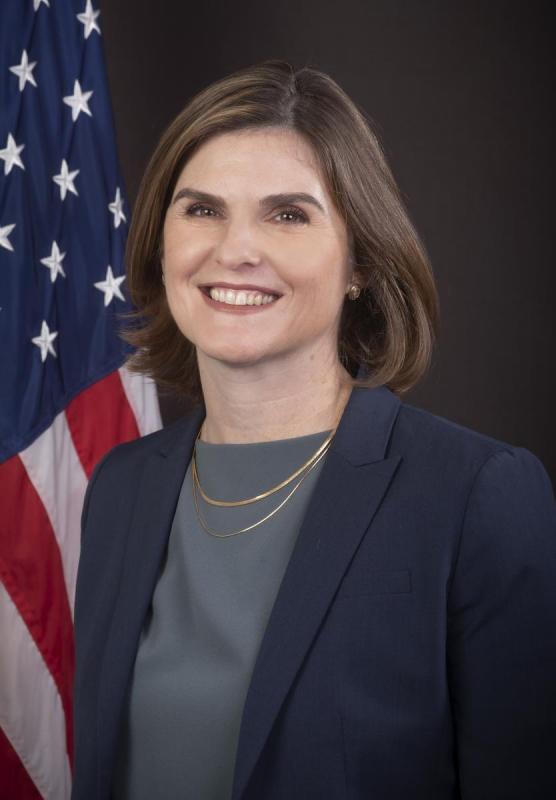
Allison Clements
Commissioner of the United States Federal Energy Regulatory Commission
5
APPEARANCES
5
PODCASTS
Sep 15, 2026

Allison ClementsGUEST
There is a lot of federal, state jurisdictional questions at the middle of this issue of who's in charge of new data centers and how they hook up to the grid.
Allison ClementsGUEST
and come up with some reforms to protect customers and to make sure we can facilitate these new large load interconnections quickly and reliably.
Allison ClementsGUEST
And FERC said, you know what? We're not going to get into that jurisdictional fight.

Brad LangleyHOST
Are there other actions you'd like to see FERC take to speed interconnection or just help modernize the grid in general?

Allison ClementsGUEST
I would say when people talk about cases of rape and incest, that is probably the first or second most common question I get on campus.
Allison ClementsGUEST
We always say that, first of all, we acknowledge that rape is horrible thing that happens and someone who is raped should be getting access to resources and should be able to should be able to recover as well as the rapist getting persecuted to the fullest extent the law and making sure we immediately address it with compassion because like I said before a lot of those who a lot of people's perspective of the pro-life movement is that we don't care about women which we do and And then we continue on to say that just because of the circumstances that a child was conceived in doesn't make them any less valuable.
Allison ClementsGUEST
A child conceived in rape and a child conceived in a loving home with two parents does not make the child any less valuable.
Allison ClementsGUEST
And so therefore, that's why we take a stance against it, as well as abortion is a very traumatic thing.
Allison ClementsGUEST
And it's to abort a child simply because it may be reminding them of this horrible thing is not going to heal them in the long term.
5 MINS LATER
speaker_0ADVERTISER
and then

Allison ClementsGUEST
We know it's going to reduce the barriers that exist for development in local communities, both on the market rate side, but also on the subsidized affordable housing side.
Allison ClementsGUEST
One of the biggest provisions in the bill was raising what's called the public welfare investment cap.
Allison ClementsGUEST
This is the threshold that exists for banks for which they can invest in specific affordable housing programs like the Low Income Housing Tax Credit Program, which is really the most important tool we have to develop affordable rental housing.
Allison ClementsGUEST
Raising this cap will allow for more private capital to invest in affordable housing development.
8 MINS LATER

Sasha-Ann SimonsHOST
What exactly does that mean for folks who may not know? And walk me through your thinking there.


Alison ClementsGUEST
It's based on a pottery that was in our family, and about 25 years ago, the pottery closed down.
Alison ClementsGUEST
So our imagination is that we came back into a corner of what had been the potter's yard and found it completely derelict, with plants growing that had maybe blown in, self-seeded, changed over time.
Alison ClementsGUEST
But what we wanted to do was to also show the pots, so we had a stand created.
Alison ClementsGUEST
It was made out of steel, and it's old and rusted now with old wooden planks on it.
Alison ClementsGUEST
The pots that are now 30 years old have been planted up to show how beautiful a potted up pot can be-


Allison ClementsGUEST
I, I am seeing it, um, in some of the transactions I'm in as more sequentially.
Allison ClementsGUEST
You can make money at the sale of, uh, the powered land, you can make money at the sale shell-ready, and then you can make money again, uh, when you go vertical.
Allison ClementsGUEST
And the capital costs involved at the powered land might be two to $3 million a megawatt.
Allison ClementsGUEST
The cap- the cap- the capital costs involved in going vertical might be $12 to $13 million a megawatt.
6 MINS LATER
Scott KlevinaMODERATOR
So, um, I'm curious what examples you're seeing and, uh, any surprises you've come across so far.