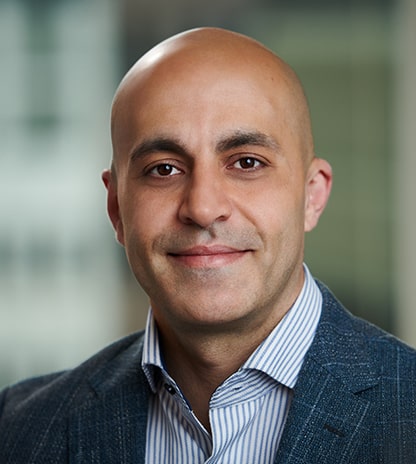
Ali Ghodsi
CEO of Databricks
10
APPEARANCES
6
PODCASTS
Aug 13, 2026


John ForttCORRESPONDENT
Tell me about what that says about agentic demand right now and why you think it's still not okay to jump into the IPO waters with that kind of an environment.

Ali GhodsiGUEST
What's happening basically is everybody's using these agents, AI agents, and the whole world is laser focused on agents, AI, and sort of, you know, that core part of it.
Ali GhodsiGUEST
But what they fail to look at is that that drives a lot of other things that are around it, that are adjacent to it.
Ali GhodsiGUEST
So if you're using agents to write software, well, all the software needs a database.
John ForttCORRESPONDENT
Because if models are open for a lot of work, they've got to be less expensive, right? Especially if you're adding context to them that makes them more effective.


Kate RooneyCORRESPONDENT
What do you make of the capabilities of Kimi, and i- how much of a threat is that to the frontier labs as we now look at almost trillion dollar valuations?
Ali GhodsiGUEST
Well, I mean, look, I think the frontier labs are amazing, and they're gonna continue doing great.
Ali GhodsiGUEST
And, uh, but what happened basically is that everybody wants to do, uh, cost controls, and they wanna control their budgets because as one executive of a Fortune 500 told me, uh, his costs of AI are increasing exponentially.
Ali GhodsiGUEST
You know, for the really difficult questions, let's ask the frontier American models and pay a lot for it.
Ali GhodsiGUEST
We just launching, uh, a completely new product for our s- that's called Customer Lake, which is in the area of marketing.
Ali GhodsiGUEST
So we're, you know, targeting, uh, marketing folks, which is not an area where we used to, uh, be active.
Ed LudlowHOST
Do you stand by that? Uh, has anything changed in your mind in the last two weeks?

Ali GhodsiGUEST
We think in the next nine months, but let's say around one year or two years, we're gonna have more software being written than in all history of mankind.


8 MINS LATER
Ali GhodsiGUEST
A SIEM is a security information event management system that does all of your detections in your organization.
Ali GhodsiGUEST
Um, but those things, they focus on how can we write, how can we help software engineers? What Genie Code really can do is it brings it to the knowledge worker, the people that create your dashboards inside of an organization, and they make sure that your revenue numbers are correct, or the people that make sure that the data that's coming in every day into the organization is correct, nothing breaks.
Ali GhodsiGUEST
Or the people that are building machine learning models that can predict your prices or your costs or, you know, doing risk as-assessment with machine learning models.
Ali GhodsiGUEST
It automates that portion, so it's sort of very complementary to cloud code and, you know, Cursor.

Caroline HydeHOST
So how are you, how are you seeing the adoption of AI agents? What does it mean actually for the f- the strength of your data business?
Deirdre BosaCORRESPONDENT
And if what you're saying is that it's easier for non-technical people to make their own databases or the AI itself to make the databases, where does that leave this trade?
Ali GhodsiGUEST
But the reality is that, look, this moat of it's very hard to move databases or it's very hard to use a different interface, teach humans to learn a new interface, that moat has decreased and almost is evaporating because humans can now just talk to an AI instead of learning a new interface.
Ali GhodsiGUEST
Does that mean that everyone immediately is going to switch away? You know, it's going to take some while.
Ali GhodsiGUEST
For instance, for databases, you need a really compelling reason to change database.
Deirdre BosaCORRESPONDENT
SAP is one that you bring up, but what about some of the more vulnerable software companies? What kind of companies are those, and when do you think they're going to be disrupted if they're not already being? I mean, look at Monday.com today, down some 20%.


Ali GhodsiGUEST
the quest for super intelligence, which is kind of intelligence that's like an almost, like godlike, it leads to recursive self-improvement of the AI, which then once you have that, it can cure cancer and solve all economical problems.
Ali GhodsiGUEST
So what the hell are you talking about, that there's a physics problem? Like, it'll, anything, any of your cost equations are gonna pale in comparison to the economic value that this thing is gonna provide.
Ali GhodsiGUEST
And the way they're developing it is bigger and bigger clusters, more and more energy, and that's how they're going about it.


Ali GhodsiGUEST
Number three, you need to put together amazing, stellar world-class team, right? That's all that matters 'cause if you're amazing, but your team is not, then you're not gonna go anywhere.
Ali GhodsiGUEST
Like, you need to actually get the team to execute again and again and again and get to the results.
Ali GhodsiGUEST
I mean, look at AWS, like, they're phenomenal at executing, right? And then, uh, finally, five, you need to do good culture.
6 MINS LATER
speaker_7UNKNOWN
Yeah.