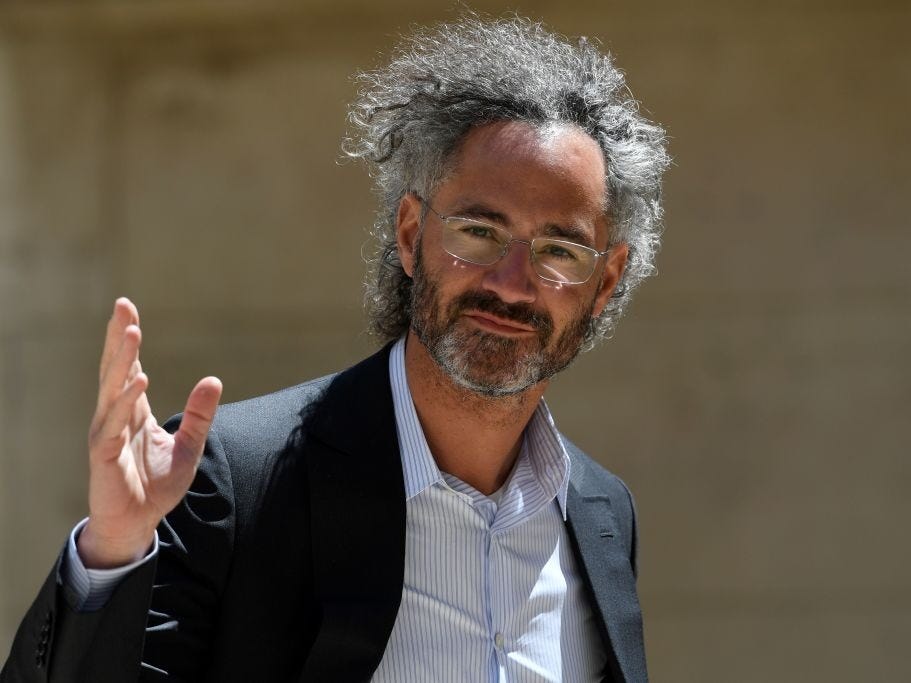
Alex Karp
CEO of Palantir Technologies
21
APPEARANCES
10
PODCASTS
Nov 11, 2026


Walter IsaacsonHOST
You wrote about the Nazis when you were in graduate school, was it? I wrote about

Alex KarpGUEST
For better or worse, it would be hard to say Heidegger was not one of the two or three most important philosophers in the last couple hundred years along with other people, maybe Wittgenstein.
Alex KarpGUEST
Heidegger – developed a form of phenomenology, which is a fancy way of explaining how things in the world could impute value onto the world.
14 MINS LATER
Walter IsaacsonHOST
Do you think this whole explosion of data collection combined with AI in some ways impinges on personal autonomy?

Alex KarpGUEST
But I think that, you know, what makes him so strong is he's ethical and a business person.
Alex KarpGUEST
Okay, so, but what's actually happening is very different than what people are reporting.
Alex KarpGUEST
What he, I believe, has realized is, if you take a philosophical frame they have, which is we are deserving of having all the IP in the world.


Alex KarpGUEST
... like profit, free cashflow, are our application layer, called ontology, and compute.
Alex KarpGUEST
What I am not just claiming, we can take an open model and in the classified or non-classified context get it to the point of a frontier model.
Alex KarpGUEST
So what is the true cost, not just what you're paying? The true cost is not ju- is what you make minus what you lose, meaning the value of your business.
Alex KarpGUEST
Now, we can get the, the frontier application to be exactly the same as a frontier model without the risk of transferring the alpha of your business to another ve- by the way, you could do this with a frontier mo- closed model too, but then the clients have to be able to ask and answer very basic questions.
8 MINS LATER

Alex KarpGUEST
Tha- that, that, and those kind of engineers are great engineers, and I'm telling you, they don't talk to the enterprises or don't understand the technical challenge.
Alex KarpGUEST
And also, by the way, the ability to be a great investor i- in the kind of where those w- that's where large language models are more useful because it's, it's probabilistic and you don't have to get better than really 51%.
Alex KarpGUEST
If you wanna manufacture a car and you need a part, or you wanna send a rocket to the moon, or you wanna put a missile on your adversary's head and bring home Americans safely, that stuff doesn't ship.
Alex KarpGUEST
And by the way, and there's not a single high-end enterprise like that that would ever put...
Alex KarpGUEST
Like, the, the, when you go to San Francisco and talk to them, their basic vibe is, "We don't have to solve your problem today, because tomorrow you're gonna go away and all of your problems are gonna be solved." It's largely religious.

Sara EisenHOST
I was gonna ask, is Anthropic, are they f- are they friend or foe? Are they competitor or partner?
Alex KarpGUEST
Um, well, first of all, you know, at Palantir, you know, people currently are focusing a lot on our commercial business, and there's a lot of interesting things there, but once, uh, war zones, uh, heat up anywhere i- in the Allied world, uh, the Palantir Maven platform, which, um, takes very valuable LLMs and makes them actually lethal and, uh, useful on the battlefield, come into action.
Alex KarpGUEST
And then the primary focus of our whole company is bringing our American, uh, war fighters home safely, meaning that when we engage, that they engage in a way that it gives them a massively unfair advantage, uh, scares our adversaries, and makes sure that when they're in action, they have an- a, the best humanly and inhumanly possible chances of coming home safe and without injury.
Alex KarpGUEST
Uh, and we have a wide swath of, of Palantirians working on various platforms, particularly the Maven platform.
Alex KarpGUEST
And then there are a lot of things that are in the public space, so Maven has been kind of discussed, and kind of older versions-
14 MINS LATER

Alex KarpGUEST
So there are some problems you could solve with this, like I wanna write a report on GDP growth in China, right? Okay, but if it's a problem that requires a knowledge store, like I wanna understand the specialized way I underwrite.
Alex KarpGUEST
I wanna understand the specialized way I drill for oil and gas that's both legal, ethical, and reduces the cost of production.


Alex KarpGUEST
And once that value, that problem is always has, eh, that problemAlways, almost always, but not always has attributes.
Alex KarpGUEST
So there are some problems you could solve with this, like I wanna write a report on GDP growth in China, right? Okay, but if it's a problem that requires a knowledge store, like I wanna understand the specialized way I underwrite.
Alex KarpGUEST
I wanna understand the specialized way I drill for oil and gas that's both legal, ethical, and reduces the cost of production.
Alex KarpGUEST
I wanna change the, the, the supply chain of my industry, whether that's military or whether that's building boxes or whether that's cars.

Alex KarpGUEST
And then, but, but then what can work is, yeah, close the borders, keep them closed.
Alex KarpGUEST
Change how we test aptitude, like, so we have an accurate diagnostic of where you could be slotted.
Alex KarpGUEST
Uh, be ruthless and like, you know, it's, it's like in, in certain, find out new ways to test and do ruthless testing and slotting.
Alex KarpGUEST
I mean, you know how when you like you wanna smoke a cigarette, it's like, "This, this cigarette may be harmful to your health." Maybe we should be putting that in universities.
speaker_4UNKNOWN
Mm.
Alex KarpGUEST
Because that, then the only solution people are gonna have is, well, you know, let's go after the unlikable rich people in tech, especially AI tech.And then, but, but then what can work is, yeah, close the borders, keep them closed, start doing huge vocational efforts, change how we test aptitude, like so we have an accurate diagnostic of where you could be slotted.
Alex KarpGUEST
Find out new ways to test and do ruthless testing and slotting, and then also go around to universities and just...
Alex KarpGUEST
I mean, you know how when you like you wanna smoke a cigarette, it's like, "This, this cigarette may be harmful to your health." Maybe we should be putting that in universities.
speaker_1HOST
[laughing]
Alex KarpGUEST
And so both for respect to the top, the Department of War and Dario, I obviously can't go into specifics.
Alex KarpGUEST
Uh, the, the, there's a, there, the Department of War is planning to phase out Anthropic.

Jim CramerHOST
Do you think that in this particular, uh, war incident that we're having right now, there's been a uniting and that these companies are helping the president to try to win this war?

speaker_2HOST
Yeah.
Alex KarpGUEST
Uh, and I would just say before I get into how the world's changed, we have American warfighters on the battlefield willing to sacrifice their lives, some of whom have sacrificed their lives.
Alex KarpGUEST
The kids and families don't know if their loved ones are coming home, and we-- I know in this room, but we should publicly, privately support them, and people who are not aware or somehow so effing spoiled that they don't realize what these people do for us, we should publicly humiliate them.
Alex KarpGUEST
And everyone has a role in that, and especially those of us who are riding a crest of intergenerational, cultural, intellectual courage advantage, which it is to be an American nowadays, obviously should not forget the warfighter who are disproportionately from the middle of our country and disproportionately have gotten screwed.
Alex KarpGUEST
I mean, half the people attacking us, it'd be good if they spent two minutes on Wikipedia at least learning the talking points they're regurgitating.
20 MINS LATER
speaker_2HOST
How do you lead such a diverse group of people, especially at scale, like at the scale you are?


Alex KarpGUEST
I think, you know, I always think there's the economic and there's a psychological and really powerful things are aligned.
Alex KarpGUEST
And honestly, when you're almost everyone who believes in that is a mark, whether they realize it or not.
Alex KarpGUEST
And that's frustrating because a lot of these people who believe in that really deserve better, but it's hard to give better if you believe in an ideology that can't work.
Alex KarpGUEST
I did come from an environment where it was not expected that I would be co-founder and have a but-for role in building arguably one of the greatest companies ever built.

Christina PartsenidisCORRESPONDENT
And I just, Alex, I'm actually going to start with you, the CEO of Palantir, just to explain, does that mean no human intervention? Can you just explain how this would work and use Lowe's as an example?
Alex KarpGUEST
Well, first of all, I'm delighted to be on the stage with what many people I believe to be one of the great entrepreneurs of my lifetime and a patriot.
Alex KarpGUEST
You could think of it as essentially a digital representative of your enterprise, including security model, which essentially takes the disabilities that have large language models and allows you to move decision making to the front line with people without people depending on how you're doing it in the context of loaves and other enterprises allows you to essentially automate decision making like how would your supply chain work how would it work if it changed uh how do you get the cheapest good to the right place given that there may be disruption but in general what's very very special i believe about our our partnership is we're going to be able to move 2x and I think in the future even faster so you get a much much faster and actually because you can control it in a more granular way much faster much cheaper and then the macro thing that I'm actually most excited about which for our country is because of that you can do manufacturing in America you can make the worker stronger and better and you have more competition because you can use open weight models, open source models.
5 MINS LATER
Christina PartsenidisCORRESPONDENT
So do you think that maybe we're overestimating the benefits of this AI build-out in the near term, which is reflected in

speaker_4UNKNOWN
(laughs)
Alex KarpGUEST
Um, well, there is an issue of taste and I think actually, um, you know, like, you always have to kind of try to steel man the other side.
Alex KarpGUEST
I- i- and so like probably the people protesting may just have heard that they should protest me, but you know, i- if you ask why could they have an argument or why do- why should you like me, love me, some cases.
Alex KarpGUEST
Honestly, some of you guys like and love me more than I like myself, (laughs) which takes a little work.
Alex KarpGUEST
But, um, uh, the, um, I think this audience as an example though is almost unfair because builders basically learn from watching like highly, highly talented people basically put a discount rate on everything anyone says, and measure accomplishment based on out performance against that discount rate.
Alex KarpGUEST
And you'll find if you're managing future builders, a lot of Palan- anyone who's Palantir in shape, that defacto you get street cred by out performing against expectations, where expectations are- are- are- are kind of multiplied against a high discount rate.
speaker_6UNKNOWN
(clapping)
speaker_1HOST
Yeah.
Alex KarpGUEST
Uh, the volume makes up for, you know, the fact that revenue decreases per client.
Alex KarpGUEST
We believe we're gonna make more from people in the future than in the past, sizably more, because it's like, why should we not...... capture part of the value that we help create.
Alex KarpGUEST
We also believe that if, from a more kind of like, kind of architectural implementation, technical perspective, the value is in high fidelity data captured in, in, in ontology with FDEs and where there's a, an enhancing factor with LLMs.
6 MINS LATER
speaker_1HOST
Mm-hmm.
speaker_0HOST
Yeah.
Alex KarpGUEST
Uh, the volume makes up for, you know, the fact that revenue decreases per client.
Alex KarpGUEST
We believe we're gonna make more from people in the future than in the past, sizably more, because it's like, why should we not capture part of the value that we help create? Actually, it doesn't have to be the majority.
Alex KarpGUEST
We also believe that if... from a more kind of, like, kind of architectural implementation, technical perspective, the value is in high fidelity data captured in- in- in ontology with FDEs, uh, where there's i- i- an enhancing factor with LLMs.
6 MINS LATER
JohnHOST
Mm-hmm.

Alex KarpGUEST
Well, first of all, Thomas is a legend in the investing community, and almost all the successful defense tech startups have been financed by him and has a reputation second to none.
Alex KarpGUEST
And I know his work and his reputation in the defense industry tech startup world, which we know very well.
Alex KarpGUEST
And without him, many of the great startups that come after Palantir would not exist.
Alex KarpGUEST
And if you look at what regional banks have been saddled with regulatory hurdles and deep technical issues, almost all of which can be solved by the combination of his insights into banking, which he's one of the most successful people in the world at, our tech infrastructure and large language models and compute.
Alex KarpGUEST
And that combination will bring the unit economics of a company like Palantir to regional banks and allow them to do what big banks are claiming to do and grow their revenue at much lower cost.


Alex KarpGUEST
The classic positivist way to look at the world is that you'll have something like the value of an object will be measured by the market, and the value of the object will have...
Alex KarpGUEST
It'll be something called Pareto optimality, which I'm sure you guys spend time thinking about here.
24 MINS LATER

Becky QuickHOST
Why did you write this? Were you mad at the educational system? Did you think that they were teaching the wrong things to people? What sparked it?
Alex KarpGUEST
Look, I think the West, as a notion and as a principle upon which it is executed again, is obviously superior.
Alex KarpGUEST
not acknowledging that because by not acknowledging it or denying it you could pretend you were smarter or better than you were has led to enormous problems in our society and also for the sake of humanity we have been blessed with a resource called talent and talent management and software production that no other country has So what does that mean for us? What does it mean for the world? How do you manage that ethically? And how do you prevent what we had, essentially? We had a pagan religion that has infiltrated our universities.
Alex KarpGUEST
And that pagan religion basically says, everything that's good about America, everything that actually works, that is ipso facto bad.
12 MINS LATER

Joe KernenHOST
Do you think we should have those concerns? And is there a way to do whatever is being done right now so that you can take the country and those who are questioning all this with you, if you will?