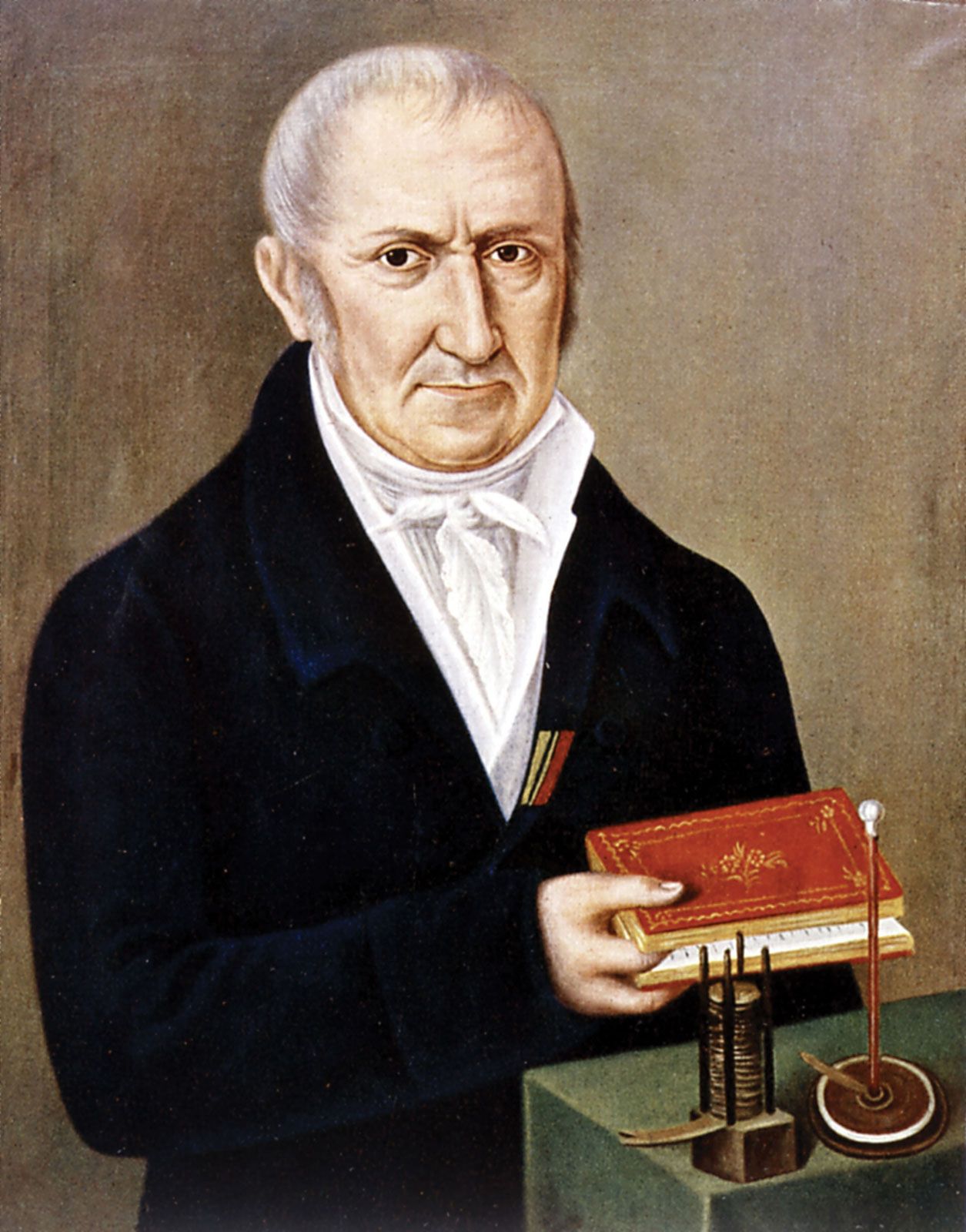
Alessandro Volta
Italian chemist and physicistWikipedia
34
MENTIONS
14
EPISODES
13
PODCASTS
Search complete. 34 mentions across 14 episodes found for "Alessandro Volta".
Sep 25, 2026

KenanHOST
so if you want unique cars and you live in a weird city that happens to have some scientist related to it, you too can request them from Bentley.
Doug DeMuroHOST
What about Alessandro Volta?
FilippoHOST
Sure.
Doug DeMuroHOST
This is Filippo's dream.
KenanHOST
There you go.
Doug DeMuroHOST
There's just, there's gonna be...
Doug DeMuroHOST
They're gonna do an Alessandro Volta version of the Tourkol-
FilippoHOST
[laughs]

Dan LongacreNARRATOR
A similar machine was made later by placing a glass disk so that it could be easily turned, and by fixing a number of rubber or silk brushes so that they would rub against the revolving glass.
Dan LongacreNARRATOR
Alexander Volta, an Italian, was also a pioneer.
Dan LongacreNARRATOR
He discovered in 1800 that two different metals in contact with each other would produce an electric current.
Dan LongacreNARRATOR
From this discovery, he invented an electric battery.
Dan LongacreNARRATOR
A copper wire was also fastened to the copper disk of the first cup and one to the zinc disk of the last cup.
Dan LongacreNARRATOR
On taking hold of these last two connecting wires, a strong electric shock was felt, and the current continued to flow regularly.
Dan LongacreNARRATOR
A battery like Volta's can be made without the cups by using a glass jar.
Dan LongacreNARRATOR
It should be remembered, however, that the strength of the battery does not depend upon the size, but upon the number of disks or plates.

speaker_1HOST
In the plumbing analogy, current is the amount of water flowing through the pipe at any given moment.
DavidHOST
It is measured in a unit called amperes, named after the French physicist André-Marie Ampère, but it is usually just shortened to amps.
speaker_1HOST
To give us a sense of physical scale, what exactly constitutes one single amp of current?
DavidHOST
One amp of current means you have over six quintillion individual electrons flowing past a single specific cross-section of the wire every single second.
speaker_1HOST
Voltage, which is symbolized by the letter E for electromotive force, is analogous to the water pressure pushing the water through the pipe.
speaker_1HOST
It is the potential energy available to do work.
DavidHOST
It is measured in volts, named after the Italian physicist Count Alessandro Volta.
speaker_1HOST
The book uses a really memorable non-water analogy to explain this concept of potential.

Sam SmithHOST
So as I talk about these, just understand that I'm gonna definitely talk more about them as I continue to go on.
Sam SmithHOST
So the first type of cell is called a galvanic or voltaic cell, and this was named after Luigi Galvani, who is actually the brother of Mario Galvani, probably more well-known, and also Alessandro Volta.
Sam SmithHOST
The second type of cell is called an electrolytic cell, and then the third type of cell, which is actually a type of galvanic cell, is called a concentration cell.
Sam SmithHOST
So let's start with the first there.

Ruth GoldingNARRATOR
Galvani thought the spasms were due to electricity in the animal and produced them at will by touching the nerve of a limb with a rod of zinc and the muscle with a rod of copper in contact with the zinc.
Ruth GoldingNARRATOR
It was proved, however, by Alessandro Volta, professor of physics in the University of Pavia, that the electricity was not in the animal but generated by the contact of the two dissimilar metals and the moisture of the flesh.
Ruth GoldingNARRATOR
Going a step further, in the year eighteen hundred he invented a new source of electricity on this principle, which is known as Volta's pile.
Ruth GoldingNARRATOR
It consists of plates or discs of zinc and copper separated by a wafer of cloth moistened with acidulated water.
Ruth GoldingNARRATOR
When the zinc and copper are joined externally by a wire, a current of electricity is found in the wire.
Ruth GoldingNARRATOR
Obviously, the higher the electromotive force and the lower the resistance, the stronger will be the current in the conductor.
Ruth GoldingNARRATOR
Hence it is desirable to have a cell which will give a high electromotive force and a low internal resistance.
Ruth GoldingNARRATOR
Voltaic cells are grouped together in the mode of Leiden jars.

Grandpa CohenHOST
In 171 he published his findings, describing the experiments that had led him toward this explanation.
Grandpa CohenHOST
A copy reached Alessandro Volta, a professor of natural philosophy at the University of Pavia, who repeated the experiments.
Grandpa CohenHOST
Volta agreed that something electrical was happening, but he questioned where the electricity came from.
Grandpa CohenHOST
In experiments involving different metals, might the metal arrangement supply the stimulus? While the frog's leg merely revealed its presence, it was the difference between seeing a bell ring and discovering what had pulled the cord.

speaker_0NARRATOR
La historia de la electricidad estaba dejando de ser una historia de curiosidades aisladas y comenzaba a convertirse en la comprensión de un principio universal.
speaker_0NARRATOR
Alessandro Volta creó la primera batería confiable en 1800, a la que llamó pila voltaica, fabricada con capas alternadas de zinc y cobre.
speaker_0NARRATOR
Esto fue revolucionario porque proporcionó a los científicos una fuente constante de energía eléctrica que podían controlar y estudiar.
speaker_0NARRATOR
Antes de la batería de Volta, los científicos habían dependido de máquinas que generaban electricidad mediante fricción, lo cual era impredecible y difícil.
12 MINS LATER
speaker_0NARRATOR
Cuando accionas un interruptor de luz, completas ese circuito y la electricidad comienza su danza invisible a través de los cables.
speaker_0NARRATOR
El voltaje es la diferencia de potencial eléctrico entre dos puntos, algunas veces descrita como el empuje o la presión que impulsa a los electrones a través de un circuito.
speaker_0NARRATOR
Se mide en voltios, una unidad que lleva el nombre del propio Alessandro Volta.
speaker_0NARRATOR
Un voltaje mayor significa un mayor empuje detrás de los electrones y una mayor capacidad para realizar trabajo.

speaker_2NARRATOR
The story of electricity was becoming less about isolated curiosities and more about understanding a universal principle.
speaker_2NARRATOR
Alessandro Volta created the first reliable battery in 1800, which he called a voltaic pile, made from alternating layers of zinc and copper.
speaker_2NARRATOR
This was revolutionary because it provided scientists with a steady source of electrical energy that they could control and study.
speaker_2NARRATOR
Before Volta's battery, Scientists had relied on machines that created electricity through friction, which was unpredictable and difficult.
speaker_2NARRATOR
Suddenly, they had a reliable source.
speaker_2NARRATOR
Around the same time, a scientist named Luigi Galvani discovered bioelectromagnetism, showing that electricity was the medium by which nerves pass signals to the muscles.
10 MINS LATER
speaker_2NARRATOR
For electrons to flow, there must be a complete path or circuit, a closed loop that allows the current to return to where it started.
speaker_2NARRATOR
When you flip a light switch, you complete that circuit, and electricity begins its invisible dance through the wires.

Henry HawkHOST
and another Italian scientist strongly disagreed with him.
Henry HawkHOST
His name was Alessandro Volta.
Henry HawkHOST
Volta argued that some of the electrical effects Galvani observed were being produced by the different metals used in the experiments rather than originating entirely within the animal.
Henry HawkHOST
The disagreement became one of the great scientific debates of its times, and wonderfully, they were each touching part of the truth.
Henry HawkHOST
Volta's work ultimately contributed to his invention of the voltaic pile, An early electric battery.
Henry HawkHOST
That's where we get the word volt.
Henry HawkHOST
But Galvani's central intuition that living nerves and muscles involve intrinsic electrical phenomena was also profoundly important.

17 Laws GuyHOST
Not a footballer, but a scientist.
17 Laws GuyHOST
Alessandro Volta.
17 Laws GuyHOST
100 years after his death, Como is putting on exhibitions, ceremonies, a new stadium, scientific gatherings, and football.
17 Laws GuyHOST
Four clubs have been invited to play for the Coppa Alessandro Volta.
17 Laws GuyHOST
One is Internationale, and Inter have already had a terrible morning.
17 Laws GuyHOST
Comense beat them 3-0.
17 Laws GuyHOST
Merza scores twice, Inter scores six, and the kid stays.
17 Laws GuyHOST
Now stop the football clock for one minute, because this is where today becomes a wonderfully OTD.
4 more episodes mention Alessandro Volta.
Create an account to see the whole feed, search across every transcript, and follow the entities you care about.