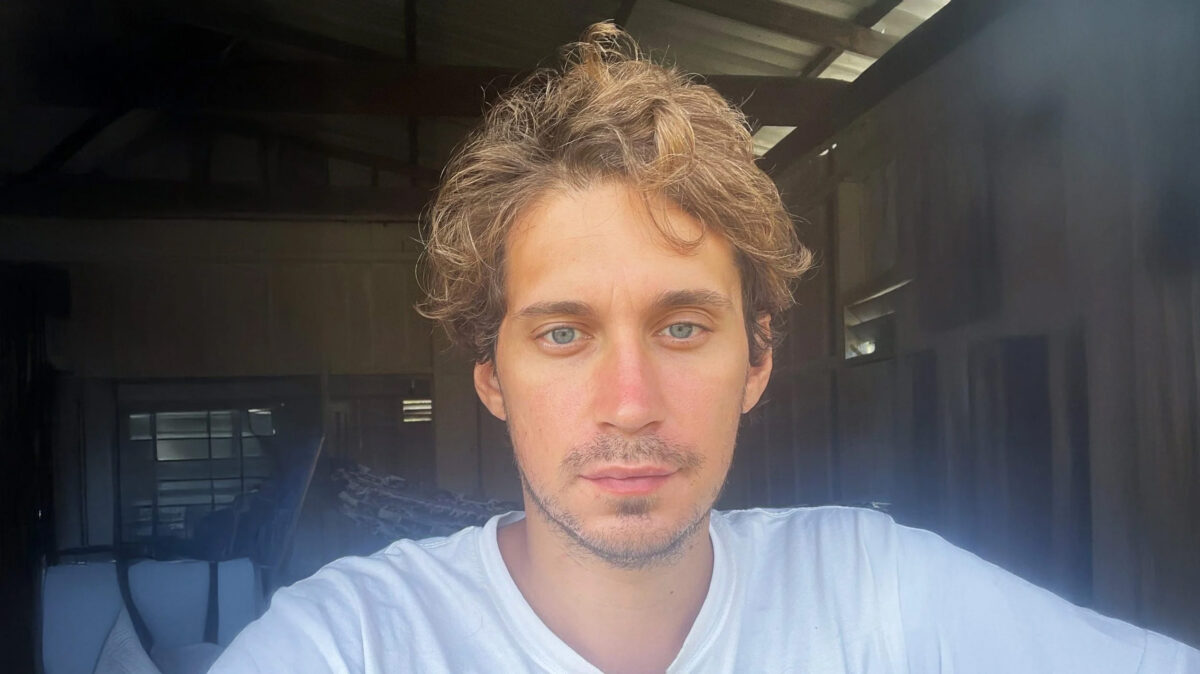
Adam Louis-klein
10
APPEARANCES
9
PODCASTS
Sep 30, 2026


Josh LevsHOST
I'm wondering what it was like for you starting October 9th and ever since to be a consumer of news and see the extent to which major news agencies play right into the lies and hate of anti-Zionism that was so prominent on the left.

Adam Louis-KleinGUEST
Yeah, I mean, what I quickly discovered, too, from this experience of it being impossible to argue or use facts with anti-Zionist was that it was all about authority.
Adam Louis-KleinGUEST
So think about these NGOs, Amnesty International, B'Tselem, Human Rights Watch.
Adam Louis-KleinGUEST
Today, I think there's been more and more scandals, and their credibility has been seriously damaged in the public, thank God, because they are not credible institutions.
9 MINS LATER
Josh LevsHOST
So that slogan, anti-Zionism is a hate movement, that's one that you want to be popularized because based on your knowledge of how societies develop, you think that will help get the message across to more people.

Adam Louis-KleinGUEST
It's not so much that many Jews are separating them, they're just constantly re-internalizing the campaign.
Adam Louis-KleinGUEST
So they hear the campaign coming from outside and then treat it as if it is just kind of a normal claim or critique.
Adam Louis-KleinGUEST
So under that assumption, everything becomes, how much do I acknowledge Israel's flaws and how much do I sort of be proud of Israel's And then it's about just measuring truth claims.
14 MINS LATER

Izzy OderbergHOST
He made it clear that he views anti-Zionists and the anti-Zionist movement as the primary obstacle to social cohesion around the conflict in the Middle East.
Adam Louis-KleinGUEST
From my experience as someone who witnessed the 2023 to 2025 anti-Zionist riots on campuses, I saw how they were narrated.
Adam Louis-KleinGUEST
That was a way of institutions to claim a kind of neutrality while they were actually often implicitly supporting the anti-Zionist riots or allowing them to unfold.
Adam Louis-KleinGUEST
Of course we know It wasn't bilateral tensions between pro-Israel and pro-Palestine, right? The anti-Zionists started these protests, these riots.
Adam Louis-KleinGUEST
The anti-Zionists initiated mass harassment and abuse of Jewish students on campus.

speaker_0NARRATOR
I started by asking Adam about the anti-Semitism that is present in the university sector.
Adam Louis KleinGUEST
So we don't really have mainstream sort of anti-Zionist hegemony in academia until the 2000s, right? So before the 2000s in the West, the anti-Zionism that appeared in the West largely was projected from the Soviet Union, anti-Zionist propaganda campaign that started post-1967 propaganda They basically established institutes called, you know, it was a pseudoscience called Zionology, where they studied Zionism as this imperial bourgeois conspiracy to oppress the working class and socialist movements all over the world.
Adam Louis KleinGUEST
And they projected this through, you know, pamphlets, publications, etc., into the West, into Western leftist communist groups.
Adam Louis KleinGUEST
And so it had a bit of a presence within the third worldist movements as far as they made themselves known in the West.
Adam Louis KleinGUEST
Now, there were also Arab nationalist intellectuals like Constantine Zureik or Fayez Sayegh, who were usually Protestant or Christian Arab intellectuals who for a long time had relationships with Levantine Christians.
Adam Louis KleinGUEST
sort of Christian missionaries who came from the U.S., right, and often spoke English.
speaker_0NARRATOR
As we've heard from a few of our guests, Adam is naturally more progressive, but has found since October 23 that his more progressive community has actually rejected him due to the fact that he's Zionist.

Renee GarfinkelHOST
So what question were you trying to answer that existing scholarship wasn't addressing?
Adam Louis KleinGUEST
In 2019, he had a very important article where he said, we should look at anti-Zionism as an ideology.
Adam Louis KleinGUEST
And he related it to the Jewish question of the past and the 19th century, early 20th century of something called the Jewish question was basically, what is the role of Jews in our society? There was a whole kind of complex of obsessive criticisms of Jews and whether they really belong, whether they're legitimate, etc., And that was kind of part of the ideology of classical anti-Semitism.
Adam Louis KleinGUEST
Now, what David Seymour showed was that you could understand anti-Zionism as a transformation of the Jewish question.
Adam Louis KleinGUEST
It's sometimes phrased as, does Israel have a right to exist? Is Israel legitimate as a Jewish state? There's this obsessive complex of criticism today around Israel.
15 MINS LATER
Renee GarfinkelHOST
Is it inherently anti-Zionist, or do proponents of the idea get some things right?

Renee GarfinkelHOST
So what question were you trying to answer that existing scholarship wasn't addressing?
Adam Louis KleinGUEST
In 2019, he had a very important article where he said we should look at antisemitism as an ideology.
Adam Louis KleinGUEST
And he related it to the Jewish question of the past and the 19th century, early 20th century of something called the Jewish question was basically what is the role of Jews in our society? There was a whole kind of complex of obsessive criticisms of Jews and whether they really belong, whether they're legitimate, etc., And that was kind of part of the ideology of classical anti-Semitism.
Adam Louis KleinGUEST
Now, what David Seymour showed was that you could understand anti-Zionism as a transformation of the Jewish question.
Adam Louis KleinGUEST
It's sometimes phrased as, does Israel have a right to exist? Is Israel legitimate as a Jewish state? There's this obsessive complex of criticism today around Israel.
15 MINS LATER
Renee GarfinkelHOST
Is it inherently anti-Zionist, or do proponents of the idea get some things right?

Renee GarfinkelHOST
category.So what question were you trying to answer that existing scholarship wasn't addressing?
Adam Louis KleinGUEST
In two thousand nineteen, he had a very important article where he said we should look at anti-Zionism as an ideology, and he related it to the Jewish question of the past.
Adam Louis KleinGUEST
In the nineteenth century, early twentieth century, of something called the Jewish question was basically, what is the role of Jews in our society? There was a whole kind of complex of obsessive criticisms of Jews and whether they really belong, whether they're legitimate, et cetera.
Adam Louis KleinGUEST
Now, what David Seymour showed was that you could understand anti-Zionism as a transformation of the Jewish question.
15 MINS LATER
Renee GarfinkelHOST
Is it inherently anti-Zionist, or do proponents of the idea get some things right?


Adam Louis KleinGUEST
So, so I mean, I mean, if we look at history, so before 1948, there were many Jewish, uh, streams, there were many Jewish groups, and they had different notions about Zionism.
Adam Louis KleinGUEST
So you had people like Reform Jews at the time, uh, in the late 19th century who said, "We should actually become, we should assimilate into the United States, redefine Judaism just as a religion, not as a nation, uh, uh, or as a people, and we don't wanna return to Israel." They had their own reasons.
39 MINS LATER

Adam Louis KleinGUEST
I mean, the names have incredible power, right? When you're dealing with a kind of systemic problem, like if you look at the academy, it's completely captured by anti-Zionists.
Adam Louis KleinGUEST
Anyone who doesn't agree with anti-Zionist hate movement is largely silenced through fear of their reputation, right? You have these so-called experts who are putting forth anti-Zionist libels, these so-called genocide scholars claiming it's a consensus even when it isn't, right? But it is a large number of people they can mobilize to support these libels from within the academy.
Adam Louis KleinGUEST
That's a, an issue of pseudoscience, right? So, so you actually have a racist movement that's captured whole institutions.
16 MINS LATER


Mijal BittonHOST
Could you take us inside the moment when you decided that fighting anti-Zionism was going to become a major piece of your life and your work?
Adam Louis-KleinGUEST
It's that moment that Herzl had when he was in France and he witnessed the Dreyfus affair for the first time.
Adam Louis-KleinGUEST
He saw those crowds rioting about Albert Dreyfus, right, as a traitor to France, as a Jew, as an agent of this Jewish conspiracy.
7 MINS LATER
Mijal BittonHOST
What would you say is the most generous version of those who disagree with you and who say that it's, that the fight against anti-Zionism should be interlinked or folded within the fight against anti-Semitism?