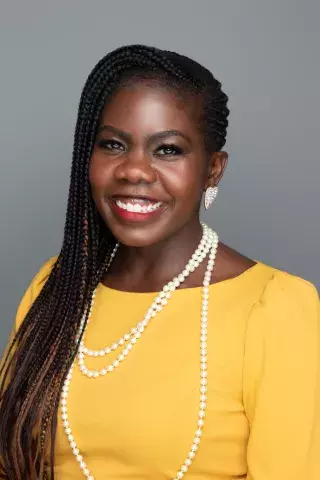
Abre Conner
6
APPEARANCES
6
PODCASTS
Oct 23, 2026


Abre' ConnerGUEST
It's an interesting point to bring up that this is just what we need for innovation and also to bring up the internet.
Abre' ConnerGUEST
When I first started my career, the fracking boom was supposedly going to be the way that we were going to achieve energy dominance across the world.
42 MINS LATER

Abre' ConnerGUEST
Well, one of the interesting things when Project 2025 was first released, we did across the association a broader deep dive into what some of that was going to look like.
Abre' ConnerGUEST
And despite certain individuals who worked on Project 2025 saying, oh, this has nothing to do necessarily with this administration.
Abre' ConnerGUEST
We're seeing many of those plays actually show up right now in the repeals and the revocation of the laws and the very protections that we have had for a number of years.
Abre' ConnerGUEST
And the endangerment finding, and now what we're seeing is the rollback to power plants as well.

Richard ChuHOST
I mentioned it a few weeks ago when it first came down, but talk about what you guys are doing in that space.

Nora KenworthyHOST
Can you talk about how you see the connecting threads between this new wave of industrial activity and what you've seen in the past?
Abre' ConnerGUEST
One of the interesting things about really understanding the history of this country and the history of this injustice more generally against people who have been seen to be potentially able to be looked over or sacrifices is that we see many of the strategies and plays from industries who think, well, this is what it's going to take for us to reach the next frontier.
Abre' ConnerGUEST
In the early 1900s, there was a number of thriving Black communities where you saw Black folks really trying to ensure that they were safeguarding economic prosperity, building out communities that would allow for Black folks to be able to thrive.
Abre' ConnerGUEST
And that time and time again, there were decisions to burn them down or take resources away from them intentionally, or to basically say, no, we're going to allow for you to build this out and then we'll just take it from you.
Abre' ConnerGUEST
And these decisions are similar to what we've continued to see for decades and decades since then.
Abre' ConnerGUEST
And fracking is another part of that playbook where you have communities where people live.
17 MINS LATER
Nora KenworthyHOST
Can you talk a little bit about how you balance those two strategies and where the wins are for both of them, but also where are the challenges?

Kayla ShannonHOST
What does this really have to do with me, right? Like if it's not in my neighborhood, If it's not happening in my state, how is this connected to me? And so I'm wondering for the listeners who are in that boat, who just cannot understand or draw the line between the two, how do you make the case that this is a civil rights fight and what made it personal for you?
Abre' ConnerGUEST
Well, at the beginning of my career, when I first graduated from law school, I moved to the Central Valley of California.
Abre' ConnerGUEST
And a lot of the work that I was doing at that time was with migrant farm workers.
Abre' ConnerGUEST
And at that time, I mean, it may seem silly now to say that fracking causes a public health crisis.
Abre' ConnerGUEST
But at that time, it was being touted as, you know, the wave of the future, the way that we were going to achieve energy dominance.
Abre' ConnerGUEST
And the places where the fracking infrastructure was going were in, you know, low income, frontline, fence line communities.
34 MINS LATER


Amy GoodmanHOST
Lay out your response to SpaceX acquiring Musk's AI company, XAI, and the lawsuit of the NAACP.
Abre' ConnerGUEST
Yeah, well, we already were in the fight of our lives with communities by fighting a billionaire who decided to go into a predominantly black community, first in Memphis, utilizing mass turbines that were polluting the community and then copy and pasting that same type of project in South Haven, Mississippi.
Abre' ConnerGUEST
And then whenever you now move into a place where now there is a trillionaire who is making decisions and feeling as though they don't—he does not have to necessarily follow the Clean Air Act, that's a problem.
Abre' ConnerGUEST
You cannot actually just go into a community, start polluting, and not actually try to get the permits.
Abre' ConnerGUEST
Regardless of who is potentially in office, the Trump administration, that does not mean that the law does not apply to you.


Abre' ConnerGUEST
... have a starting point, and had conversations with folks who actually developed out those EJ principles as well.
Abre' ConnerGUEST
And it was the first set of data center principles that have been nationally developed around how community-guided principles should look.
Abre' ConnerGUEST
And they are that our health and the environment are sacred, that communities most affected must lead, that jobs cannot justify harm, accountability must be enforceable, that we reject false solutions and fossil fuel dependency, infrastructure must be community-led, interconnected harms require interconnected solutions, solidarity builds power, and that we walk our talk.
Abre' ConnerGUEST
And what was really important, even in developing the principles, was also just the community that was built during those several days that we were there in Memphis with folks who had said, like, "Wow, we thought we were the only group that [laughs] was fighting on data center issues in our communities," or, "We didn't know that, you know, there was this other group in, in the other part of the country who also was, like, dealing with the same challenges that we were." And I will say that I think that, you know, folks being there and being able to be energized, you know, at the height of the conversations of people trying to figure out what it is that they could do, you know, well before there were many other conversations that were happening, I think that that helped create a silver lining, um, for communities who at that point did not feel like there was the unification to allow for the mobilization to happen in the way that we're seeing it now.
Abre' ConnerGUEST
Do we need more time in order to sit back, pause, to do the research to see whether or not it even makes sense to build it there? When I first graduated from law school, I moved to the Central Valley of California, and I was doing a lot of work with migrant farm workers and in places where, uh, companies and the oil and gas industry was like, "Oh, this would be greatFor fracking.
Abre' ConnerGUEST
Um, and so [laughs] a lot of the conversations, right, at that time was around if we don't get fracking moving as quickly as possible, we're going to miss this moment for energy dominance, for us to be able to make the advances that we need in the energy sector, and we have to do it now.