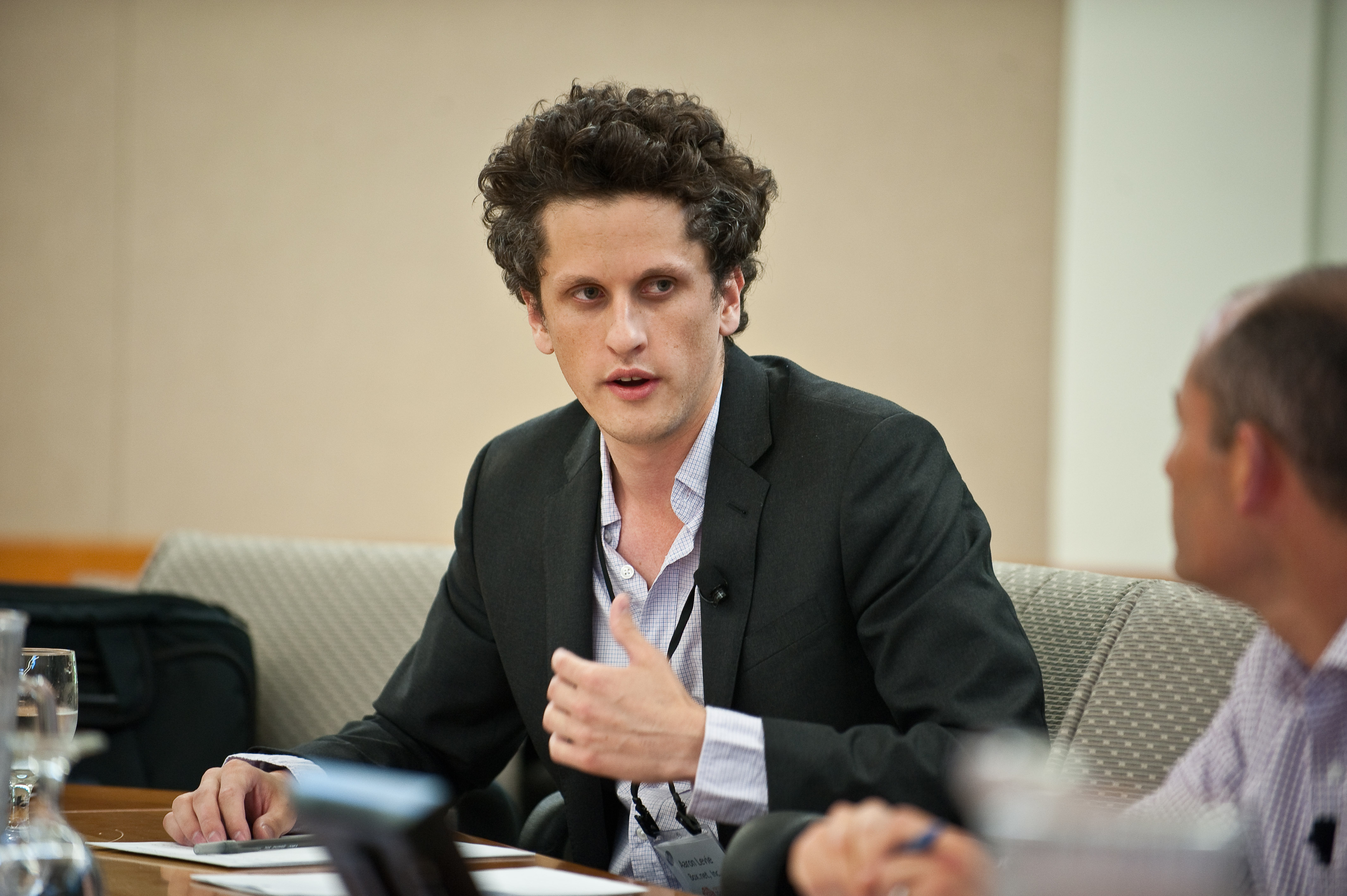
Aaron Levie
CEO of Box
65
APPEARANCES
36
PODCASTS
Nov 5, 2026

Carl QuintanillaHOST
Is that about the cadence of budgets? Is it a timing thing or does it reflect a wholesale rethinking of AI budgets?

Aaron LevieGUEST
I think, you know, it's I would generally say it's always hard to kind of over rotate on one or two announcements of one company's policies.
Aaron LevieGUEST
Some companies, you know, sometimes over deploy AI and realize that they need to kind of figure out their their budget allocation process.
Aaron LevieGUEST
That probably slightly misrepresents the broad scale adoption trends that we tend to see across at least our customer base and across the economy.
Aaron LevieGUEST
If you study even Silicon Valley companies that are often the earliest adopters of these technologies, we're still in a period where we keep reaching new sort of levels of frontier of how we're going to use AI inside of our workflows.
Aaron LevieGUEST
So cybersecurity is a great recent example where a year ago, we probably had very few tokens going into cybersecurity use cases.

Sara EisenHOST
Why do you think there's such a disconnect and how and how do we how do you go about changing the public perception?
speaker_3MODERATOR
What's been the most craziest thing that you've ever seen so far?
Aaron LevieGUEST
Well, like if you just take the basic premise and then draw it out, like when we started Box, our rate of progress as a startup was 100% correlated to how many hours we could be on a keyboard and type things.
Aaron LevieGUEST
That was the only point of leverage we had was how fast we could type text into a keyboard.
14 MINS LATER
speaker_3MODERATOR
That's not going to work for you, man.

speaker_4ADVERTISER
Visit the website for full terms and conditions.
22 MINS LATER
speaker_8ADVERTISER
See Experian.com for details.

Mike SantoliHOST
So, Aaron, what has to happen for the infrastructure to get to a place where you could have just this background hum of all of these agents constantly working? I mean, at what cost, I guess, is some of the questions, because even with things like Muse, the question is, what is the cost meta to deliver on some of these relatively simple consumer applications?
Aaron LevieGUEST
So on the consumer side, the subsidization will likely come from the actual agent vendor themselves.
Aaron LevieGUEST
And they're able to subsidize this due to either advertising or transactions happening through their platform and commerce to some degree.
Aaron LevieGUEST
So I think the consumer side will be kind of a very simple equation about, can you flow commercial activity through your platform? On the enterprise side, it'll eventually converge with the ultimate value that enterprises are getting from these agents.
Aaron LevieGUEST
And that will be whether life sciences companies can accelerate drug discovery.
Aaron LevieGUEST
It will be whether financial services firms or trading firms are able to create better alpha in the market.


SophiaHOST
Mm
Aaron LevieGUEST
... background kind of operations at some kind of frequency to go and do, uh, task execution for me that is, again, 100% decoupled from my ability to go and kick them off.
Aaron LevieGUEST
Um, so for instance, if you say, "Hey, I wanna go deploy 10,000 agents to, uh, basically go upgrade a major piece of software or, um, go do life sciences research and do a bunch of tests on, you know, new medical experiments, um, or I wanna have agents be able to get kicked off every time that some code changes in our code base, and then, and then basically fan out to review every single change in the code and, and, uh, every permutation of risk that gets generated by those changes from a cybersecurity standpoint," these are actually where you're gonna see just a complete nonlinear growth of, of AI use ca- Um, because what will happen is we will start to look at every problem through the lens of how much compute can we throw at this problem to solve it either faster or with higher efficacy.
Aaron LevieGUEST
And it's gonna completely change the way that we think about a lot of workflows in the economy.
Aaron LevieGUEST
Um, you know, the average, uh, hedge fund will just basically be deploying, you know, near infinite amounts of compute at looking through every single possible trade they could be making with every amount of research they can create.
Aaron LevieGUEST
The average life sciences company is obviously gonna fan out agents in parallel to do an unbelievable amount of research, um, against every, again, kind of, sort of, you know, pathway that they can, they can possibly think of.
Aaron LevieGUEST
Um, you're gonna obviously have, uh, uh, agent swarms go out and get executed in, in AI research, uh, itself.
10 MINS LATER
SophiaHOST
Mm


Kelly EvansHOST
Is it too early to figure out how to invest in this yet? Or is the winner, the likes of Meta and so forth, are they staring us in the face?

Aaron LevieGUEST
Well, I think, you know, I can't really provide investment advice on this front, but I think you can certainly sort of extrapolate out, you know, maybe we get to a point where there's a few hundred million users of these kinds of personal agents and what type of economic activity will a user or consumer, you know, kind of give to their agent and how will that activity be executed? One of the biggest flips is in a world of agentic task execution, the both opportunity and risk is that the preference of the end user starts to become less important than what the agent is just able to execute.
Aaron LevieGUEST
I might have a preference traditionally of where I would want to buy something or where to transact.
Aaron LevieGUEST
But if an agent can find a better price or a better opportunity for me, maybe I end up going with whatever that agent goes and decides or recommends.
Aaron LevieGUEST
So that has the opportunity to provide a little bit of a market shift In some of the dynamics based on, you know, who's an incumbent now versus maybe who's an incumbent later.
Aaron LevieGUEST
But unfortunately, that doesn't exactly tell you what to invest in because you have also a huge opportunity for the incumbents to respond very effectively.
Aaron LevieGUEST
There's a kind of increasingly famous line in Silicon Valley that says build something that agents want.


Erik TorenbergHOST
... how have you reacted and reflected on what's happened there and just the discourse that's followed? How do you-
Aaron LevieGUEST
Maybe I'll say one thing that we probably all agree with, and then we can figure out where we maybe kind of fracture off.
Aaron LevieGUEST
I think we would agree that any AI lab right now at the frontier should be building in the safest way possible with the highest degree of governance and security and whatever your definition of alignment is.

Martin CasadoGUEST
They need to say, "No, we don't think this stuff we're gonna do is gonna cause extinction," and then I think this becomes this very sensible-

Sara EisenHOST
What are you hearing from the enterprises right now? I mean, are they asking for more powerful agents? Are they asking for help understanding the highest return on investment? Are they concerned about security and stealing of data, as Alex Karp noted last week?
Aaron LevieGUEST
Yeah, how about all of the above? This is, I mean, and I can list about 10 more topics.
Aaron LevieGUEST
So, you know, I regularly get to have the opportunity to, you know, host dinners with CIOs and CEOs kind of across a range of industries.
Aaron LevieGUEST
And every topic you just mentioned, in addition to, you know, open weights versus closed weights, post-training your own models? How do we sort of re-engineer our business processes and workflows to be able to use AI agents? These are all the topics I think on the minds of every, again, CIO or technology leader or even CEO across the economy.
Aaron LevieGUEST
I think you're going to see we're entering the period which is really the AI diffusion era.
Aaron LevieGUEST
I think even this week will be a great example of all new breakthroughs on the model front.


John CooganHOST
And so that's why the company's performing well in the markets over the last couple months, for example.
Aaron LevieGUEST
I don't know of a single company still being run the way that it was run maybe 18 months ago.
Aaron LevieGUEST
And then I think we're – there still will clearly be some parts of the market that don't capture as much of the value as they did previously.
6 MINS LATER


Aaron LevieGUEST
You're just trying to put a, a, an, a sort of interface up there that somebody presses a button and moves to the next step.
Aaron LevieGUEST
So for most of the world, the value creation of code has been to automate things and to be able to have it as a utility.
Aaron LevieGUEST
And we'll probably still use the term slop for a while because, because there's taste in kinda front-end design, and there's taste in, in sort of systems, and you don't wanna have vulnerabilities in your code.
25 MINS LATER

Aaron LevieGUEST
So that's kinda probably part one, and then part two, I think embedded in there was a little bit of a call to arms on the US actually needs to be probably even more invested in open weights models, and we probably want even more companies kind of showing up to the table with this innovation.
Aaron LevieGUEST
And so it didn't seem like it was directly about we must support all of the things that are happening in China as much as US needs to continue to support open weights.
Aaron LevieGUEST
I know, by the way, like distillation's actually not always bad, and there's lots of use cases around it, so let's maybe like calm down on some of the FUD on that.
10 MINS LATER

Aaron LevieGUEST
Well, when you deploy AI agents in an enterprise, those AI agents need access to the critical information in your organization, and so much of that critical information lives inside of unstructured data.
Aaron LevieGUEST
So if you think about data inside of a database or a CRM system, that's structured data.
Aaron LevieGUEST
Data inside of your documents, your marketing assets, your research material, material, that's all unstructured data, and that's the data that we store and we have been storing for many years.
Aaron LevieGUEST
And so when enterprises wanna be able to have A- AI agents that can automate a loan review process or an insurance claim process or a contract review process, they need to be able to deploy AI agents with access to, in a very secure way, their enterprise content.
Aaron LevieGUEST
So we've built a platform that allows enterprises to go and do that in a secure way, in a well-governed way, in a way that's compliant, uh, for any industry they're in.

Brian SullivanHOST
... how much of your revenue is sort of new sales, people coming to Box for the first time ever, never, never been with you guys but want this, versus sort of layering on or adding on capability?


Aaron LevieGUEST
So so so I think what first of all, the fable model is is, you know, kind of an unprecedented level of of intelligence and capability.
Aaron LevieGUEST
So so the clearly anthropic, you know, designed an incredible and trained an incredible model.
Aaron LevieGUEST
But the US government effectively enacting an export control, which meant that non-US citizens aren't able to use the model, is really kind of a completely new precedent and moment in AI regulation.
Aaron LevieGUEST
where we've never seen that before for any kind of frontier model being held back legally from being available in the market.
Aaron LevieGUEST
And the implications are, first of all, it's almost entirely impractical for any AI lab to be fully responsible for you know, the nationality of the customers that are using it.
12 MINS LATER

Aaron LevieGUEST
I mean, each of the models kind of capabilities that you see improve, you know, unlock another tranche of use case.
Aaron LevieGUEST
So even Fable, you know, there'll be a new set of legal financial services, healthcare, life sciences use cases that get opened up.
Aaron LevieGUEST
But there's no question that sort of Fable 7 or Fable 8 will unlock another, you know, 70% of the next, you know, sort of tranche of use cases.
Aaron LevieGUEST
So I think that there's no, we continue to need all the model progress that's possible.
Aaron LevieGUEST
At the same time, and these two things can be true at once, you have a model overhang, which is basically the models are really powerful.
13 MINS LATER

Paul Klein IVHOST
What's going to happen there? And what do you think those types of companies to think about?

Aaron LevieGUEST
... you know, that, that very early offer, um, and just taken it off the table.
Aaron LevieGUEST
And then l- you know, later as we scaled... 'Cause we, we've had, uh, we ha- we've had every problem thrown at us.
Aaron LevieGUEST
So there are definitely, you know, there's d- definitely, you know, parts of the, of the journey where we would've, you know, if anybody had shown up with, with any offer, we would've, we would've accepted it probably.
Aaron LevieGUEST
And then it's, you know, as these things go, like, when people do actually show up for offers, you g- you, you're like, your, your, your chemicals in your head are totally different, and you're like, like, "Oh, my gosh," like, "We just gotta keep doing this." And so probably the most classic one that we faced was a, a very kinda serious interaction where, where we would've, you know, been, I think, quite happy about the outcome on any kind of financial measure.
38 MINS LATER
speaker_4UNKNOWN
Yeah


Aaron LevieGUEST
I, I prefer Occam's razor on this one, um, which is, um, you know, ever since Mythos, um, you know...
Aaron LevieGUEST
M- Mythos very clearly was this event that basically said, y- you know, "AI is obviously getting super powerful.

Aaron LevieGUEST
I sort of have my own experience of AI and then I've seen it from either peers or other people in the industry.
Aaron LevieGUEST
And so I kind of, I believe I have a good pulse on this, which is I use AI, I think as much as any CEO out there.
Aaron LevieGUEST
I'm using it for prototyping of new products, developing new ideas, doing lots of market research, automating customer intelligence.
Aaron LevieGUEST
And at the very start of that journey, you do these things like you prototype a piece of software or you do some market research and you are like, oh, my God, this thing is going to just automate everything.
Aaron LevieGUEST
And what are the implications of this and what does this mean? And you almost have this sort of existential dread, you know, for a few moments there.
11 MINS LATER

Michael KrigsmanHOST
Because you just yourself just described, you know, the using different models, which means you're swapping.
Deirdre BosaCORRESPONDENT
Um, how firm exactly is this footing? In other words, how do investors know that this is sustainable versus software just clearing a lower bar here?
Aaron LevieGUEST
So, um, so [laughs] I, I won't be able to talk about the trading dynamics of, uh, of the Street right now.
Aaron LevieGUEST
But what I can say is, you know, last week I think was great evidence, uh, from a variety of earnings calls, uh, really across security, data platforms, systems of record that all showed, uh, that these businesses are extremely healthy right now.
Aaron LevieGUEST
Uh, we had a fantastic Q1, uh, we just reported, and, um, uh, we're seeing momentum really across all segments, all industries and geographies.
Aaron LevieGUEST
And the common trend from our customer base that we're seeing, I think it's true, you know, not to speak of, of, you know, too much for Salesforce, Okta, b- Mongo, uh, and others is, and Snowflake is, uh, enterprises need to be able to have core systems where their data and their workflows can, can go and be managed and secured and then connected up to all of the AI agents that they're using.
Aaron LevieGUEST
Uh, so I think you're seeing a lot of resilience in these platforms, uh, that's showing up in the Q1 numbers, and I think obviously reflected in, you know, much of the, the rebounding conversation that we're now seeing over the past couple days.


Matt TurckHOST
I think the frontier tokens, uh, has increased, which is completely opposite from the narrative that we were all telling one another in the last couple of years, uh, that the cost of token was always going down.
Aaron LevieGUEST
I'm not 100% sure it's, it's just the subsidization, uh, change as much as like, no, like these models are just way bigger and, and, and they're, you know, the hardware is, is not getting any cheaper anytime soon, and we have a capacity constraint.
Aaron LevieGUEST
And so you've got like, you've got like a few atypical patterns, uh, from, from normal computing, which is like usually like there's economies of scale and you don't have the same kind of shortage.
Aaron LevieGUEST
And so then as you build out, everything gets cheaper and you have Moore's law.
37 MINS LATER
Matt TurckHOST
How does the rest of the organization evolve? I'm sure that must be a, a key, uh, real concern when you talk to Global 2000 companies, right? Like the whole, "Well, partly, uh, you know, AI is taking my job," kind of thing.


Ben CasnochaHOST
In what ways do you think incumbents are vulnerable to startup disruption, either in general or in this moment of AI agents?
Aaron LevieGUEST
I actually, at least in the way we internally think, we actually force ourselves to think, imagine if the incumbents are actually really good.
Aaron LevieGUEST
then how would you win? Because if you can develop that strategy, then you'll win if they're bad also.
Aaron LevieGUEST
But if they're really good, you're gonna need to know what is your angle of attack.
Aaron LevieGUEST
Now, the part where maybe it meets the middle is, you don't want to get yourself into this loop, and people do, which is you over-assume what the incumbent will do, and then that kind of creates paralysis, and then you just freeze and you don't go after the market.
Aaron LevieGUEST
So I would still go after the market, but you should actually assume the incumbents are eventually going to figure this out, and again, if they don't, then you're gonna be bigger than you thought, and if they are, then you at least have had a kind of an opening.
11 MINS LATER
Ben CasnochaHOST
But Aaron, next three to five years, what are you seeing across all the companies you're working with? How fast do you see the deployment of these agents?


Aaron LevieGUEST
So it's this interesting dynamic where, uh, a- a younger group, not necessarily in age, but maybe in skill or time in that domain, so an earlier group in that domain, um, can have as much leverage and in many cases even more because of their mindset differences than somebody that is, like, super experienced in a field.
Aaron LevieGUEST
Now- Now interestingly, the- the- the advice can go in all directions because you can, you know, you could have somebody maybe too early in that field, and then, um, and then use AI in the wrong way and- and get the wrong outcomes.
Aaron LevieGUEST
Uh, equally, you could have somebody extremely experienced that decides to adopt the technology, and then they have a total superpower because they understand all of the contours of- of whatever they're working on, you know, whether it's writing code or doing healthcare or doing biotech.
Aaron LevieGUEST
And they will be actually, uh, even more capable of- of leveraging these tools if they have the kinda right mindset wiring, uh, to be able to lever them, uh, le- leverage them.
Aaron LevieGUEST
So I think that the core idea is that we're just at this amazing moment where if you're super ambitious, you wanna go deep into technology, ideally you're technical or- or becoming technical so you can kinda really know your way around these tools, you can make up for, again, lots and lots of years of- of skills that- that you would've otherwise had to go and develop.
Aaron LevieGUEST
And I think that's an incredible thing for democratizing, um, you know, knowledge and skillsets and expertise.


Casey NewtonHOST
... how much of that whiteboard would look the same, and how much would just be totally different?
Aaron LevieGUEST
[laughs] Well, I'd probably, uh, if my recollection serves me, uh, it was probably a lot of it was, was trying to compare the on-prem days to cloud and why, why cloud was, was such a big deal.
Aaron LevieGUEST
And, um, uh, I, I feel like my predictive capabilities were, were pretty, pretty locked in, um, you know, sort of maybe short of AGI.
Aaron LevieGUEST
Uh, but the whole, the whole idea was, was software's gonna move from your data centers, it's gonna move to the internet, and in the process, the, the real power of that is that it becomes available to way more companies, you know, s- businesses of all sizes, uh, lines of businesses that, that never could have used software before, end users, and this was a sort of this phase of consumerization of IT.
Aaron LevieGUEST
So, so, so that, that kinda played out, and then obviously we're now in, like, the next frontier of what is, what is software gonna look like in the future.
Aaron LevieGUEST
Like, if you are, you know, running a global, you know, uh, supply chain at a Fortune five hundred company, you want deterministic systems and software that power your ERP.
31 MINS LATER

Aaron LevieGUEST
Yeah, well, because I think, and this is going to be, these are going to get lumped together for a while.
Aaron LevieGUEST
You know, the API call in the box, the API call in the Workday, the API call in the Salesforce.

Akash PasrichaHOST
So I am curious around, um, did you go about setting a, a defined budget, uh, at box and to, have you blown through that budget yet?

Aaron LevieGUEST
Well, I think the gap is, and M-Martin, I'm sure you see this, but I think the gap is caused by the styles of work that exist in Silicon Valley and in engineering roles versus sort of the rest of the world.
Aaron LevieGUEST
So, and we've talked about this a couple times in, in different forms, but, but, you know, the, the technical aptitude of an engineer is just, like, insanely high.
Aaron LevieGUEST
The, the ability to use your own tools and make your own choices is insanely high.
Aaron LevieGUEST
And when things go wrong with the systems that you choose, you can just, like, quickly debug them and then make them sort of work for you.
12 MINS LATER


Danny FortsonHOST
Is what we are at the start of effectively a kind of a remaking of the internet or one layer below that for agents, not for humans? Like, what is happening?
Aaron LevieGUEST
Imagine that you have this AI agent, which you can just think of as an AI assistant for all intents and purposes, but instead of just answering questions for you, it can actually go and roam around the internet or use tools to be able to do its work.
Aaron LevieGUEST
And so you could tell an agent, "I'd like you to draft a contract or a marketing campaign asset or a presentation to a client," and it will go and almost quite literally use the software to create that set of data.
Aaron LevieGUEST
Now, on its end, it's actually just writing code and, and running scripts, but by and large, it's using the, the kind of core primitives of those applications to do its work.
Aaron LevieGUEST
So it could generate a document, and that document will be written like a Word document.
11 MINS LATER
Scroll for more appearances