[upbeat music] [air whooshing] So back in the day, if you were a writer covering Major League Baseball, as I did, um, you would have access to the players before the game and then after the game, and the clubhouse would open, I don't remember what it was, two and a half hours before the game, and you could walk in.
So you're doing something on the Pittsburgh Pirates, and you wanna talk to, uh, Jason Kendall.
Hopefully, Jason Kendall is sitting there, and you sit there, and you talk to him for a while.
You wanna talk to Ken Griffey Jr. or Joe Valentine, you walk in the Reds clubhouse, and you talk to them, and usually, it was fairly easy.
Now, players would hide from you, and players would oftentimes pretend to be doing something so they didn't have to talk to you, but it wasn't necessarily combative.
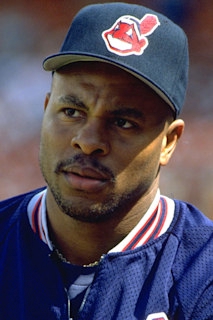
Kerry, Jeff needs to talk to you for a couple minutes." "Okay, no problem." However, if you were covering the Cleveland Indians as a B writer for one of the papers in Ohio or as a national guy, and you had to do something on that team, you would walk into the clubhouse, and the first thing you would do, and I mean the first thing you would do, is look for Albert Belle, their star outfielder, and the second thing you would do is avoid him like hepatitis C.
Albert Belle was known as a terrorizing, brutalizing, potentially violent baseball player who you just could not deal with, and it's kind of a crazy story.
His given name is Albert Joan Belle, but he went by Joey, and he was born in Shreveport, Louisiana, August 25th, 1966.
Um, in high school in Shreveport he was an Eagle Scout, [laughs] he was the president of the Future Business Leaders of America, he was sixth in his high school, on paper, like this all-American kid.
But there's this moment, he was a star baseball player, star football player, and there was this moment in high school.
And Joey Bell, Joey at the time, strikes out, takes his helmet, slams it to the ground, and storms off.
And people are kind of like, what the fuck? But like, his mother always remembered it at this moment.
Like, she said he wasn't a violent person, but when he threw his helmet, it wasn't to hurt someone.
[upbeat music] [air whooshing] So back in the day, if you were a writer covering Major League Baseball, as I did, um, you would have access to the players before the game and then after the game, and the clubhouse would open, I don't remember what it was, two and a half hours before the game, and you could walk in.
So you're doing something on the Pittsburgh Pirates, and you wanna talk to, uh, Jason Kendall.
Hopefully, Jason Kendall is sitting there, and you sit there, and you talk to him for a while.
You wanna talk to Ken Griffey Jr. or Joe Valentine, you walk in the Reds clubhouse, and you talk to them, and usually, it was fairly easy.
Now, players would hide from you, and players would oftentimes pretend to be doing something so they didn't have to talk to you, but it wasn't necessarily combative.
Kerry, Jeff needs to talk to you for a couple minutes." "Okay, no problem." However, if you were covering the Cleveland Indians as a B writer for one of the papers in Ohio or as a national guy, and you had to do something on that team, you would walk into the clubhouse, and the first thing you would do, and I mean the first thing you would do, is look for Albert Belle, their star outfielder, and the second thing you would do is avoid him like hepatitis C.
Albert Belle was known as a terrorizing, brutalizing, potentially violent baseball player who you just could not deal with, and it's kind of a crazy story.
His given name is Albert Joan Belle, but he went by Joey, and he was born in Shreveport, Louisiana, August 25th, 1966.
Um, in high school in Shreveport he was an Eagle Scout, [laughs] he was the president of the Future Business Leaders of America, he was sixth in his high school, on paper, like this all-American kid.
But there's this moment, he was a star baseball player, star football player, and there was this moment in high school.
And Joey Bell, Joey at the time, strikes out, takes his helmet, slams it to the ground, and storms off.
And people are kind of like, what the fuck? But like, his mother always remembered it at this moment.
Like, she said he wasn't a violent person, but when he threw his helmet, it wasn't to hurt someone.
The rest of this transcript — segmented and speaker-labeled, so you land on the exact moment something was said
Search every transcript — by keyword, by phrase, or by meaning, across every show Radar indexes
Trends — what is surging across podcasts, measured against its own baseline
Alerts — when a name you follow appears in a newly indexed episode
No account is needed to search Radar.