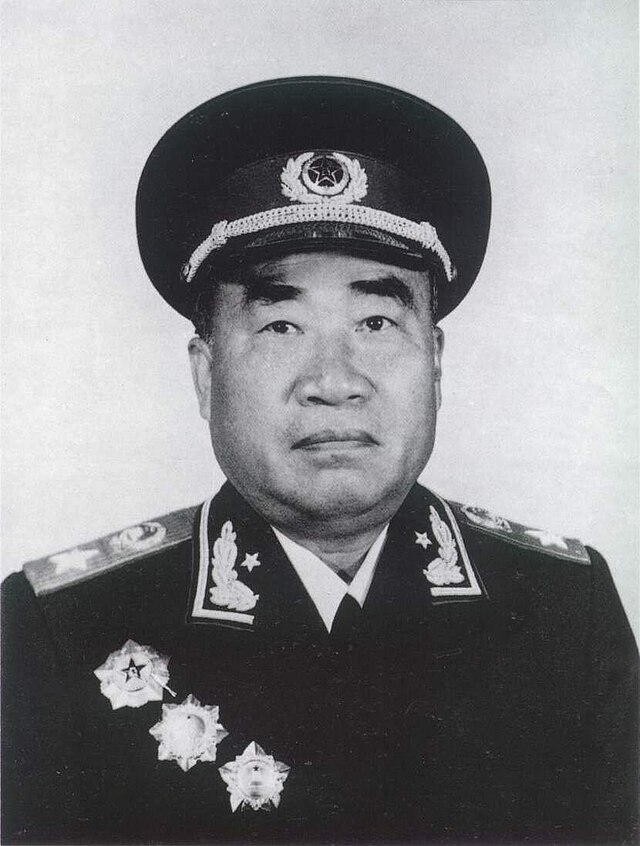
Zhu De

Zhu De

Revolutionary and former Vice President of the People's Republic of ChinaWikipedia

Search complete. 17 mentions across 5 episodes found for "Zhu De".

Oct 21, 2026

Matthew RothwellHOST
0:00
[upbeat music] Welcome to episode 138 of the People's History of Ideas podcast.
Matthew RothwellHOST
0:09
Two episodes ago, among other things, we discussed how in January 1930, Mao Zedong and Zhu De lured the suppression force that had been sent to crush the communist insurgency away from western Fujian and into Jiangxi, and then circled around and defeated the counter-revolutionaries.
Matthew RothwellHOST
0:29
This was a classic application of their 16 character formula for waging guerrilla warfare.
Matthew RothwellHOST
0:34
Quote, "The enemy advances, we retreat.

9 MINS LATER

Matthew RothwellHOST
9:38
You might remember that back in episode 116 we discussed the Xingguo land law, which the communists passed when they occupied Xingguo and some neighboring counties in southern Jiangxi before moving into western Fujian.
Matthew RothwellHOST
9:53
This initial effort at carrying out a land reform in southern Jiangxi, however, was stymied by the opposition of local communist leaders.
Matthew RothwellHOST
10:02
After the Fourth Red Army left Xingguo, these local Communist Party leaders went so far as to mobilize peasants to put up slogans denouncing Mao Zedong and Zhu De.
Matthew RothwellHOST
10:14
Now, in January 1930, this opposition within the Communist Party to carrying out a full-scale land reform was perceived by Mao Zedong and Zhu De as the primary obstacle to consolidating the Red Army's recent victory by establishing red political power across several counties in southern Jiangxi.

Unknown podcast

Mao Zedong: The Revolutionary Who Changed China Forever – A Bedtime History Documentary

Oct 13 · 2 Mentions

speaker_0NARRATOR
40:11
Revolution had its own morality.
speaker_0NARRATOR
40:16
April 1928, Zhu De arrived with a thousand soldiers from a failed uprising in Nanchang.
speaker_0NARRATOR
40:26
Zhu was everything Zedong wasn't.
speaker_0NARRATOR
40:30
Professional soldier, trained in Germany, calm where Zedong burned hot.

33 MINS LATER

speaker_0NARRATOR
73:14
The empire ruled through a young woman's ears.
speaker_0NARRATOR
73:19
Nineteen seventy-six arrived with omens.
speaker_0NARRATOR
73:24
Zhou Enlai died in January, Zhu De in July.
speaker_0NARRATOR
73:31
The old revolutionaries disappearing like lights going out.

Unknown podcast

📚 Chinese Spies: From Chairman Mao to Xi Jinping

Oct 7 · 2 Mentions

speaker_1HOST
18:17
Nie became an expert in cryptography and wireless messaging, and decades later, he would become one of the founding fathers of the Chinese atomic bomb.
speaker_1HOST
18:26
You also had three future marshals of the People's Liberation Army, Ye Jianying, Chen Yi, and Zhu De, all operating within this European crucible.
speaker_0HOST
18:33
crucible.It creates a bond of absolute trust, a shared operational language that you can only get by surviving the pressure cooker together.
speaker_0HOST
18:43
But the tragedy of this story is that when this highly trained, paranoid cadre of operatives finally returns to China in the mid-1920s, they don't get to slowly build an organization.

11 MINS LATER

speaker_1HOST
30:22
It really is.
speaker_1HOST
30:23
He Zhihua was deeply entrenched in the party's early history.
speaker_1HOST
30:26
She was the ex-wife of Zhu De, the famous communist general.
speaker_1HOST
30:30
She had been part of the student worker networks in Germany.

Unknown podcast

Mao Zedong: From Humble Beginnings to Revolutionary Leader — The Rise of Modern China and Its Lasting Impact

Oct 4 · 5 Mentions

speaker_0NARRATOR
44:11
The party ordered several uprisings in the summer and autumn of 1927, calculated to demonstrate that the communist movement had not been broken.
speaker_0NARRATOR
44:21
The most significant of these, and the one with the longest consequences for Chinese history, was the Nanchang Uprising on the first of August, led by Zhou Enlai and a military commander named Zhu De.
speaker_0NARRATOR
44:34
The Nanchang rebels held the city for a few days before being driven out by nationalist forces, then retreated south in disarray.
speaker_0NARRATOR
44:43
The date of the Nanchang Uprising, the first of August 1927, is still celebrated as the founding date of what eventually became the People's Liberation Army, which tells you something about how founding myths work.
speaker_0NARRATOR
48:47
An army that stole from farmers made enemies.
speaker_0NARRATOR
48:51
An army that paid and treated people respectfully made a supply network.
speaker_0NARRATOR
48:55
In April of 1928 Zhu De arrived at Jinggan Shan with the remnants of the Nanchang Uprising forces, several thousand men, veterans of actual combat, and far better armed than Mao's current force.
speaker_0NARRATOR
49:10
The two men merged their armies into what became known as the Fourth Red Army, with Zhu De as military commander and Mao as political commissar.

Unknown podcast

Mao Zedong: From Humble Beginnings to Revolutionary Leader — The Rise of Modern China and Its Lasting Impact

Oct 4 · 5 Mentions

speaker_0HOST
44:11
The party ordered several uprisings in the summer and autumn of nineteen twenty-seven, calculated to demonstrate that the communist movement had not been broken.
speaker_0HOST
44:21
The most significant of these, and the one with the longest consequences for Chinese history, was the Nanchang Uprising on the first of August, led by Zhou Enlai and a military commander named Zhu De.
speaker_0HOST
44:34
The Nanchang rebels held the city for a few days before being driven out by nationalist forces, then retreated south in disarray.
speaker_0HOST
44:43
The date of the Nanchang Uprising, the first of August, nineteen twenty-seven, is still celebrated as the founding date of what eventually became the People's Liberation Army, which tells you something about how founding myths work.
speaker_0HOST
48:51
An army that paid and treated people respectfully made a supply network.
speaker_0HOST
48:55
In April of nineteen twenty-eight...
speaker_0HOST
48:58
Zhu De arrived at Jinggan Shan with the remnants of the Nanchang uprising forces, several thousand men, veterans of actual combat, and far better armed than Mao's current force.
speaker_0HOST
49:10
The two men merged their armies into what became known as the Fourth Red Army, with Zhu De as military commander and Mao as political commissar.

We value your privacy

We use cookies to understand how you use our platform and to improve your experience. Click “Accept All” to consent, or “Decline non-essential” to opt out of non-essential cookies. Read our Privacy Policy.