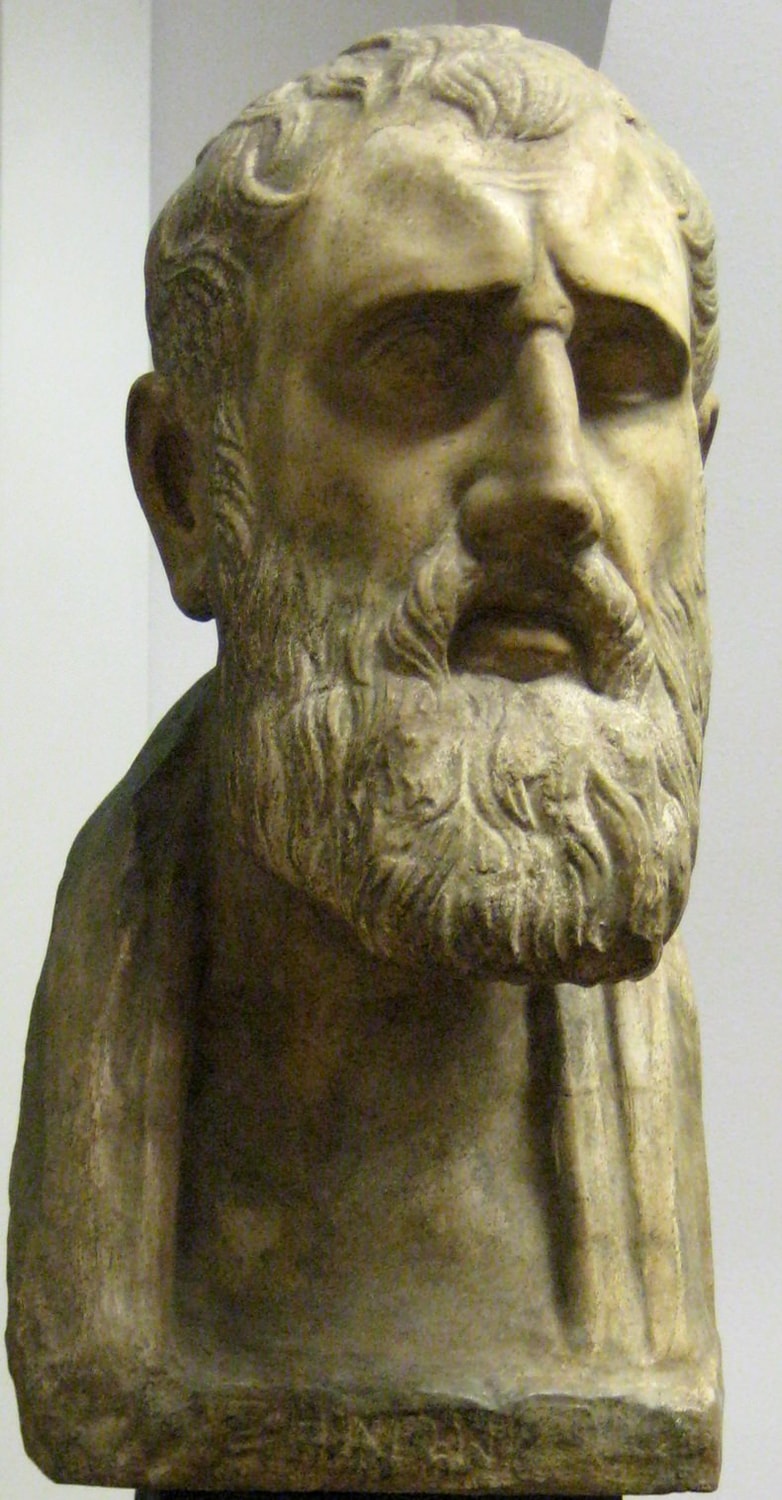
Zeno of Citium
PhilosopherWikipedia
34
MENTIONS
9
EPISODES
7
PODCASTS
Search complete. 34 mentions across 9 episodes found for "Zeno of Citium".
Nov 18, 2026

David ShapiroHOST
Write a brief history of Stoicism.
David ShapiroHOST
The Stoic philosophy was founded by Zeno of Sidium in the 3rd century BC.
David ShapiroHOST
It teaches that the way to deal with difficult situations is to remain calm and rational.
David ShapiroHOST
The Stoic philosophy was very influential in the Roman world and was later revived in the Renaissance.
8 MINS LATER
speaker_5ADVERTISER
academic
David ShapiroHOST
paper.
David ShapiroHOST
The Stoic philosophy, which was founded by Zeno of Citium, teaches the development of self-control and fortitude as a means of overcoming destructive emotions.
David ShapiroHOST
The Stoics believe that by understanding the reason for things, one could attain a state of inner tranquility.

speaker_0HOST
This is Stoicism for Winners and this is a new chapter of Master Your Mind.
speaker_0HOST
His name was Zeno and he was born in Citium, a city on the island of Cyprus around the year 334 BC.
speaker_0HOST
Citium was a Greek city but with a large Phoenician population and that origin would follow him all his life like a brand.
speaker_0HOST
In Athens, he would always be seen as an outsider.
speaker_0HOST
More than one rival would mock him by calling him the Phoenician, and it was hardly meant as a compliment.
11 MINS LATER
speaker_0HOST
Go back for a moment to the harbor at the Piraeus.
speaker_0HOST
Zeno had every reason to stay there.
speaker_0HOST
He could have waited for some merchant from Citium to lend him money.
speaker_2HOST
No connections, no wealthy family, no education, just a strong body used to taking punches.
speaker_2HOST
In Athens, he met Zeno of Citium, a former merchant from Cyprus, who taught while walking up and down beneath a colonnade decorated with paintings, beside the agora, the so-called painted stoa.
speaker_2HOST
From that stoa, that porch, the Stoics take their name.
speaker_2HOST
Cleanthes began listening to him and never left his side again.
speaker_2HOST
Since he had nothing to live on, he started working at night.
speaker_2HOST
He drew water from the wells to irrigate the gardens around the city, bucket after bucket, while everyone else slept.
speaker_2HOST
And by day, aching all over, he would sit and listen to Zeno and practice the arguments.
speaker_2HOST
That's why they gave him a nickname that stayed with him all his life.
speaker_1HOST
Not long after Polemo became head of the Academy, a Phoenician merchant arrived in Athens from Citium, a city on the island of Cyprus.
speaker_1HOST
His name was Zeno.
speaker_1HOST
He had come across philosophy almost by chance, and he set about listening to every teacher he could to learn from each of them.
speaker_1HOST
Diogenes Laertius records the list of his teachers, Crates the Cynic, Stilpo, and, according to one source that the dates make doubtful, Xenocrates himself for ten years.
speaker_1HOST
And on that same list there appears one more name, Polemo.
speaker_1HOST
Zeno of Citium is the founder of Stoicism, the man who, years later, would begin teaching as he walked up and down beneath a painted porch in Athens, the Stoa, which gave the school its name.
speaker_1HOST
Everything you've heard today, Epictetus, Seneca, Marcus Aurelius, descends from him.
speaker_1HOST
And one of the men from whom the founder of Stoicism learnt was that young man who once walked drunk into a lecture, his garland askew, to laugh at the teacher.

speaker_2HOST
Like so many Roman customs, it was imported from Greece.
speaker_2HOST
It began with Zeno of Citium, a merchant whose shipwreck left him nothing.
speaker_2HOST
That loss led him to Athens, where he stumbled into a philosophy bookshop and then into a whole new way of thinking.
speaker_2HOST
From there, Stoicism evolved into a major school of thought, and when Rome conquered Greece, Stoicism became one of the most influential philosophies in the empire.

speaker_1HOST
But if you prefer to think of time as moving in great cycles of creation and destruction, if I feel like I do personally, or ever had the feeling of deja vu, the Stoics are for you.
speaker_1HOST
Founded by Zeno of Citium, circa 334 to 262 BC, in Athens during the late 4th century BC, the Stomachs argued that, quote, creative fire, unquote, was the primal building block of the cosmos.
speaker_1HOST
Eventually, this fire would consume everything, and then the cosmos would be reborn.
speaker_1HOST
Events known as the ekpirosis, or conflagration, conflagration, and... apocatastasis or restoration only brief fragments and reports some of them hostile remain of the early stoics on this theory some stoics even rejected the idea of cyclical conflagrations there are no detailed accounts of how the conflagration would unfold or how humans should prepare for it in the fragments that survive of the early stoics most likely it was believed to lie in the distant future The Stoic perspective of the end of the world changed during the Roman period.

Pete QuiñonesHOST
interrupt you real quick so that you, I'm sorry.
Pete QuiñonesHOST
Yep, Zeno of Citium, around three, in the 300s BC.
Pete QuiñonesHOST
he's basically considered the founder of stoicism he forms a school uh cleanthes is his uh his student uh chrysippus is his student so you know in the in the bc times in the before times you did have a school a stoic school and these these are the three you know early figures in establishing stoicism um in in ancient greece but Later, Romans picked up on it, like Seneca, Epictetus.
Pete QuiñonesHOST
I can never pronounce his name.

Pete QuiñonesHOST
Let me interrupt you real quick so that you, you know, I'm sorry.
Pete QuiñonesHOST
You know, Zeno of Citium, around three, in the 300s B.C., He's basically considered the founder of Stoicism.
Pete QuiñonesHOST
He forms a school.
Pete QuiñonesHOST
Cleanthes is his student.