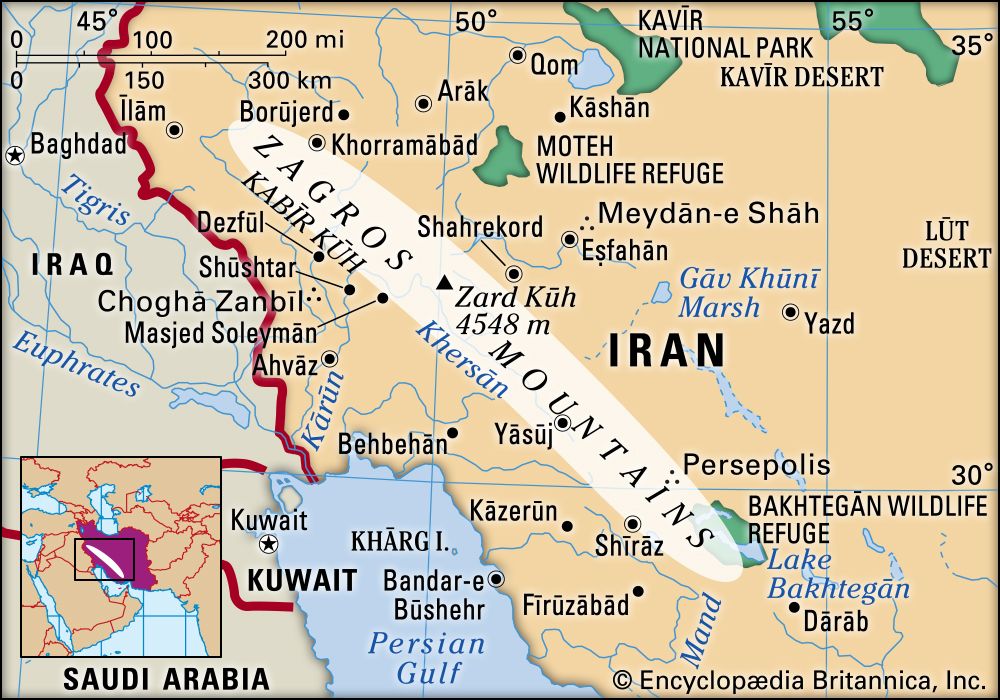
Zagros Mountains
Mountain range in IranWikipedia
28
MENTIONS
25
EPISODES
24
PODCASTS
Search complete. 28 mentions across 25 episodes found for "Zagros Mountains".
Oct 5, 2026

Sanjeev KapoorGUEST
...
Sanjeev KapoorGUEST
the Iranian shoulder-fired missile took down an F-15 of America over Iran, over Zagros Mountains in April 2026.
Sanjeev KapoorGUEST
Should...
Sanjeev KapoorGUEST
This is the first loss, American loss in 23 years of combat after Iran, uh, i- Iran-Iraq War-

Annie DillardSOUNDBITE_SPEAKER
The skin on his face moved like a thin bronze plating that would peel." The grass at our feet was wild barley.
Annie DillardSOUNDBITE_SPEAKER
It was the wild einkorn wheat which grew on the hilly flanks of the Zagros Mountains, above the Euphrates Valley, above the valley of the river we called River.
Annie DillardSOUNDBITE_SPEAKER
We harvested the grass with stone sickles, I remember.
Annie DillardSOUNDBITE_SPEAKER
We found the grasses on the hillsides.

Heval MamosteGUEST
Yeah.
Heval MamosteGUEST
The Kurds, uh, mostly, like, originated from the, like, Zagros mountain range, like between the, like, Iran and, like, Turkey and, like, uh, Iraq.
Heval MamosteGUEST
And there are, like, two different way to describe the, like, Kurdish identity and the nation.
Heval MamosteGUEST
The one coming from the, mostly from the Iranian languages, like, you know, when you say the Kurdish, it's actually coming from this Persian language, mostly point they are the, like, the tribal community that, like, travel from place to place and mainly, like, dealing with the, like, farming or, like, you know, gathering, the other, uh, occupations.

Lloyd Llewellyn-JonesGUEST
I can't imagine the...
Lloyd Llewellyn-JonesGUEST
You know, wood for instance, you know, it had to be bought from the mountains of, of Turkey or from the Zagros, or from, you know, if you wanted really fine wood, from, from Lebanon.
Lloyd Llewellyn-JonesGUEST
I can't imagine the cost of kindling in Babylon.
Lloyd Llewellyn-JonesGUEST
To, to make all of those glazed bricks must have been a real expense for the Babylonians.

Alex LeffHOST
Wars are declared.
Alex LeffHOST
Foreigners from the Zagros Mountains and Persian plains are captured and enslaved and sent to Sumer to work as Zex.
Alex LeffHOST
These wars devastate the landscape, which only strengthens the Lugal.
Alex LeffHOST
Refugees of these wars, with nothing left to live on in their homelands, migrate to Sumer out of survival necessity and volunteer to become Zex.

HaydenHOST
Cuneiform had only been deciphered at the beginning of the 19th century, just a few decades before Smith was born.
HaydenHOST
In western Iran, about halfway between Baghdad and Tehran, lies a mountain in the Zagros range called Bisitun or Behistun, meaning something like divine place or place of God.
HaydenHOST
Prominently displayed 100 meters up a sheer cliff is an enormous inscription measuring around 15 meters tall and 25 meters wide with various writing surrounding it, displaying the image of 11 men, with one towering over the others and trodding another figure underfoot.
HaydenHOST
The first Western reports noting the site and the ruins found there date to the early 1600s, and over the next two centuries, the strange scripts found carved into the mountain were noted by many travelers.
9 MINS LATER
HaydenHOST
Our culprit peoples are specifically the Massagetae, the Saka, and the Derbikis.
HaydenHOST
Because so many of our written sources in the first millennium BCE come from the Middle East and increasingly Eastern Europe, it can be easy to forget that further to the east, there lie many, many peoples and countries and kingdoms.
HaydenHOST
Babylon and Assyria had both struggled to project a consistent amount of administration or hegemony beyond Western Iran and the Zagros Mountains, and so they haven't factored in that much until now.
HaydenHOST
I mean, you had Ashurbanipal's big raids.

Ben MacIntyreGUEST
It weighed about 60 pounds.
Ben MacIntyreGUEST
They were gonna send in dozens of them, and I'm not exaggerating here, and blow up the mountain passes in, in the Zagros Mountain range, bring the mountain down to stop Soviet armor from crossing the border.
Ben MacIntyreGUEST
Now, if that had happened, I mean, um, that was only the lowest level.
Ben MacIntyreGUEST
I mean, otherwise, they could use tactical nuclear weapons, or they could have attacked the nuclear bases inside the Soviet Union.

Elsie SelwynNARRATOR
End footnote.
Elsie SelwynNARRATOR
These Kashu, who sprang up suddenly out of obscurity, had from the earliest times inhabited the mountainous districts of Zagros on the confines of Elymais in Media, where the Kassians of the classical historians flourished in the time of Alexander.
Elsie SelwynNARRATOR
Footnote.
Elsie SelwynNARRATOR
The Kashu are identified with the Kassians by Thais, by Schroeder, by F.R. Delitzsch, by Halevi, by Thiel, by Hamel, and by Jensen.
9 MINS LATER
Elsie SelwynNARRATOR
As there were no mountains in the country, they turned to the marshes, and like the Hyksos in Egypt, made themselves at home about the mouths of the rivers, on the half-submerged lowlands, and on the sandy islets of the lagoons which formed an undefined borderland between the alluvial region and the Persian Gulf.
Elsie SelwynNARRATOR
The covert afforded by the thickets furnished scope for the chase which these hunters had been accustomed to pursue in the depths of their native forests, while fishing, on the other hand, supplied them with an additional element of food.
Elsie SelwynNARRATOR
When their depredations drew down upon them reprisals from their neighbors, the mounds occupied by their fortresses and surrounded by muddy swamps offered them almost as secure retreats as their former strongholds on the lofty sides of the Zagros.
Elsie SelwynNARRATOR
They made alliances with the native Aramaeans, with those Kashti, properly called Chaldeans, whose name we have imposed upon all the nations who, from a very early date, bore rule on the banks of the lower Euphrates.

Louise GoldsteinHOST
And what I was really interested about is walking... and that not being done before and what you kind of learned about perseverance and yourself and could you tell us a little bit more about that as well
Emily GarthwaiteGUEST
I think particularly walking in Iraq and I've had the opportunity to have projects in in Iran across the border the Zagros mountains where walking is involved as people instantly welcome you in because of how you arrive and meet them.
Emily GarthwaiteGUEST
It's an incredibly humble thing to be walking, whether you're as a pilgrim, but you're just a traveler on foot.
Emily GarthwaiteGUEST
And it started with the pilgrimage.

speaker_3HOST
Normal stuff.
speaker_3HOST
And you open your mailbox and there is a federal notice informing you that you are being conscripted to fight in a subterranean tunnel system in the Zagros Mountains.
speaker_5HOST
It is a total paradigm shift.
speaker_3HOST
It's unimaginable.
15 more episodes mention Zagros Mountains.
Create an account to see the whole feed, search across every transcript, and follow the entities you care about.