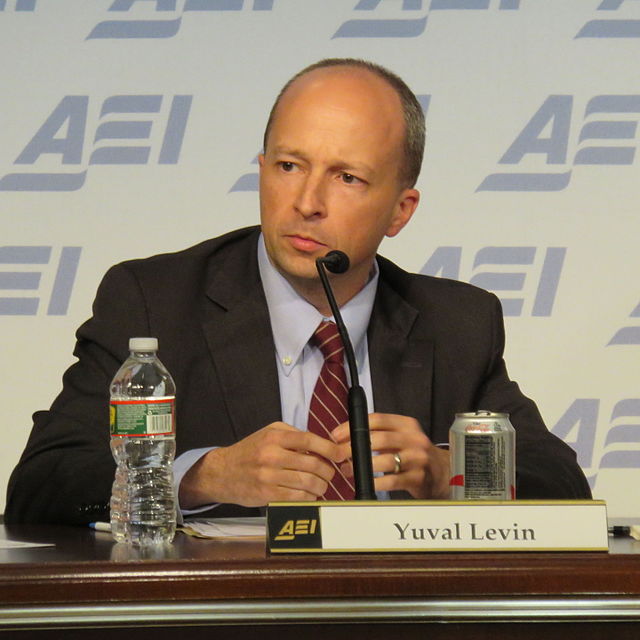
Yuval Levin
American political analystWikipedia
28
MENTIONS
22
EPISODES
19
PODCASTS
Search complete. 28 mentions across 22 episodes found for "Yuval Levin".
Nov 3, 2026

Spencer CoxGUEST
And I always want to point this out, that when I'm talking about kind of healthy politics and healthy tribalism, it does not mean that we all have to get along, that we all have to agree.
Spencer CoxGUEST
As the author Yuval Levin has said, that unity is not believing the same thing.
Spencer CoxGUEST
Unity is acting together.
Spencer CoxGUEST
And the Constitution is the thing that forces us or gives us the framework for acting together, knowing we won't always get our way, but there's a path forward to at least getting some of what we want if we're willing to build those coalitions.

Eric PratumHOST
Yuval Levin, thank you for joining me.
Eric PratumHOST
Where does today's recording find you?
Yuval LevinGUEST
Well, thanks very much for having me.

Chris GriswoldGUEST
Well, I don't know.
Chris GriswoldGUEST
I mean, in defense of our biotech friends, I think it would depend on the course of study, right? I mean, there's all kinds of ways I can imagine someone getting their hands dirty, so to speak, in the lab, figuring out how this actually works outside of the classroom.
Chris GriswoldGUEST
That does have the features that I'm interested in.
Chris GriswoldGUEST
But you're taking us there already.
Chris GriswoldGUEST
And some really thoughtful people, I think, have identified that.
Chris GriswoldGUEST
Alex Karp, the CEO of Palantir, said that in a conversation with Sean O'Brien, in a conversation you moderated.
Chris GriswoldGUEST
He's like, look at all my Yale grad friends in the elite circles I've run in.
Chris GriswoldGUEST
they will not handle it well if they lose their white collar job and don't know what to do.

Monica GuzmanGUEST
We've gotten through worse in the past.
Monica GuzmanGUEST
A wonderful scholar who was on my podcast, Yuval Levin, makes this point about the American national anthem, that most countries' anthems are about how beautiful their countries are.
Monica GuzmanGUEST
Our anthem is about barely surviving the night, that battle with the bombs, and that a sense of doom contributes to an American sense of vigilance.
Monica GuzmanGUEST
Our Democratic Republic has been radical from the start, and it's depended on us being able to tango with each other on really uncomfortable, difficult things and get through hard times together.

Jonah GoldbergHOST
before you even talked about the voters.
Jonah GoldbergHOST
And, you know, we've all been in institutions where there are certain individuals that everyone just recognizes have greater wisdom, greater integrity, whatever, but they may not necessarily play well at a stump speech kind of thing, right? You know, like at AEI, I think you would get on the first round of balloting a very high number of people who would make Yuval Levin a czar, if we could.
Jonah GoldbergHOST
But, like, Yuval would not be a great rally speaker, right? And I'm wondering...
Jonah GoldbergHOST
When you have sort of so much more, I mean, was it Talberg, the democratic totalitarianism or whatever? When you're empowering the masses to make decisions more, I'm not saying that democracy hasn't led to everyone being a demagogue.

Nat MalkusHOST
But in this episode, we're going to do something a little different and talk about one of the populations schools serve, adolescents.
Nat MalkusHOST
How are technologies such as social media, AI, and location tracking affecting teenagers? What are gender relations like among high school students? And how do teens today think about religion, politics, and America? To discuss these questions and more, I invited my colleague Dan Cox back onto the podcast.
Nat MalkusHOST
Dan Cox is the director of the Survey Center on American Life here at AEI.
Nat MalkusHOST
He's also the author of a recent report, A Digital Divide in American Adolescence, Gender, Class, and the New Teenage Experience.
30 MINS LATER
Nat MalkusHOST
Let's go.
Daniel A. CoxGUEST
Let's see how quickly you can think on your feet.
Nat MalkusHOST
It's interesting how clearly this reflects on our colleague Yuval Levin's observation that sort of disorders of youth that we used to think about might be transgression or aggression or other kinds of things that we thought, well, kids should not be doing those things.
Nat MalkusHOST
And now it seems like there's more disorders of passivity, which are not actually excesses, they're doing too little.

Nat MalkusHOST
But in this episode, we're going to do something a little different and talk about one of the populations schools serve, adolescents.
Nat MalkusHOST
How are technologies such as social media, AI, and location tracking affecting teenagers? What are gender relations like among high school students? And how do teens today think about religion, politics, and America? To discuss these questions and more, I invited my colleague Dan Cox back onto the podcast.
Nat MalkusHOST
Dan Cox is the director of the Survey Center on American Life here at AEI.
Nat MalkusHOST
He's also the author of a recent report, A Digital Divide in American Adolescence, Gender, Class, and the New Teenage Experience.
30 MINS LATER
Nat MalkusHOST
Let's go.
Daniel A. CoxGUEST
Let's see how quickly you can think on your feet.
Nat MalkusHOST
It's interesting how clearly this reflects on our colleague Yuval Levin's observation that sort of disorders of youth that we used to think about might be transgression or aggression or other kinds of things that we thought, well, kids should not be doing those things.
Nat MalkusHOST
And now it seems like there's more disorders of passivity, which are not actually excesses, they're doing too little.
Matthew MehanGUEST
Mark Bauerlein takes a chapter.
Matthew MehanGUEST
Yuval Levin takes a chapter, Melissa Muskella, a number of scholars and think tank policy education reformers, most of whom have some knowledge of curriculum, civic ed, liberal arts in that field.
Matthew MehanGUEST
And so it's kind of a deeply knowledgeable both about education policy and reform, but also curriculum and the sort of traditional horse sense of how we have successfully educated in the past.
Matthew MehanGUEST
Yeah.

Matthew MehanGUEST
Yes, uh, there's quite a few of us.
Matthew MehanGUEST
Um, the, uh, yes, Dr. Arnn writes a preface, Ryan Anderson writes a conclusion, Mark Bauerlein takes a chapter, Yuval Levin takes a chapter, Melissa Moschella, a number of scholars and, uh, think tank policy education reformers, most of whom have some knowledge of curriculum-
Scot BertramHOST
Mm-hmm
Matthew MehanGUEST
... civic ed, liberal arts in that field.
12 more episodes mention Yuval Levin.
Create an account to see the whole feed, search across every transcript, and follow the entities you care about.