Youngstown Sheet & Tube Co. v. Sawyer
Case in courtWikipedia
55
MENTIONS
12
EPISODES
4
PODCASTS
Search complete. 55 mentions across 12 episodes found for "Youngstown Sheet & Tube Co. v. Sawyer".
Oct 14, 2026

Dan HermanSOUNDBITE_SPEAKER
National emergencies trigger a defined set of laws, not unencumbered presidential authority.
Dan HermanSOUNDBITE_SPEAKER
An emergency declaration from the president does not override constitutional dictates exclusively giving states and Congress the authority to administer elections, nor would it override the Supreme Court's decision in Youngstown Sheet and Tube Co. v. Sawyer, 1952, that prohibited the governmental takeover or seizure of critical infrastructure without congressional approval.
Dan HermanSOUNDBITE_SPEAKER
As a result, an officer who issues such an order would likely be subject to all the penalties listed in Section 592, including up to five years in prison, in addition to potential court-martial consequences, such as dishonorable discharge.
Dan HermanSOUNDBITE_SPEAKER
Protecting a polling site is also likely a violation of the Posse Comitatus Act, since protecting is traditionally a law enforcement function, not one permitted to be undertaken by armed military personnel.

speaker_4GUEST
The foundation of this is Article III of the Constitution.
speaker_4GUEST
It limits the federal judicial power strictly to actual cases and controversies.
speaker_3HOST
So they can't just give advice.
speaker_4GUEST
No, absolutely not.
6 MINS LATER
speaker_3HOST
It keeps the judges from becoming, like, super legislators or shadow executives.
speaker_4GUEST
That's a great way to put it.
speaker_4GUEST
It confines them to their lane, deciding active cases.
speaker_3HOST
All right.
speaker_4HOST
This requires us to examine how power and immunity operate at the absolute highest levels, utilizing recent landmark jurisprudence that has rewritten the textbooks.
speaker_3HOST
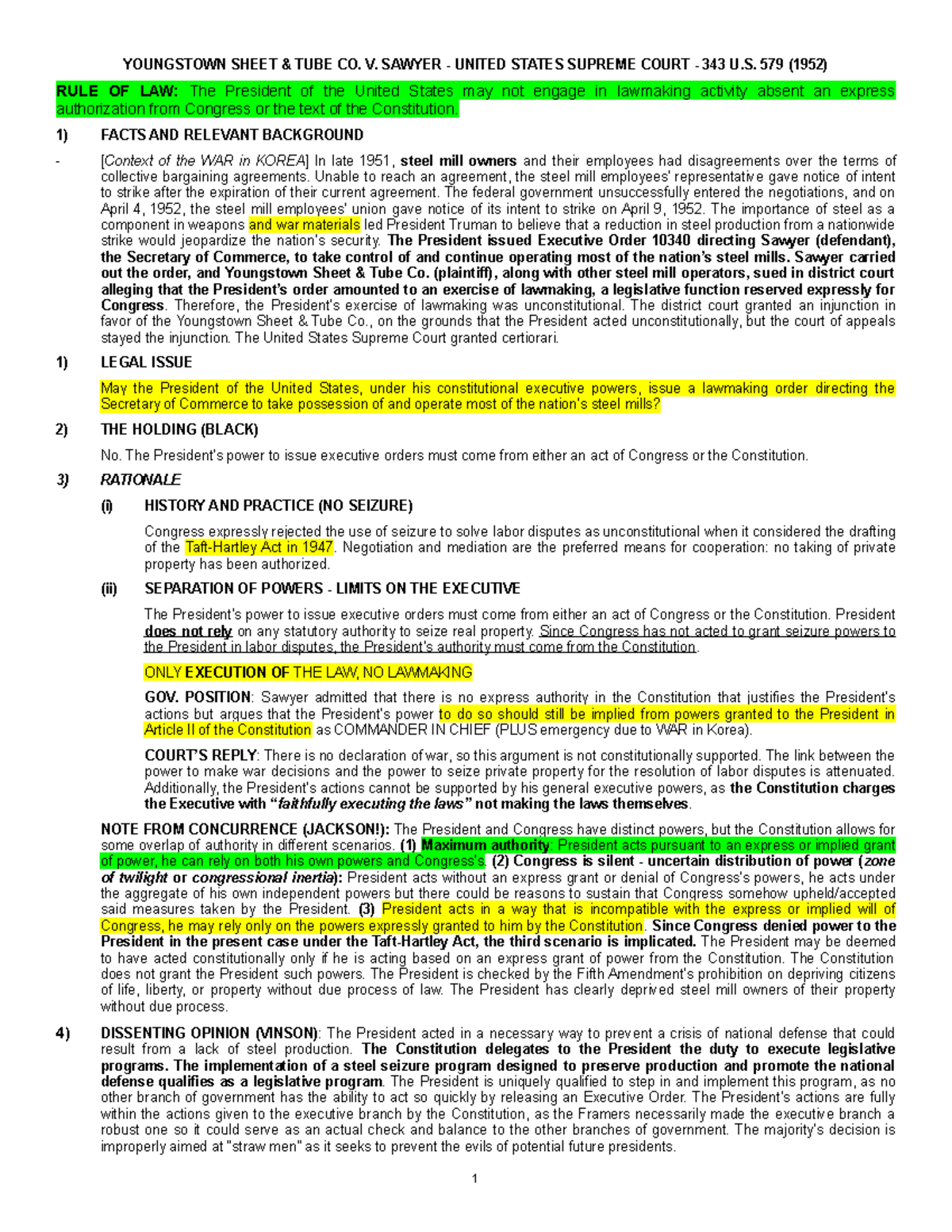
Every single exam analysis of presidential power must begin with Justice Robert Jackson's famous concurring opinion in Youngstown Sheet & Tube Co. v. Sawyer, the Korean War steel seizure case.
speaker_3HOST
He provided a tripartite framework for analyzing executive action that the court still use today.
speaker_4HOST
Category one.
speaker_1NARRATOR
Indeed, there is a Supreme Court case that sets forth the tiers of presidential power, where it is at its apex and at its low point.
speaker_1NARRATOR
Youngstown Sheet and Tubco v. Sawyer provides the framework still used today to decide if a president has exceeded their constitutional powers.
speaker_1NARRATOR
Under Youngstown, when a president acts in direct violation of a congressional statute, say by deploying troops to the polls in violation of Section 592, their powers are at their lowest.
speaker_1NARRATOR
When at its lowest ebb, a president can rely only upon his own constitutional powers minus any constitutional powers of Congress over the matter.
speaker_1NARRATOR
Courts can sustain exclusive presidential control in such a case only by disabling the Congress from acting upon the subject.
speaker_1NARRATOR
Under this application, it is likely that the president can only overcome Youngstown if he is able to show that the Constitution vests exclusive authority over the military and elections in the president.
speaker_1NARRATOR
As noted above, the Constitution explicitly grants military and election powers to Congress.
speaker_1NARRATOR
Therefore, the president would be acting unconstitutionally by deploying troops to the polls.
speaker_3UNKNOWN
I'll try to be quick.
speaker_3UNKNOWN
The first one, I would love to see an amendment to codify and strengthen the Supreme Court's ruling in Youngstown.
speaker_3UNKNOWN
That is, a 1952 case
speaker_2NARRATOR
involving President Truman's attempt to seize steel mills during the Korean War.
speaker_3HOST
When analyzing the structural boundaries of presidential power, you do not start with the text of Article Two, because Article Two is notoriously vague.
speaker_3HOST
You start with the most important framework in executive branch jurisprudence, a concurring opinion written by Justice Robert Jackson in the nineteen fifty-two case Youngstown Sheet & Tube Co. v. Sawyer.
speaker_2HOST
The historical context of Youngstown is incredible.
speaker_2HOST
It is nineteen fifty-two.
speaker_2HOST
What happens when the president acts without Congress or even explicitly against them?
speaker_1HOST
For this, we turn immediately to the most famous framework in constitutional law, Justice Robert Jackson's concurring opinion in Youngstown Sheet & Tube Co. v. Sawyer.
speaker_1HOST
If you wanna understand presidential power, this is the hydraulic system of the American Republic.
speaker_2HOST
Let's set the stage for Youngstown because the history explains the mechanism.

DeepakGUEST
And what I did was, For context, I'm in moot court at Princeton.
DeepakGUEST
So one case I've been having to think about a lot is Youngstown.
DeepakGUEST
So I did controller for Youngstown.
DeepakGUEST
And funnily, I found that in 194 pages of Trump v. Barbara, there was no mentions of Youngstown.
DeepakGUEST
Yet in 41 pages of your brief, there are eight mentions of Youngstown.
DeepakGUEST
And I know these word count games really don't mean all that much, but I was just curious to What you make of the fact, especially that the Kavanaugh concurrence and the two dissents in particular do not mention Youngstown.
DeepakGUEST
I know sometimes, I think Justice Thomas addresses the statutory issue at least once, but I was just wondering, this is a case in which an executive order is contrary to an act of Congress, and we don't see mention of Youngstown in the dissents, which of course have to win on both the constitutional and statutory issue.
DeepakGUEST
So I'm curious what you make of that, and maybe why do you think that was the case?
speaker_3HOST
And to analyze whether a presidential action is valid, you do not just hunt for random case law.
speaker_3HOST
You must apply the single most important analytical framework in all of executive power jurisprudence, Justice Robert Jackson's three-part concurring opinion from Youngstown Sheet & Tube Co. v. Sawyer.
speaker_2HOST
The factual background of Youngstown is essential.
speaker_2HOST
It is 1952.
52 MINS LATER
speaker_7NARRATOR
Do not begin by asking if the nation faces a crisis.
speaker_7NARRATOR
Instead, you must ask, "What is the legal source of the president's authority?" It must stem either directly from the constitutional text or from a statutory delegation by Congress.
speaker_7NARRATOR
The mandatory analytical tool for evaluating the validity of any executive action is Justice Robert Jackson's three-part framework from Youngstown Sheet & Tube Co. v. Sawyer.
speaker_7NARRATOR
You must apply this framework.
speaker_3HOST
When the president acts, how do we measure the constitutionality of that action?
speaker_2HOST
Almost every presidential action must be analyzed through the lens of Justice Robert Jackson's famous three-part concurring opinion in Youngstown Sheet & Tube Co.
speaker_3HOST
During the Korean War, President Truman unilaterally seized the nation's steel mills to prevent a labor strike, claiming inherent executive power as commander-in-chief.
speaker_2HOST
The Supreme Court struck the seizure down, but Jackson's framework became the gold standard for analyzing executive power.
34 MINS LATER
speaker_6NARRATOR
The absolute first rule for analyzing presidential power is simple: Do not assume a general emergency power exists.
speaker_6NARRATOR
You must immediately look for the definitive source of the president's authority.
speaker_6NARRATOR
Is it granted directly by the Constitution in Article II, or is it delegated by a statute passed by Congress? When analyzing executive power, you will rely heavily on Justice Jackson's renowned tripartite framework from Youngstown Sheet & Tube Co.
speaker_6NARRATOR
v. Sawyer.
2 more episodes mention Youngstown Sheet & Tube Co. v. Sawyer.
Create an account to see the whole feed, search across every transcript, and follow the entities you care about.