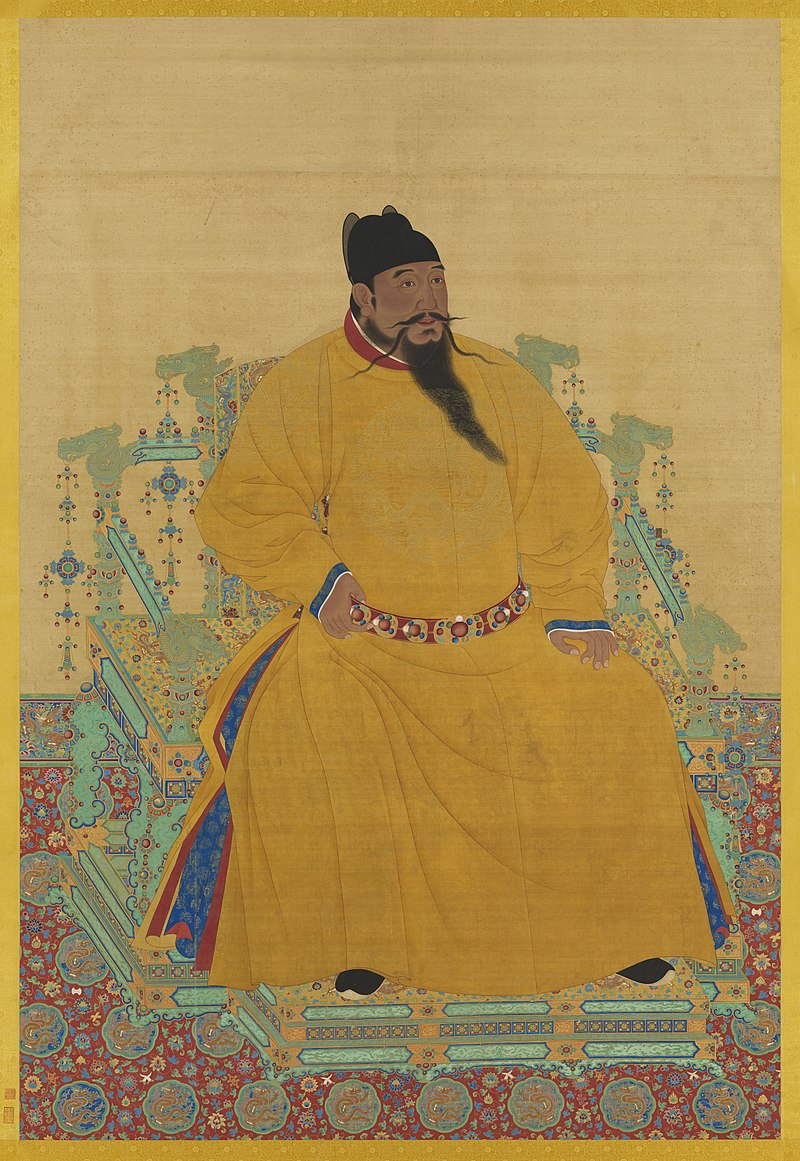
Yongle Emperor
Former Emperor of ChinaWikipedia
114
MENTIONS
7
EPISODES
6
PODCASTS
Search complete. 114 mentions across 7 episodes found for "Yongle Emperor".
Nov 25, 2026

Laszlo MontgomeryHOST
But despite all the claims of where he went and what he did, at the end of the day, these records have not surfaced and perhaps never will.
Laszlo MontgomeryHOST
1421 was the year of the sixth voyage, the final voyage of the Yongle Emperor's reign.
Laszlo MontgomeryHOST
All his luck was about to run out.
Laszlo MontgomeryHOST
The Emperor would pass from the scene in 1424 after a series of bruising and calamitous setbacks.
Laszlo MontgomeryHOST
After such a spectacular voyage, you'd figure they'd at least get a hero's welcome.
Laszlo MontgomeryHOST
But the mood now in Beijing after the excesses of the Yongle Emperor...
Laszlo MontgomeryHOST
No one was in the mood to talk about these fleets and the exorbitant costs to build the Forbidden City that only stood for a short while before being struck by lightning and, you know, all that that meant.
Laszlo MontgomeryHOST
Gavin Menzies' version of events is that, after they were finished in Africa, the fleets split up and went on to sail to North and South America, Australia, and the polar extremes in the Arctic and Antarctic.

speaker_4NARRATOR
it has been thought that the conversion of china to christianity under the guiding influence of the jesuits would soon have become an accomplished fact but for the ignorant opposition to the use of these terms by the franciscans and dominicans who referred this question among others to the pope In 1704, Clement XI published a bull declaring that the Chinese equivalent of God was Tianchu, Lord of Heaven, and such it has continued to be ever since, so far as the Roman Catholic Church is concerned, in spite of the fact that Tianchu was a name given at the close of the 3rd century B.C. to one of the eight spirits.
speaker_4NARRATOR
That the two terms refer in Chinese thought to one and the same being, though possibly with differing attributes, even down to modern times, may be seen from the account of a dream by the Emperor Yongle, A.D. 1403-1425, in which His Majesty relates that an angel appeared to him with a message from Shang-Ti, upon which the Emperor remarked, Is not this a command from Tian? A comparison might perhaps be instituted with the use of God and Jehovah in the Bible.
speaker_4NARRATOR
At the same time it must be noted that this view was not suggested by the Emperor Qiang Sai, who fixed upon Tian as the appropriate term.
speaker_5ADVERTISER
When the days get shorter, visibility matters.

John CarmodySOUNDBITE_SPEAKER
What might have been the result? Indeed, only serendipity thwarted a Chinese discovery.
John CarmodySOUNDBITE_SPEAKER
Long after a Shoulu statuette was discovered in 1879, when a road was being constructed where Darwin now stands, it was realised that this was possibly a relic of a visit by one of the ships of the great Chinese explorer Cheng Ho in 1430-1433, during the reign of the Emperor Yung Lo.
John CarmodySOUNDBITE_SPEAKER
As a result of Courtier's opposition, these voyages ceased with the Emperor's death soon afterwards, so Australia was left for European discovery.
John CarmodySOUNDBITE_SPEAKER
What indeed might have been the course of our social history if various British governments had accepted some of the proposals, including one from John Maria Matra, that active recruitment of Chinese labourers and merchants be pursued for the colony of New South Wales.

John CarmodySOUNDBITE_SPEAKER
What might have been the result? Indeed, only serendipity thwarted a Chinese discovery.
John CarmodySOUNDBITE_SPEAKER
Long after a Shoulu statuette was discovered in 1879, when a road was being constructed where Darwin now stands, it was realised that this was possibly a relic of a visit by one of the ships of the great Chinese explorer Cheng Ho in 1430-1433, during the reign of the Emperor Yung Lo.
John CarmodySOUNDBITE_SPEAKER
As a result of Courtier's opposition, these voyages ceased with the Emperor's death soon afterwards, so Australia was left for European discovery.
John CarmodySOUNDBITE_SPEAKER
What indeed might have been the course of our social history if various British governments had accepted some of the proposals, including one from John Maria Matra, that active recruitment of Chinese labourers and merchants be pursued for the colony of New South Wales.
Laszlo MontgomeryHOST
When these Ming armies invaded Yunnan, by the way, and defeated the rebels there, a young 11-year-old Muslim boy was captured.
Laszlo MontgomeryHOST
His name was Ma He, but later on he will gain fame and immortality as the eunuch admiral Zheng He, who sailed the seas in the name of the Yongle Emperor in ships that were the titanics of their day.
Laszlo MontgomeryHOST
We'll get to him later and look at his amazing life.
Laszlo MontgomeryHOST
Zhu Yuanzhang's reign was known as the Hongwu Era, and he's often referred to as the Hongwu Emperor.
18 MINS LATER
Laszlo MontgomeryHOST
It was indeed the end of an era, but a new era was about to begin.
Laszlo MontgomeryHOST
Just as Tang Gaozhu founded the Tang Dynasty, it was his son, Tang Taizong, who led the dynasty to reach much greater heights.
Laszlo MontgomeryHOST
So it was with the founder of the Ming and his son, Zhu Di, who became the Yongle Emperor.
Laszlo MontgomeryHOST
But before this Zhu Di became emperor, there's a whole mess that has to be cleaned up regarding the succession.

KarenHOST
The Ming Dynasty had 16 emperors and ruled for 276 years until 1644, when the dynasty collapsed following a massive rebellion and was eventually replaced by the Qing Dynasty.
KarenHOST
Next, let's talk about Emperor Zhu Di.
KarenHOST
Through all the context clues of the show, we know that Against the Current draws heavily from the early Ming Dynasty, particularly during the reign of Zhu Di, the third emperor of the Ming Dynasty.
KarenHOST
Now, the drama doesn't follow history exactly, but closely enough, and we have to spend a bit of time on this emperor because he is a fascinating and highly controversial character.
KarenHOST
Born in 1360, Zhu Di was the fourth son of the founding emperor Zhu Yuanzhang.
KarenHOST
He was not originally given the throne or made crown prince as is normal for succession.
KarenHOST
Instead, he was given the title of the Prince of Yan or Yan Wang with his regional headquarters in Beiping or modern-day Beijing.
KarenHOST
But when the second Ming Emperor Zhu Yunwen, grandson of Zhu Yuanzhang and nephew of Zhu Di, ascended the throne in 1398, at the age of 20, he opted to enact a policy known as Xue Fan, which was aimed at reducing the power and autonomy of the imperial princes.

LukeHOST
And so... um, going to the new world and, and seeing these people who were less technologically advanced because they had not, they had not been forced to be technologically advanced by being in an interconnected, you know, three continental world like the, you know, like Africa, Europe, and Asia had been for so long.
LukeHOST
And, um, That was just easy pickings for them, whereas when China – when the Ming dynasty looked inward following the death of the Yongle Emperor in the 1430s and decided to recall the treasure fleet and burn all their double-masted ships – they could do that and still remain incredibly wealthy and have these nice, these, these nice lives.
LukeHOST
Yeah.
LukeHOST
Like comparatively.