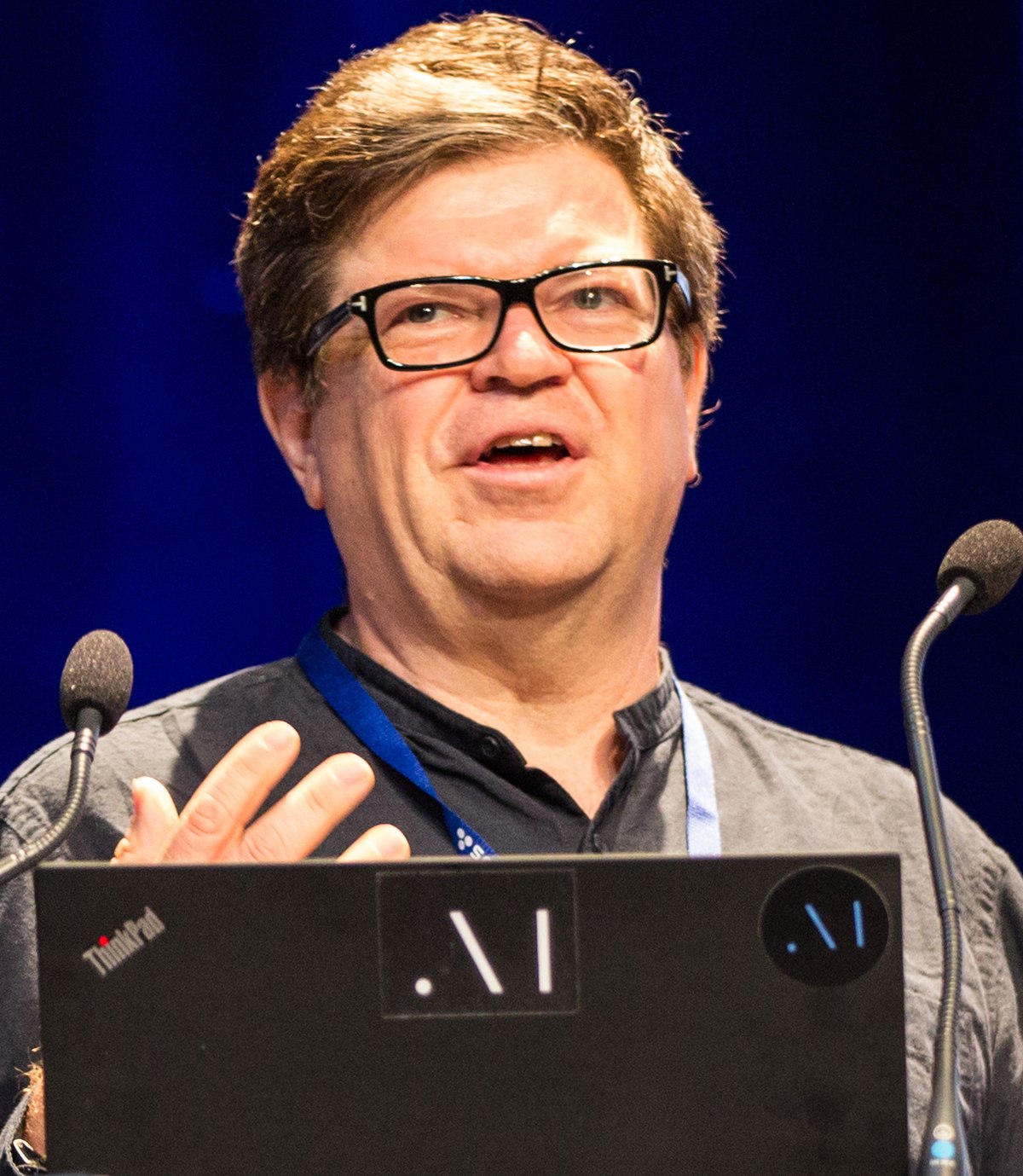
Yann LeCun
French computer scientistWikipedia
88
MENTIONS
73
EPISODES
66
PODCASTS
Search complete. 88 mentions across 73 episodes found for "Yann LeCun".
Sep 12, 2026

Ksenia SeGUEST
And I just came back from a workshop about world models and it was absolutely jarring.
Ksenia SeGUEST
There were tremendously smart people from Stanford and Hartford and Yann LeCun was there and they were all discussing world models, but they do not agree on what world models actually are.
Ksenia SeGUEST
So when we talk about world models and why I want to focus on them in my publications, because I think it's just more about action, being able to predict and act, like wider understanding what's happening.
Ksenia SeGUEST
Physics is super important part of it.

Jim LoveHOST
Dario Amodei and his sister left open AI to start Anthropic because they were concerned that open AI would control AI.
Jim LoveHOST
You know, now you've got Mark Zuckerberg who goes in and out of open source or open weight AI that first put on to that by Jan LeCun who was saying we must have an open source, open weight AI.
Jim LoveHOST
So everybody's trying to keep track.
Jim LoveHOST
the other guy for, because they're, as you said, Marcel, I'm the only one you can trust.

Simon WhiteGUEST
So I'd say that, say that's one thing.
Simon WhiteGUEST
Um, and I think, uh, you know, Yann LeCun, who was the former head of AI at Meta-
John StepekHOST
Yeah
Simon WhiteGUEST
... now has his own, um, company, but he was always of the point of view that, you know, you have to have bad motives.

Austin HankwitzHOST
And this isn't just an isolated blip.
Austin HankwitzHOST
Meta's own chief AI scientist, Yann LeCun, one of the actual godfathers of AI, left the company back in November after 12 years, saying that his vision for AI research had gone fundamentally incompatible with where Meta's leadership wanted to go with AI.
Austin HankwitzHOST
Jeff Dean, who was Google's chief scientist, left with three senior researchers last month to start their own AI company.
Austin HankwitzHOST
And even an Anthropic researcher quit this week, specifically citing fear that Anthropic and its rivals are racing toward technology it won't- Ultimately be able to control.

Ciaran MartinHOST
But whilst that received a lot of attention, there was a lot of more technical pushback, some of which didn't receive much, get that much viewership, but basically showed that the way the reinforcement learning works on these models that are kind of programmed to do this, even if they're not told to do exactly this.
Ciaran MartinHOST
And the incomparable and irrepressible Jan LeCun, the former Meta chief AI scientist, put it thus.
Ciaran MartinHOST
He described the reaction from Frontier AI as, OMG, our airplane crashed when we instructed our autopilot to run into the ground at all costs after removing the low-level anti-crash safety mechanism.
Ciaran MartinHOST
So there has been pushback on this, but it's been a very, very divisive point.

Gengis Ale PennoHOST
You can take some crazy tangents on this.
Gengis Ale PennoHOST
So How do we get to from, so from LLMs to world models, and now we get to Jepa and Jan LeCun, right? Like, how do you explain, like, what is Jepa?
David KlindtGUEST
Okay, so Jepa is an idea that came from Jan about 2022, while he was still at Facebook.
David KlindtGUEST
And I remember I was also at Facebook at that time.

Dorian SmileyHOST
But when it comes to learning, you think about how... quickly a human being learns to drive.
Dorian SmileyHOST
You know, I think Jan LeCun has pointed this out many times, like takes, I think it's something like 25 hours or something behind the wheel for a person to learn how to drive is taking AI 25 years, you know, so like quite different learning trajectories here.
Dorian SmileyHOST
And it's the same thing on, and the fact we retain knowledge, you know, like we have memories.
Dorian SmileyHOST
We can actually retain and recall knowledge when useful.

speaker_0NARRATOR
So why is Meta spending billions to scoop these talents up? By 2025, Meta faced a critical juncture.
speaker_0NARRATOR
Despite having once led fundamental research, spearheaded by its chief scientist, the legendary Yann LeCun, the company's standing had been eclipsed by the dramatic breakthroughs of OpenAI and Google.
speaker_0NARRATOR
Furthermore, its flagship project, a model codenamed Behemoth, reportedly suffered from delays and significant technical obstacles.
speaker_0NARRATOR
Zuckerberg knew that his company had to double down on artificial reasoning or face total irrelevance in the coming technological era.

Philipp SchneeGUEST
World models are actually something that might be interesting.
Philipp SchneeGUEST
So, for example, the ex-AI head of Meta, Yann LeCun, he was recently also in a podcast telling that all the information tokenized that has been used for training LLMs has been observed by a four-year-old child just by eyesight.
Philipp SchneeGUEST
So a four-year-old child observed more information just by eyesight than the whole text on the world.
Philipp SchneeGUEST
So I think these world models are so much more information dense and so much more complex to train.
Dorian SmileyHOST
But when it comes to learning, you think about how... quickly a human being learns to drive.
Dorian SmileyHOST
You know, I think Jan LeCun has pointed this out many times, like takes, I think it's something like 25 hours or something behind the wheel for a person to learn how to drive is taking AI 25 years, you know, so like quite different learning trajectories here.
Dorian SmileyHOST
And it's the same thing on, and the fact we retain knowledge, you know, like we have memories.
Dorian SmileyHOST
We can actually retain and recall knowledge when useful.
63 more episodes mention Yann LeCun.
Create an account to see the whole feed, search across every transcript, and follow the entities you care about.